Representative End User Clients







Representative Automation Clients







Representative Software Clients








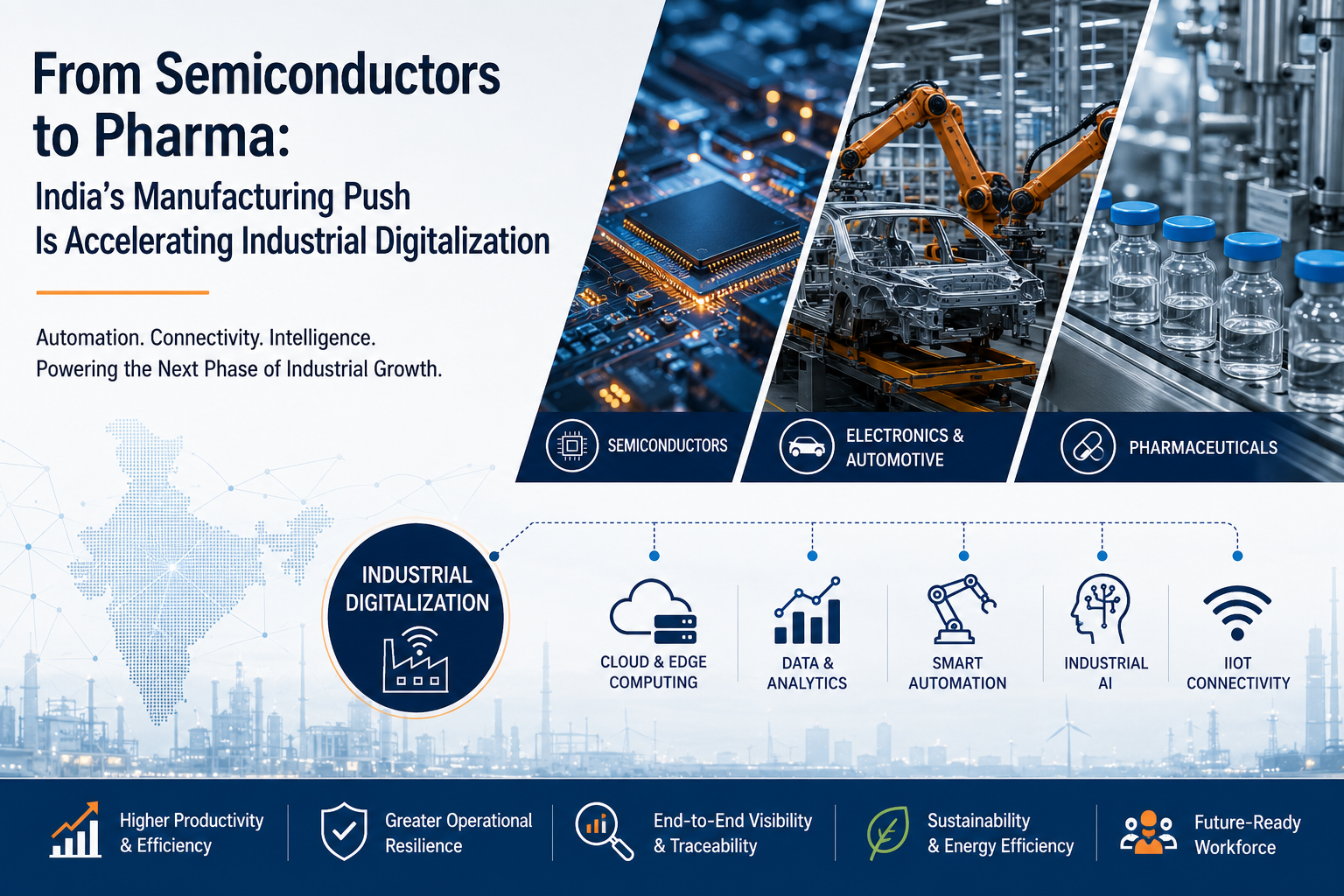
India’s manufacturing sector is entering a new phase of industrial transformation. While production growth and supply chain diversification continue to dominate headlines, a quieter shift is taking place beneath the surface. Across semiconductors, electronics, pharmaceuticals, batteries, and industrial infrastructure projects, many of India’s newest manufacturing investments are being designed with significantly higher levels of automation, connectivity, and operational intelligence from the outset.
This is important because the discussion around manufacturing expansion is no longer limited to adding capacity. Increasingly, competitiveness is being shaped by how effectively new facilities can operate in highly data-driven, automated, and AI-enabled environments.
India’s semiconductor ambitions are creating some of the clearest examples of this transition. Semiconductor manufacturing environments require extremely high levels of precision, environmental control, operational visibility, and process consistency. These requirements naturally increase dependence on advanced automation architectures, industrial software, analytics, predictive maintenance, and integrated operational technologies.
The growth of semiconductor manufacturing initiatives under the India Semiconductor Mission, along with investments involving companies such as Tata Electronics and Micron Technology, reflects more than a push for local manufacturing capacity. These projects also represent the development of digitally intensive industrial ecosystems that rely heavily on automation, process control, industrial data infrastructure, and advanced monitoring systems.
In many ways, semiconductor manufacturing highlights a broader industrial trend. Modern facilities are increasingly expected to deliver real-time operational intelligence, higher asset reliability, stronger production traceability, and improved process consistency from the beginning rather than through gradual modernization later.
One of the most significant shifts occurring across India’s manufacturing sector is the rise of digitally designed greenfield facilities. Historically, many industrial digital transformation initiatives focused on upgrading legacy environments through phased modernization projects. Today, many newer plants are being designed with integrated digital architectures from the start.
This changes the operational landscape considerably.
New facilities are increasingly being developed with connected instrumentation, advanced process automation systems, manufacturing execution systems (MES), predictive maintenance capabilities, centralized operational visibility, and Industrial IoT connectivity built directly into the operational framework. Instead of retrofitting digital capabilities onto existing infrastructure, organizations are embedding these technologies during the plant design phase itself.
This trend is especially visible in industries where operational reliability, process precision, and compliance requirements are critical. Semiconductor manufacturing is one example, but pharmaceutical manufacturing is also undergoing a similar transition.
India’s pharmaceutical sector has long been a major global manufacturing force. However, increasing regulatory expectations, growing product complexity, and rising operational pressures are accelerating the need for more connected and intelligent manufacturing environments.
Modern pharmaceutical facilities increasingly require stronger data integrity, continuous monitoring, improved traceability, and more advanced process visibility. These demands are encouraging broader adoption of automation, digital quality systems, integrated manufacturing platforms, and AI-driven operational analytics.
This broader transition also aligns with ARC Advisory Group’s ongoing analysis of Industrial AI, including its discussion on “Industrial AI’s Role in Digital Transformation of Manufacturing Industries,” which explores how AI-enabled operational intelligence is increasingly becoming foundational to modern manufacturing environments.
As pharmaceutical manufacturing environments become more digitally connected, organizations are also paying greater attention to cybersecurity, operational resilience, and governance frameworks. These areas are becoming increasingly important as manufacturing systems integrate larger volumes of operational and production data across enterprise environments.
India’s manufacturing expansion is also creating new demand for industrial data infrastructure. Modern manufacturing operations increasingly depend on the ability to contextualize, manage, and operationalize large volumes of industrial data in real time.
This is contributing to growing interest in:
Industrial data platforms.
Unified Namespace (UNS) architectures.
Edge computing.
Industrial AI deployment frameworks.
Advanced visualization and analytics.
Reliability-centered automation strategies.
AI-assisted operations.
The industrial conversation is therefore shifting from simple automation toward operational intelligence and decision support. Manufacturers are increasingly evaluating how digital systems can improve uptime, reliability, process optimization, sustainability, and production responsiveness simultaneously.
This broader transition also connects with several ongoing ARC discussions around Industrial AI maturity, software-defined automation, digital worker technologies, and operational resilience in modern industrial environments.
India’s manufacturing growth is often discussed through the lens of economics, geopolitics, or supply chain diversification. While these factors remain important, the technological dimension is becoming equally significant.
Many of the country’s newest manufacturing investments are not simply adding production lines. They are introducing increasingly digital, automated, and data-intensive operational models into the industrial ecosystem.
As this trend continues, India’s manufacturing expansion is increasingly positioning industrial digitalization as a core pillar of the country’s next phase of industrial growth. The convergence of automation, Industrial AI, connected operations, and digitally integrated manufacturing environments is likely to shape how the next generation of industrial facilities is designed, operated, and optimized across the country.
ARC Advisory Group’s work with manufacturers on these challenges spans areas such as data architecture, contextualization, and scaling Industrial AI into regulated production environments. A broader set of ARC perspectives on Industrial AI trends, architectures, and deployment strategies is available through its Industrial AI viewpoints.