Representative End User Clients







Representative Automation Clients







Representative Software Clients








Summary
Siemens recently held its third annual Oil & Gas Innovations Summit at Minute Maid Park in Houston, Texas. The company has been steadily developing its capabilities for the upstream and midstream oil & gas sectors. Even in light of lower oil prices, Siemens recognizes that there are key opportunities for technology suppliers to help industry participants innovate and reduce costs.
Of particular interest at this event were the application of the COMOS engineering software and the XHQ enterprise intelligence offering. Most people don't know that Siemens is the second largest supplier of software in Europe, surpassed only by SAP. The company is combining this increasingly powerful software capability with its offerings in control infrastructure to bring value to key oil & gas industry applications.
The overall event drew in about 500 people, many of them end users from the surrounding area who are already Siemens customers. At the Siemens XHQ User Group meeting, which occurred in parallel, ARC Advisory Group got an excellent briefing on the company's software solutions, from COMOS to XHQ. Siemens is well positioned to help industry participants improve business performance in today's tough oil & gas industry environment. Current low oil prices put a lot of pressure on the industry to use automation more effectively to reduce cost and increase profitability. Siemens is ready to provide solutions that help meet these requirements. The fact that the company drew a record crowd to this event in such a tough market shows that the users are really looking for a better way to manage costs and find a more effective path to operational excellence.
Analytical Facility Tour
ARC participated in an associated media tour of the new Siemens analytical facility in Houston, a brand new space with 30,000 square feet of production space where analytical shelters are fitted with analytical instruments and necessary infrastructure. The facility utilizes a number of innovative production techniques.
Today, through its acquisition of Elsag Bailey back in the late '90s, Siemens is the world's largest supplier of process gas chromatographs. It is one of only a few automation suppliers that can fully stage and integrate analytical shelter buildings for requirements in all climates.
Keynotes Highlight Upstream Business Challenges
The Summit featured many interesting keynote speakers, starting with Raj Batra, president of the Digital Factory division of Siemens. Mr. Batra stressed the need for more advanced forms of automation to deal with the cost pressures and increasingly challenging business environment of the oil & gas industry. Mr. Batra also pointed out the desperate need to modernize existing oil & gas infrastructure, citing a statistic from Morgan Stanley that the current oil & gas infrastructure in North America is the oldest it has been since 1938.
Dan Norman, economist and director of international studies at the MAPI Foundation, gave a good presentation about the factors impacting the cost of oil. He cited spare capacity, intermittent market volatility, and the value of the dollar as key factors; as well as speculation, terrorist activity, and geopolitical instability. Rig counts are dropping considerably in the Gulf of Mexico, but efficiency is increasing. When dealing with onshore shale oil, however, it's necessary to continually drill new wells. The amount of oil consumed per inflation-adjusted GDP has increased by about 2.4 percent per year, but consumption is growing a lot less rapidly. Long-term EIA projections show that petroleum consumption will remain essentially flat because of increased energy efficiency.
E&P Looks to More Advanced Forms of Automation
Erlend Engum of National Oilwell Varco gave a good presentation on the increasingly sophisticated automation approaches used for the exploration & production (E&P) side of the business. The company is increasingly automating its drilling processes with multi-protocol support, advanced HMI solutions for smart machines, and integration of third-party equipment.
The drilling industry wants more reliability, safety, and automated rig processes. Robust networks, simulator testing, and smart rig design and layout are all key requirements, as are better software lifecycle management and reduced unplanned downtime. Many downstream oil & gas industry processes share remarkably similar requirements, illustrating the increasing convergence of automation requirements for all applications across the oil and gas supply chain. Mr. Engum also spoke about the role of big data and the need to make sense of millions of data points to make sound business decisions.
Avoiding Cybersecurity Pitfalls in Upstream Oil & Gas
Alice G. Barnett, Manager, Information Technology Audit for ConocoPhillips spoke about cybersecurity pitfalls to avoid in oil and gas operations. Ms. Barnett spoke about "Black Swan" events that cannot be predicted and are totally unexpected, but can be rationalized in hindsight. While companies cannot predict these events, they can design to prevent them from negatively impacting their businesses. Cyberattacks are also becoming more successful, with the success rates of cyberattacks doubling between 2013 and 2014.
However, Ms. Barnett pointed out that, while "hacktivists" and nation states are persistent bad actors, the most common threat actors for manufacturing IT are insiders. Ms. Barnett pointed out the importance of internal access and identity management; good password management ("How many people still use 'abc123' or 'password' as their password?"); and protection from malware through patching, antivirus, and blocking USB ports. She also highlighted the need for physical security, pointing out that not many end users have intrusion detection software, and even many of those that do, are not maintaining logs long enough. Sometimes, it can be weeks or months before an organization realizes that someone is in their system. Ms. Barnett pointed out that no matter how good your processes and technologies are, it comes down to the competence of your people.
Siemens Software Value Proposition for Oil & Gas
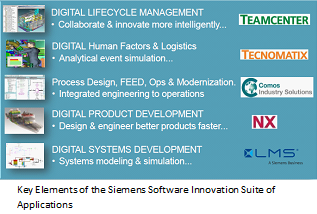
Andreas Geiss, Vice President of Siemens Industry Software, gave a presentation on how the company can help its oil & gas industry users make better-quality decisions across the value chain through Siemens' COMOS engineering software, XHQ enterprise intelligence software, and other software offerings. Mr. Geiss did an excellent job pointing out that value that the company brings to the oil & gas industry through its suite of applications.
Conclusions
With the oil market experiencing continued depressed prices and rig counts continuing to remain low, many in the industry are looking to make their existing operations more efficient and modernize their existing infrastructure. ARC still believes there are strong opportunities for technology suppliers in both upstream and midstream oil & gas, and Siemens appears to be well-positioned to take advantage of these opportunities and provide customers with a full suite of applications, services, and control system infrastructure to meet a wide range of applications.
All signed-in ARC Advisory Group clients can view this report in pdf format at this Link
If you would like to buy this report or obtain information about how to become a client, please Request ARC Info
Keywords: Siemens, Oil & Gas, COMOS, XHQ, Process Automation, Process Safety, ARC Advisory Group.