Representative End User Clients







Representative Automation Clients







Representative Software Clients








Manufacturing today is increasingly shaped by an age of permacrisis. Geopolitical fragmentation, energy price volatility, and tightening trade and industrial policies have steadily eroded the predictability that mass production once relied on. In this environment, scale alone no longer guarantees resilience. Countries and industries are reassessing not just how value is created, but also where production is located, recognizing that geographic choices influence exposure to supply-chain disruptions, regulatory risk, and strategic dependencies.
Over time, several economies have emphasized high-value manufacturing as a way to strengthen resilience while capturing greater strategic and economic value. Volume-driven, low-cost production has become increasingly commoditized, placing sustained pressure on margins and differentiation. High-value sectors, by contrast, rely more heavily on technical complexity, process know-how, and tighter integration with downstream applications. These characteristics reduce exposure to oversupply cycles and allow production to remain viable even as cost structures rise. At the same time, such industries are more closely aligned with national priorities around advanced technology, energy transition, and sustainability, reinforcing their longer-term strategic importance.
For Singapore, this orientation is shaped not only by policy intent but also by structural realities. Limited land availability, rising factor costs, and deep integration into global trade have long constrained the viability of scale-driven manufacturing. Instead, the country has prioritized sectors where competitiveness is derived from precision, reliability, and system integration rather than volume alone. Semiconductors, biomedical sciences, and specialty chemicals exemplify this approach, positioning Singapore as a high-value node within global production networks and as a resilient hub for complex, application-specific manufacturing.
The chemical industry provides a glimpse of how Singapore is navigating this environment. In 2021, the country signaled a strategic focus on specialty chemicals, reflecting a broader move away from volume-oriented production. Around the same period, global capacity for basic petrochemicals such as ethylene and propylene expanded rapidly, particularly in China and the Middle East. This expansion intensified competitive pressure on traditional commodity segments and increased exposure to price volatility. Against this backdrop, Singapore’s specialty chemicals segment has shown relative resilience, supported by targeted industrial planning and closer alignment with regional demand, while other segments continue to recalibrate in response to shifting market conditions.
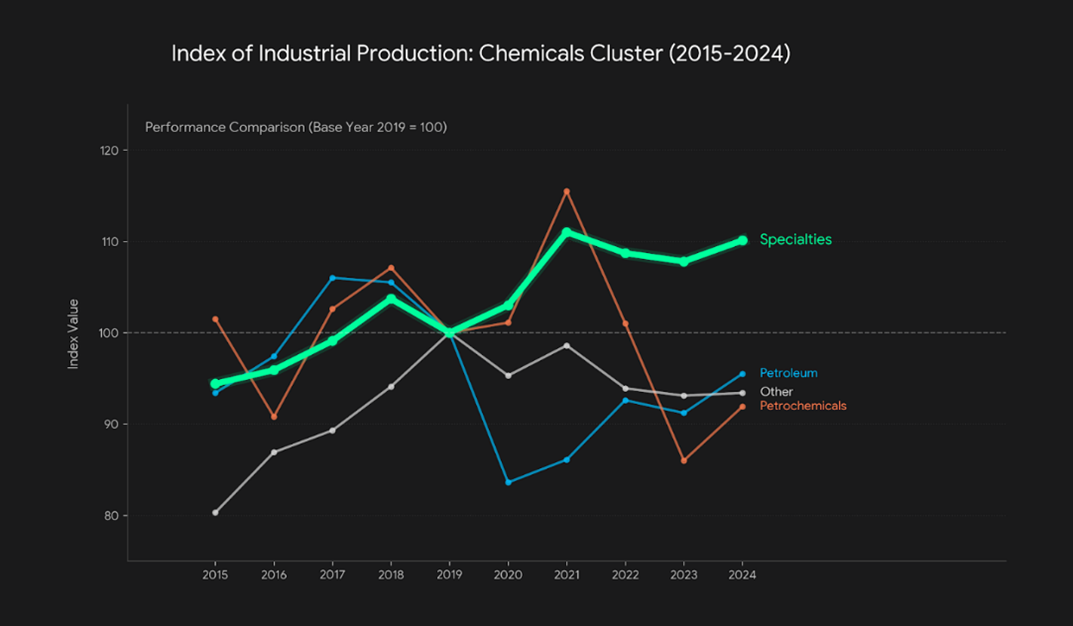
Amid this reorientation toward high-value manufacturing, several global chemical and industrial players have continued to make advanced investments or strategic shifts in Singapore, illustrating where value is increasingly being created within the sector:
ExxonMobil operates an integrated refining and petrochemical complex on Jurong Island and started up a new technology unit in September 2025. This facility upgrades lower-value molecules, including fuel oil and refinery residues, into higher-value Group II lubricant base stocks and liquid fuels. Key outputs include EHC 340 MAX™, an extra-heavy Group II base stock used in engine oils, gear oils, marine lubricants, and industrial greases. The expansion adds approximately 20,000 barrels per day of Group II capacity, strengthening the site’s role in supplying higher-performance base stocks to regional markets.
Aster Chemicals and Energy, a joint venture between Indonesia’s Chandra Asri Group and Glencore, now operates the Bukom refinery and Lube Oil Complex. In December 2025, the company announced a US$155 million rejuvenation program for the Bukom facility. A central element is the revitalization of the Lube Oil Complex, enabling the upgrading of refinery residues into base oils for industrial, marine, and automotive applications. Scheduled for completion in 2026, the project aims to improve operational flexibility and asset longevity while supporting regional energy and lubricant supply resilience.
Evonik recently expanded its high-value footprint in Singapore with the MetAMINO® complex for DL-methionine and its first Asian alkoxides facility, inaugurated in August 2025. Both facilities produce application-specific, functional chemicals: DL-methionine for animal feed and nutrition, and alkoxides for biodiesel production, pharmaceuticals, and chemical recycling. The alkoxides plant, with an annual capacity of 100,000 metric tons, operates fully on electricity and achieves net-zero Scope 1 and Scope 2 emissions, making it the largest of its kind in Southeast Asia.
Arkema operates a bio-based polymer production facility on Jurong Island, using castor oil as its primary renewable feedstock. In January 2026, the company announced that its new Rilsan® Clear transparent polyamide (PA11) unit is fully operational. The US$20 million investment is expected to triple Arkema’s global capacity for this transparent, bio-based grade, which is used in high-precision applications such as eyewear, AR/VR devices, healthcare components, and electronics. The expansion further positions the Singapore site as a key production hub for transparent polyamides in Asia.
Singapore’s chemical sector remains a key pillar of its industrial landscape, adapting steadily to structural and market changes. The recent investments highlighted provide a glimpse into the broader transformation underway, particularly toward advanced manufacturing and higher-value applications. In the current era of uncertainty, sustainability remains a central focus of this transformation in Singapore, providing a clear and strategic direction for the industry as the nation advances toward its net-zero goals. This focus is reflected in emerging projects across the country, including energy and renewable developments, sustainable aviation fuel feasibility and pilot programs, bio-circular materials, and other low-carbon technologies. These initiatives are forming the building blocks for the chemical sector’s ongoing evolution, shaping its long-term trajectory in a deliberate and forward-looking manner.