Representative End User Clients







Representative Automation Clients







Representative Software Clients








ARC Advisory Group has been tracking and analyzing the ultrasonic flowmeter market for decades. Over the years, ARC’s market research has helped end users and suppliers understand how ultrasonic flow measurement technologies have evolved across oil & gas, energy, water & wastewater, chemicals, and other process industries.
Historically, the ultrasonic flowmeter market was relatively easy to interpret. A small group of well-established global suppliers set the benchmark at the high end of the market, while a growing number of regional and low-cost suppliers competed aggressively on price for standard process measurement applications. Supplier selection was often a balance between performance requirements and budget constraints. At the same time, increasing competition enabled smaller suppliers to find their place in specific market segments.
As the market has matured and buyer expectations have evolved, this traditional view of the competitive landscape has become less sufficient.
To better reflect these changes, ARC developed the MarketMap framework as a structured and research-driven way to evaluate technology markets. ARC MarketMap provides a clear, visual perspective on how suppliers are positioned by assessing solution capabilities and overall market strength, helping industry stakeholders understand both current performance and future readiness.
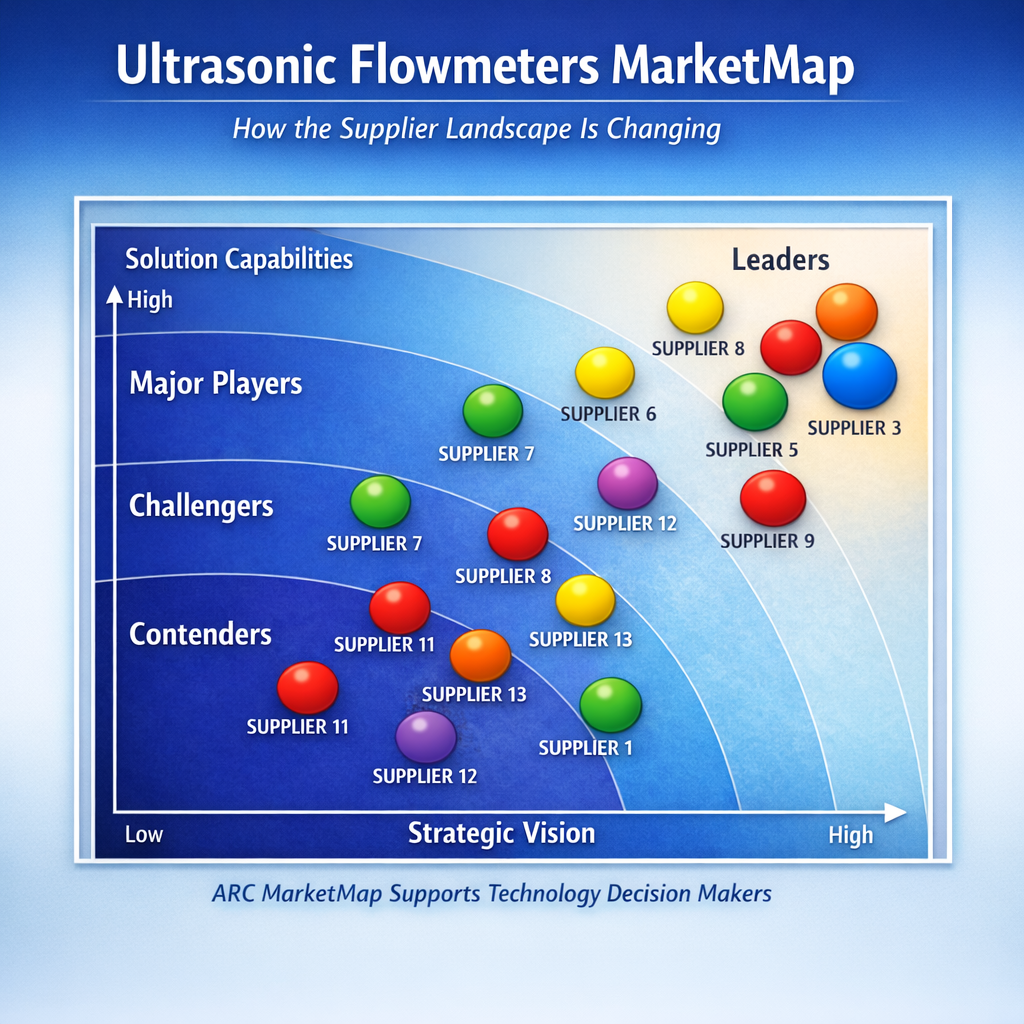
When the ultrasonic flowmeter market is viewed through this MarketMap lens, a clear shift becomes apparent. The competitive landscape is no longer defined primarily by hardware performance or price positioning alone. Instead, suppliers are increasingly differentiated by broader capabilities and their ability to execute consistently over the long term. From this perspective, ARC MarketMap focuses on several key market dimensions that are reshaping supplier positioning.
One area where this shift is clearly visible is in how suppliers support modern operations. Some suppliers have expanded their offerings to better align with connected operations, remote visibility, and smarter maintenance practices. Others continue to rely more heavily on traditional, manual approaches. These differences are increasingly reflected in how end users evaluate and shortlist suppliers.
The energy transition is also reshaping the ultrasonic flowmeter market. As hydrogen, biogas, biomethane, and LNG projects move beyond pilot stages into broader deployment, buyers are placing greater emphasis on which suppliers are making meaningful investments to support these emerging applications, rather than simply adapting legacy solutions.
At the same time, buyers are reassessing how suppliers position themselves around custody transfer and fiscal measurement. Rather than relying solely on high-level claims, end users are increasingly focused on the depth of experience, long-term commitment, and supporting infrastructure behind these capabilities.
Global execution capability has emerged as another important differentiator. Large projects are increasingly distributed across multiple regions, and suppliers are expected to provide consistent support across geographies. The ability to deploy, service, and support ultrasonic flowmeters reliably at a global scale is becoming a key factor in supplier selection.
Taken together, these trends indicate that the ultrasonic flowmeter market is entering a new phase. Price and basic performance still matter, but they are no longer sufficient on their own. Capability depth and market strength are playing a much larger role in how suppliers are evaluated.
ARC’s Ultrasonic Flowmeters MarketMap applies this structured perspective to help industry stakeholders better understand how the supplier landscape is evolving and where meaningful differentiation is emerging in a changing market.
For more information on ARC’s MarketMap methodology and how it supports technology buyer decision-making, please visit ARC MarketMap for Technology Products & Services | ARC Advisory Group.