Representative End User Clients







Representative Automation Clients







Representative Software Clients








Reliability has become one of the defining priorities in modern process plant design. While efficiency and optimization continue to matter, operators and engineers increasingly recognize that plant performance ultimately depends on the stability of core measurements. Among all instrumentation variables, level measurement plays a uniquely critical role. When level measurements fail, the consequences often extend far beyond control deviations, affecting safety, availability, and asset integrity.
Radar level measurement is gaining attention not simply because it provides accurate readings, but because it fundamentally improves system reliability. Across industries, radar is being specified less as an instrumentation upgrade and more as a design choice that reduces risk, minimizes failure points, and strengthens the overall resilience of process plants.
Plant reliability is often discussed in the context of maintenance or operations, but its foundation is laid much earlier. Design decisions determine how systems behave under normal operation as well as abnormal and upset conditions. A level measurement technology that performs consistently only under ideal conditions introduces hidden vulnerabilities into the plant.
Radar level measurement addresses this challenge by offering reliable performance across a wide range of process environments. Its non-contact nature removes exposure to process fluids, eliminating many common failure mechanisms associated with fouling, corrosion, coating, or mechanical wear. From a design perspective, this immediately reduces the likelihood of sensor degradation and unplanned intervention.
As plants become more complex and operate closer to safety and environmental limits, the tolerance for measurement instability continues to shrink. Radar supports reliability by reducing dependency on process conditions that designers cannot always control.
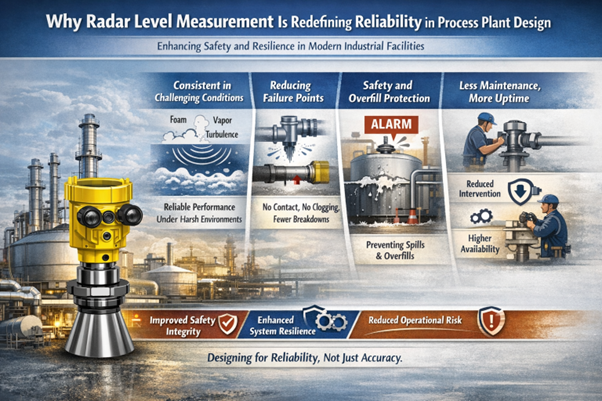
One of the strongest arguments for radar in plant design is its behavior during abnormal conditions. Many measurement technologies perform adequately during steady operation but struggle when exposed to turbulence, vapor formation, foam, pressure variation, or temperature fluctuations. These are precisely the situations where reliable level measurement is most critical.
Radar signals are largely immune to changes in the surrounding atmosphere within vessels. As a result, level readings remain stable even when process conditions deviate from the norm. This consistency reduces nuisance alarms, false trips, and erratic controller responses, all of which undermine operator confidence and increase operational risk.
In reliability-focused design philosophies, stable measurement during abnormal operation is often valued more than maximum accuracy under ideal conditions. Radar aligns well with this principle.
Process plants contain numerous potential single-point failures, and level measurement is often among them. A failed or unreliable level sensor can interrupt production, trigger shutdowns, or compromise safety functions. Radar helps mitigate this risk by offering a simpler and more robust measurement architecture.
Because radar sensors do not rely on process contact, impulse lines, diaphragms, or pressure compensation, they eliminate several common failure paths. There is no need to account for density variations, line blockages, or material buildup at the sensing interface. This simplification reduces the number of assumptions engineers must consider when designing reliable systems.
In critical applications such as storage vessels, reactors, separators, and utility systems, radar is increasingly specified as part of a defensive design strategy aimed at lowering overall plant vulnerability.
Level measurement is closely tied to plant safety, particularly in applications related to overfill protection, containment, and loss prevention. A protection system is only as reliable as the measurement driving it. Inconsistent or unreliable signals compromise the integrity of safety layers and increase the probability of human intervention at precisely the wrong moment.
Radar level measurement contributes to safer designs by maintaining reliable detection even when surface conditions are unstable. This makes radar well suited for safety-related applications where confidence in the signal is as important as the measurement itself. Designers can use radar to support alarm management strategies that are less prone to spurious activation and operator fatigue.
By reducing false alarms and missed detections, radar helps maintain the credibility of safety systems, which is a critical element of safe plant operation.
Reliability and availability are closely linked. Measurement technologies that require frequent calibration, cleaning, or adjustment inevitably introduce variability into plant operation. Every maintenance intervention creates an opportunity for error, delay, or unintended consequences.
Radar level measurement reduces this dependency by maintaining performance without routine interaction with the process. Fewer maintenance tasks translate into fewer opportunities for inadvertent damage or misconfiguration. Over time, this contributes to more predictable plant behavior and improved availability.
From a design standpoint, specifying technologies that minimize routine intervention supports strategies focused on long-term operational continuity rather than short-term optimization.
The reliability benefits of radar level measurement are evident across a wide range of industries. In oil and gas facilities, radar supports dependable level monitoring in storage tanks and process units where vapor layers and variable conditions are common. In chemical plants, radar enables reliable measurement of aggressive or hazardous media without introducing additional exposure points.
Water and wastewater facilities rely on radar for stable level measurement in environments subject to turbulence, debris, and changing surface conditions. Food and beverage operations benefit from non-contact measurement that maintains hygienic integrity while delivering consistent performance. Power generation facilities use radar to support dependable operation of auxiliary systems where level deviations can disrupt overall unit stability.
In each case, radar is selected not merely for measurement capability, but for its contribution to plant reliability and risk reduction.
Traditional comparisons between level technologies often focus on cost or installation simplicity. From a design reliability perspective, the more relevant criteria are failure modes, sensitivity to process variation, and long-term stability. Technologies that depend on process contact or environmental assumptions introduce additional complexity into reliability analysis.
Radar distinguishes itself by operating independently of many of these variables. This independence simplifies design decisions and reduces the need for compensating measures elsewhere in the system. When reliability is treated as a design objective rather than a maintenance outcome, radar naturally becomes the preferred choice.
The growing adoption of radar level measurement reflects a broader shift in engineering mindset. Level sensors are no longer viewed solely as instruments that report a process variable. They are recognized as foundational elements that influence safety, availability, and system behavior across the plant.
By selecting radar level measurement, designers signal a commitment to stability, resilience, and reduced operational risk. The technology supports plants that are easier to operate, less prone to disruption, and better aligned with long-term reliability goals.
Radar level measurement is redefining reliability not through incremental improvement, but by reshaping how engineers approach plant design. Its ability to perform consistently under varying conditions, reduce failure pathways, and support safer operation makes it a natural fit for reliability-driven engineering strategies.
As process plants become more complex and expectations around safety and uptime continue to rise, the importance of dependable level measurement will only grow. Radar level measurement stands out as a technology that supports reliability not as an afterthought, but as a fundamental design principle.