Representative End User Clients







Representative Automation Clients







Representative Software Clients








KEYWORDS: Industrial AI, Pharmaceuticals, Quality Management Systems (QMS), Regulatory Compliance, CAPA
Transitioning from simple compliance tools to advanced predictive quality platforms, Quality Management Systems are experiencing a significant transformation. The integration of artificial intelligence (AI) is reshaping QMS by moving beyond their traditional roles as record-keeping solutions. AI enables these systems to become intelligent platforms that not only ensure compliance and facilitate documentation, but also enhance decision-making, streamline processes, and empower organizations to take a more proactive approach to quality management. This evolution is especially evident in industries with complex regulatory requirements, such as pharmaceuticals, where the stakes for documentation and the cost of quality issues are particularly high.
Quality Management Systems (QMS) have traditionally served as systems of record for compliance, documentation, and audit readiness. Artificial intelligence (AI) is now extending QMS into systems of intelligence that augment decision-making, reduce cycle times, and enable more proactive quality management.
The most important update for QMS leaders is not simply adding AI features; it is rethinking QMS as a governed quality intelligence layer. Organizations should update their QMS roadmaps to emphasize embedded AI, predictive quality, supplier intelligence, continuous inspection readiness, and human-in-the-loop governance. The strongest near-term opportunities are repetitive, evidence-heavy workflows—such as document retrieval, deviation triage, CAPA support, audit preparation, and supplier risk analysis—where AI can reduce manual effort while preserving quality-unit accountability.
Modern QMS platforms are used across manufacturing, chemicals, energy, consumer goods, and life sciences to manage document control, nonconformance, CAPA, audits, training, risk, and supplier quality. Adoption is driven by regulatory requirements, the need for traceability, and tighter integration with ERP, MES, and PLM systems. Across industries, QMS has become a core system rather than a standalone quality tool.
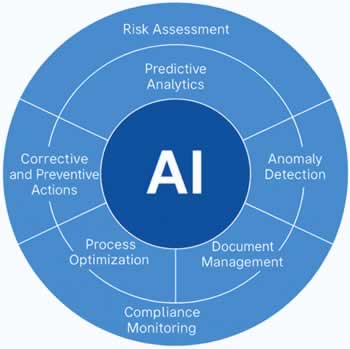
Pharmaceutical and life sciences organizations face uniquely complex quality and regulatory environments. QMS workflows are highly documented, globally distributed, and closely scrutinized by regulators. At the same time, product complexity is increasing due to biologics, personalized medicine, and advanced therapies. These pressures make pharma especially well-suited for AI that reduces manual effort while preserving traceability, validation discipline, and human accountability.
AI is being used to classify, summarize, and retrieve controlled documents such as SOPs, policies, and validation records. Natural language capabilities reduce the time spent searching and preparing documentation for audits and inspections. In pharma, this improves inspection and readiness without changing validated content.
ARC Advisory Group clients can view the complete report at the ARC Client Portal.
Contact Us if you would like to speak with the author.
Obtain more ARC In-depth Research Market Analysis.