Representative End User Clients







Representative Automation Clients







Representative Software Clients








KEYWORDS: Industrial Automation, Brazil, Process Automation, Discrete Automation, Industrial AI, Remote Operations, Open Automation, MES, EU-Mercosur, ARC Forum Rio
Brazil has been a focus for ARC and its Clients for many years. Petrobras, Aixa Energia, Aimirim, and SMAR are long-term clients, and when looking for new growth opportunities, many companies have looked to Brazil. However, Brazil has lagged in the past. Since the acronym “BRICS” was formed, the countries have gone in all different directions, and China has certainly outpaced all other contenders. This may change.
“A few years before COVID, I talked to Brazilian automation companies, and they grudgingly admitted that they see themselves 5 years behind their Western counterparts. When Ceise presented at our Barcelona Forum in 2025, there was nothing in there but state-of-the-art.”
Florian Güldner, Managing Director Europe, ARC Advisory Group
Brazil is becoming a strategically important industrial automation market as its large domestic economy, strong process industries, expanding discrete manufacturing base, and changing trade environment increase pressure to modernize. The market is moving beyond a protected, inward-looking model toward greater openness, technology intensity, and demand for automation, industrial AI, remote operations, and local engineering capabilities.
ARC estimates put Brazil’s combined process and discrete automation market at $3.5 billion, or 2 percent of global automation demand. Process automation accounts for 80 percent of expenditures, led by oil & gas, utilities, biofuels, chemicals, pulp & paper, and other asset-intensive industries. At the same time, discrete demand is positioned to benefit from modernization in automotive, food & beverage, packaging, and machinery.
The EU-Mercosur trade agreement is expected to gradually reduce tariffs and non-tariff barriers, particularly for industrial goods such as machinery, chemicals, pharmaceuticals, cars, and automotive parts. This creates both opportunity and pressure: Brazilian manufacturers will need to improve productivity and upgrade existing operations, while global technology suppliers will face a more dynamic competitive environment.
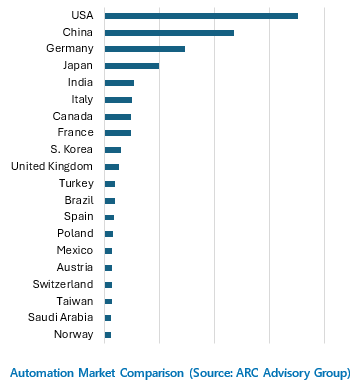
Brazil’s renewed relevance rests on three forces: scale, industrial diversity, and geopolitical realignment. Its industrial base spans offshore oil & gas, biofuels, utilities, chemicals, pulp & paper, automotive, food & beverage, packaging, and machinery, creating opportunities for vendors that can serve both capital-intensive infrastructure and high-volume manufacturing applications.
For decades, Brazil used tariffs, local-content requirements, complex taxes, customs procedures, and regulatory barriers to encourage local manufacturing. This supported domestic production but also raised costs, limited export competitiveness, and slowed the diffusion of imported technologies in some sectors. As barriers decline, Brazilian manufacturers will face stronger pressure to improve productivity and adopt modern automation architectures. The Mercosur–EU free trade agreement will be both a carrot and a stick, encouraging investment in and modernization of Brazil's manufacturing base.
ARC Advisory Group clients can view the complete report at the ARC Client Portal.
Contact Us if you would like to speak with the author.
Obtain more ARC In-depth Research Market Analysis.