Representative End User Clients







Representative Automation Clients







Representative Software Clients








Industrial and Operational Technology (OT) cybersecurity is rapidly changing as Artificial Intelligence (AI) becomes more integrated. This shift offers new ways to detect, prevent, and respond to threats, but it also introduces challenges like AI-driven attacks and the need for flexible security systems. AI can process large amounts of data, spot unusual activity, predict vulnerabilities, and automate responses, helping organizations better protect critical infrastructure and manufacturing operations. As IT and OT converge, the attack surface grows, and there's an increased demand for AI-driven security tools that connect these areas.
Implementing AI in industrial and OT cybersecurity brings its own set of difficulties. These include risks from adversarial AI, concerns about data privacy, false positives that could disrupt operations, and the extra computing power needed for complex AI models. Despite these issues, OT cybersecurity suppliers are using AI to develop stronger and more adaptable defenses. By combining AI’s data analysis capabilities with Zero Trust principles, end users can create a proactive, resilient security approach that addresses the continually evolving threats to OT across all manufacturing sectors.
AI has become ubiquitous in ICS/OT cybersecurity solutions. From automated firewall rule configuration to anomaly detection and response. The pace of new AI functionality, along with its potential benefits and challenges, can be difficult to keep up with. If you evaluated your vendor’s OT cybersecurity offerings a year ago, your information is already outdated.
AI is also making it easier for malicious actors to create sophisticated malware campaigns and to increasingly automate the creation of more sophisticated malware. AI also greatly enhances an attacker’s ability to create convincing phishing emails, select targets, and more. End users must also look to secure their own AI implementations within their organizations. Most manufacturing companies don’t have a comprehensive inventory of the AI tools their employees and developers use. They could be sharing proprietary corporate data with commercial large language models, which are also continuously scraping data from the Internet. Users need to ensure that their data is protected from AI sprawl. When using AI for industrial and OT cybersecurity, it's important to take a comprehensive approach that includes people, processes, and technology. Educating and training staff is essential to ensure they're aware of both the opportunities and risks of AI-powered tools. Setting up clear policies, governance structures, and response plans specifically for AI environments is crucial to getting the most out of AI while reducing vulnerabilities. By balancing these elements, organizations can fully leverage AI to protect critical operations and keep their businesses running smoothly despite increasingly complex cyber threats.
AI is profoundly impacting industrial and OT cybersecurity across several key market areas. Let’s look at AI’s impact on industrial next-generation firewalls (NGFWs), network monitoring solutions, and the other critical domains of ICS/OT cybersecurity. Let’s take a look at where AI in its many forms is popping up in OT cybersecurity products and applications.
The integration of AI into industrial and operational technology (OT) cybersecurity marks a critical shift from reactive to proactive defense. In complex industrial environments where downtime can pose physical safety risks or result in massive financial losses, AI-driven automated responses can provide a significant advantage. AI-powered security can instantly throttle suspicious data flows or isolate compromised PLCs and industrial controllers. This has the potential to reduce the window of exposure from hours to milliseconds, effectively containing threats before they can disrupt critical infrastructure.
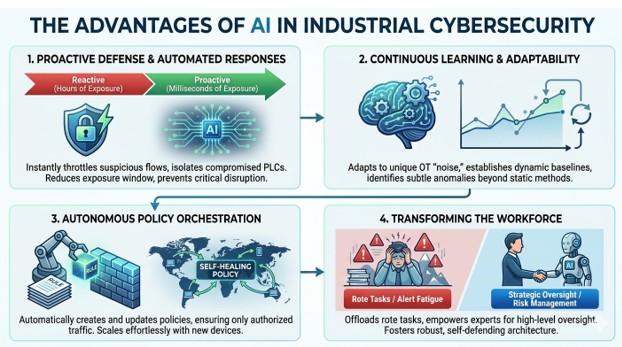
The second key advantage is continuous learning, which allows the security system to adapt to the unique "noise" of an industrial network. OT environments are often highly specialized and sensitive to latency. AI models establish a baseline of normal machine-to-machine communication and refine these profiles as network conditions evolve. By constantly learning from new data points and emerging attack patterns, the system becomes more resilient over time, identifying subtle anomalies that would bypass static, signature-based detection methods.
Table of Contents
ARC Advisory Group clients can view the complete report at the ARC Client Portal.
Contact Us if you would like to speak with the author.
Obtain more ARC In-depth Research Market Analysis.