Representative End User Clients







Representative Automation Clients







Representative Software Clients








Keywords: Artificial Intelligence (AI), Cloud Computing, Digital Twins, Machine Learning (ML), Risk Modeling, Sayre’s Law
The fundamentals of beneficial data sharing for utilities and energy companies are changing. As a result, the trajectory for savvy leaders is one which can put their organizations on the cusp of a major inflection point to drive growth and profitability upward, due to removal of barriers via emerging cloud and AI-driven trends. A famous saying is worthy of deep consideration for utilities and energy company decision makers who are willing to take a fresh look at their industry’s history, in this regard: "The competition is so intense because the stakes are so low." This odd saying, known as Sayre’s Law, originated in academia, and helps explain why so many graduate students and PhDs compete for a scant number of low-paying faculty positions. In stark contrast to energy and utilities, consider how a highly profitable “frenemies” or "co-operative competition" model in the finance and insurance industries has been reducing risk via long-standing data sharing ecosystems:
These two examples shared below have lessons in them for utility and energy companies as they grapple with the "energy trilemma."
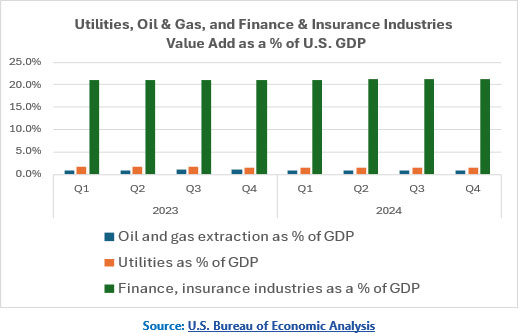
Why data sharing is strong in the finance and insurance industries becomes clearer if we compare the historical “stakes” involved. Specifically, size-wise, as part of the $29.8 trillion GDP, the insurance industry and finance dwarf the utility and energy sectors in size.
Overall, at 21 percent of the U.S. GDP, the finance and insurance industries are 14 times larger than the utility industry, which come in at 1.5 percent by the same measure.
The annual revenue for just the ten largest financial institutions in the U.S. is around $1 trillion, 2 to 3 times the size of the total annual electricity sales revenue of all U.S. electric utilities combined.
Similarly, at $680 billion last year, the combined revenue of just four insurance companies—Cigna, United Health Group, Allstate, and Progressive Insurance, was roughly equal to the annual revenue of all electric, gas, and water utilities in the U.S. combined.
The results are even more dramatic when comparing the profitability of financial institutions to the profitability of utilities and energy companies. For example, the most successful large investor-owned utilities in the U.S. typically consider 13 percent a good ratio of net income to revenue, and a similar figure for earnings is commonplace for major U.S. oil companies, while 30 percent is the figure that Bank of America, and Morgan Stanley Chase, achieved for the same measure last year.
Historically, the relevance of Sayre’s Law is clear, as the higher profitabil-ity and larger scale of finance and insurance enabled the creation of risk-related data-sharing ecosystems that benefited all participants in other-wise competitive markets.
ARC Advisory Group clients can view the complete report at the ARC Client Portal.
Contact Us if you would like to speak with the author.
Obtain more ARC In-depth Research Market Analysis.