Representative End User Clients







Representative Automation Clients







Representative Software Clients








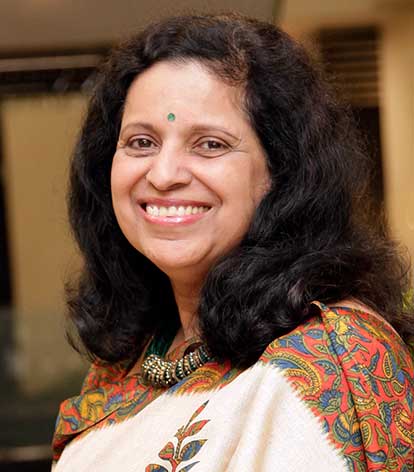
Attendee interest remained high during the second day of ARC Advisory Group's fifteenth India Forum for the process and discrete industries in Bangalore, India on July 7, 2017. ARC structured this forum, Industry in Transition:  Realizing the Digital Enterprise, to provide end users, solution providers, and decision makers an opportunity to learn about the latest solutions for industry, network effectively, and get an overall view of the market and its requirements.
There is increasing recognition among industrial companies that new approaches are disrupting established business models; and to keep pace it is imperative to adopt these new strategies and processes. Some companies already have a robust strategy for digital transformation, along with a realizable roadmap. This digital transformation will be widespread with far reaching impact as it necessitates the convergence of information technology (IT), operational technology (OT), engineering technology (ET), and a host of other services.
The presentations and lively Q&A sessions on the second day of the forum emphasized that digitization enables companies to improve the performance of their service operations by facilitating:
The day began with a keynote address on evolving technology trends that are reshaping the manufacturing landscape by G. Ganapathiraman, Country Manager, ARC Advisory Group, India. Speaking about the information-driven manufacturing sector, he said that modern process automation systems are essential to put information in context to the  current state of operations; and that smart machines need open systems to work together. Business pressures are driving manufacturers to become real-time integrated enterprises and achieve operational excellence. According to Mr. Raman, current megatrends in automation include:
The presentations that followed highlighted the evolving technology trends across different sectors.
The next speaker, Dr. B. Ashok, Scientist–F, Deputy Project Director, Aeronautical Development Agency (ADA), spoke about realizing the digital enterprise in the aerospace sector. He said the aerospace sector is a “low-volume, high-value, high-risk,” industry; which makes it challenging to manage innovation. The gestation period for new airframes is long (15 years from design concept to fleet induction) and the sector is highly regulated. Additionally, managing and integrating diverse vendors and their components is hugely challenging. The game changers are computers and avionics. Dr. Ashok said that digitization is the new frontier for aerospace and showed a framework of how the digital enterprise can connect the various operational layers and drive “quantum leaps in performance and revenue.” The digital context-aware platform takes advantage of wireless, sensing, and wearable/portable display technologies.
Next was a joint presentation on unleashing the power of wireless to achieve operational excellence in a refinery by Sunil Mohan Jadekar, Chief Manager – Central Engineering Services, HPCL Mumbai Refinery; and Khushbu Chaplot Chaudhary, Plantweb Solutions Leader, Emerson Automation Solutions. Mr. Jadekar said that the company’s operating challenges are:
The requirement was to digitize and achieve operational certainty using leading core technology, for which the Mumbai Refinery deployed Emerson’s solutions, which Ms. Chaudhary elaborated upon.
Presenting the trends in the power sector, M.K. Srivastava, General Manager, Project Engineering Division NTPC, and head C&I Department spoke about the company’s experiences and journey toward realizing the digital enterprise. He explained, “Digital disruption is more than just a technology shift, it’s a new business model.” To create the enterprise of tomorrow, “digital” must be integrated with the business process. One of the key elements of digitization are the 3Rs, he said – Right data to the Right people, at the Right Time. Mr. Srivastava said that NTPC is on the digital path, and in this context, he spoke about data visualization and analytics, digital twins, and digital workers - and where/how they are being deployed. Further, he spoke about NTPC's "Antariksh" central monitoring center, in which real-time data from systems and equipment in multiple plants and from multiple OEMs is readily available; based on the concept of “move data, not people.”
This session began with a presentation on IoT in the aerospace sector by K. Parthasarathy, Director IT, Antrix. He said that in the “high-quality, high-reliability” aerospace manufacturing sector, quality, productivity and traceability are of paramount importance. He said that IoT can help eliminate losses in issues like sensitive raw materials with short shelf life and the wide range of manufacturing variables that must be controlled closely during composite manufacturing. IoT accelerates context-aware, real-time, data-driven action and the benefits are quantifiable. Mr. Parthasarathy explained how the convergence of IoT and satellite imaging in geospatial will be the next major innovation; correlating information in time and space.
 The next speaker, Sheetal Paralikar, Manager (Business Development, Factory Automation), Siemens, presented on advance controller requirements for digitization. She spoke about how the internet is revolutionizing the business world and creates major challenges for manufacturing companies as they have to constantly remain agile and alert. Customers are looking for open and flexible systems, she said. Simulation and cloud applications, connecting various automation vendors are on the rise.
Industrie 4.0 is the next level of manufacturing where humans, devices, and systems are connected along the value chain and relevant information is available in real time. The cornerstones of Industrie 4.0 are:
This was followed by a joint presentation by Chethan K. Group Director, Quality and Excellence Champion, Kalyani group of companies and Praful Kushwaha, Manager – IT Services, leading Industrie 4.0 deployment, Bharat Forge. Their focus was on how Industrie 4.0 is enabling lean practices across the organization. Mr. Chethan opined that industry should learn to walk the lean path first and then attempt to fly, through “digitally enabled lean.” This concept was explained via a case study on deployment of predictive intelligence on crankshaft grinding.
Next, Chandrashekar Bharathi, Managing Director and co-founder of Ace Micromatic MIT, gave an overview of the company’s products, global footprint, and its journey toward realizing the digital enterprise. He said it is important to add value at all levels – strategic, tactical, and operational. Mr. Bharathi explained how the digital enterprise enables:
The next presenter, Sanoj James, Head Engineering, juwi Southeast Asia, spoke about the company’s efforts to remotely monitor solar farms globally. Mr. James gave examples of solar PV plants in the utility-scale power and microgrid ecosystems, and how important it is to have real-time operational data of energy flow, grid management, and plant operations.
For the differing systems (utility-scale and microgrid), SCADA must be flexible as the requirements, scale, and volume are different, he said. Mr. James spoke about the company’s energy evaluation tool, which is easily configurable and flexible to interface with all devices with open protocols. The future lies in prediction (predictive maintenance), diagnostics (coupled with asset management will be a value-add), and control (as more renewables are integrated into the grid).
The last speaker at the forum, Vivek Gupta, General Manager & Head-Instrument, DCM Shriram spoke about the importance of alarm management to prevent industrial accidents, the associated regulatory standards, and the alarm management lifecycle. Mr. Gupta suggested these steps for industry:
After the Q&A session, Rajkumar Paira, Analyst, ARC Advisory Group gave the vote of thanks to all those who had helped make the event a success.
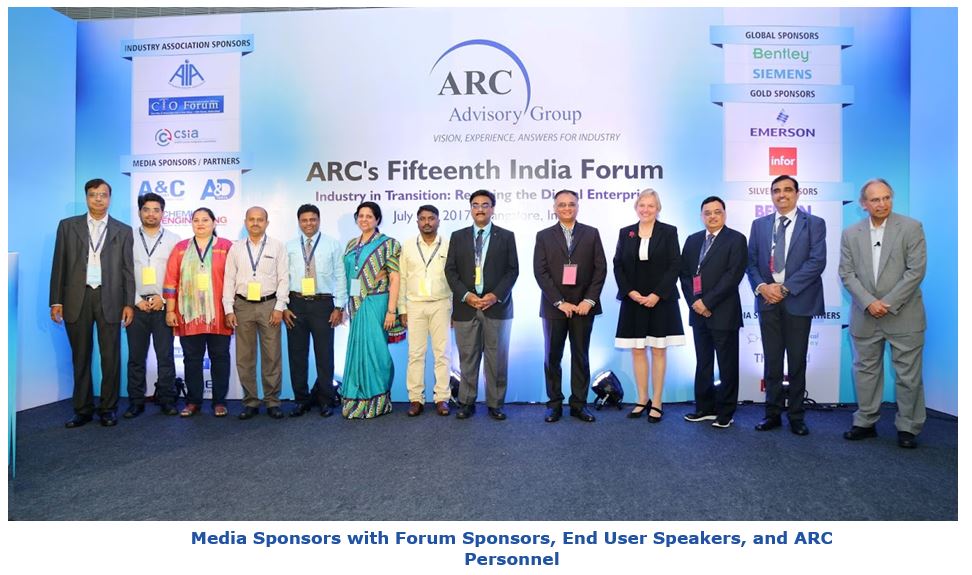
ARC’s India forum on realizing the digital enterprise provided useful information about how to proceed on this journey. There is no “one-size-fits-all” kind of approach – each industry’s expectations and experiences are vastly different. The presentations and case studies showcased multiple challenges, perspectives, and benefits of digitization. The digital transformation of industries is disrupting conventional business models and ARC observes some degree of uncertainty and wariness for industrial organizations to adopt new ways of doing things.
This is expected because most organizations would prefer to remain within their comfort zones and maintain established practices. Hence, the networking opportunity at ARC forums enables learning about best practices by connecting and collaborating with other organizations and people; eventually bringing about a change in mindset.
Based on ARC research and analysis, we recommend the following actions for owner-operators and other technology users:
If you would like to buy this report or obtain information about how to become a client, please Contact Us
Keywords: ARC India Forum, Digital Enterprise, Digitization, Industrie 4.0, Aerospace, Refining, Power, Remote Monitoring, Alarm Management, Renewables, ARC Advisory Group.