Representative End User Clients







Representative Automation Clients







Representative Software Clients








A digital twin is a dynamic virtual representation of a physical entity using real-world data synchronized from multiple sources. The nature of a digital twin tends to change as the target asset scales up from small (equipment) to large (a plant or city). Aspects of the physical entity being represented, the associated stakeholders, and benefits lead to two major categories of digital twins in the discrete and process industries, and smart cities:
Initially, digital twins were deployed in the cloud and usually built on IoT platforms. The platforms provided an IT infrastructure including data management, analytics, and a variety of services. As adoption of performance twins advanced, limitations were found, and edge computing deployment alternatives evolved. Also, 5G networks have new capabilities aligned with data communications for digital twins with widely distributed assets.
Recommendations and actions to be considered are:
The term “digital twin” appears in many vendors’ marketing programs, with a wide variety of interpretations. The first step for a meaningful review and recommendation requires a definition and description of the term:
A digital twin is a dynamic virtual representation of a physical entity using real-world data synchronized from multiple sources. The representation can take a form ranging from a mathematical algorithm (physics, machine learning, and/or AI) to a 4D model. Uses span across preventing bad events, improved decision support, and cross-functional collaboration.
Each digital twin has these key aspects:
The nature of a digital twin tends to change as the target asset scales up from small (equipment) to large (a plant or city). Small twins are often an algorithm for predictive maintenance (PdM), equipment operating performance (operator guidance), and/or energy management. Plant or city twins usually involve an enterprise application for information sharing, business process automation, and collaboration using a 3D model as the user interface and navigation.
Aspects of the physical entity being represented, the associated stakeholders, and benefits lead to two major categories of digital twins:
The performance digital twin supports operations and maintenance with higher asset reliability and operational performance. Analytics combined with both process and equipment data, offers new opportunities to improve the reliability of industrial assets, and enables owner-operators to progress toward near zero unplanned downtime.
The twin has algorithms to model the asset and calculate expected values under normal conditions. Deterioration is detected when real-time data deviate from the anticipated value. The degree of deviation is used to predict equipment failures and/or operator training needs.
Real-time data from equipment in operation is captured. Typically, process data comes from the plant historian, and equipment data through the Internet of Things (IoT). For analytics, the model uses first principle math, machine learning and/or artificial intelligence. PdM combines equipment and process data with analytics to forecast a failure and send alerts.
With the performance digital twin deploying PdM, maintenance occurs when truly needed i.e., just prior to process degradation or equipment failure. Benefits of this proactive maintenance include improved uptime, asset longevity, maintenance costs, safety, schedule compliance, and revenue.
Preventive maintenance schedules maintenance based on time intervals or number of cycles. This approach assumes the probability of failure increases with use and schedules work prior to an uptick in the rate of a failure. Unfortunately, only 18 percent of assets follow this pattern.[1] The other 82 percent of assets display a random failure pattern with failures and unplanned downtime occurring between preventive maintenance activities. A performance digital twin for predictive maintenance schedules maintenance based on current conditions rather than anticipated wear from usage.
The scope of a performance digital twin project typically involves a specific asset like the equipment, unit, or production line. This market is served with two predominate approaches by Original Equipment Manufacturers (OEM) or end users.
The equipment supplier develops a digital twin that monitors the health and performance of its product at the user’s location. The associated customer support services range from diagnostics with email alerts to proactively scheduling the OEM’s technician for a repair before a problem with the equipment occurs. Typically, the supplier charges a small set-up fee and a periodic subscription service.
The end user (typically employing an engineering services provider) develops the digital twin tailored for the equipment’s application and the user’s business processes. When an issue is indicated, the twin sends an alert and often initiates business process automation through the enterprise asset management (EAM) application for repair prior to impacting production. The initial development cost is contained by deploying a packaged asset monitoring platform with data communications, data management, and analytics.
Three approaches are common for analytics in a performance digital twin.
A team with extensive knowledge of an asset develops a formula, calculations, or rules to determine an asset’s health. This approach uses design specifications and information about the product’s design, component supplier datasheets, and other sources. Historical data provides a means to test the model.
Developing and testing this type of model is often expensive. With their deep knowledge of the equipment and how it is applied, OEMs often take the engineered algorithm approach. Also, an OEM can make a viable business case by spreading the development cost over many machines for delivery of condition monitoring services.
Machine learning automates the building of the diagnostic model for data analysis. It is a branch of artificial intelligence where systems learn from data, identify patterns, and make assessments with minimal human intervention. Machine learning algorithms build a mathematical model based on historical data without being explicitly programmed. There are several types of machine learning including neural networks, decision tree learning, support vector machines, regression analysis, Bayesian networks, and genetic algorithms.
Digital twin applications deployed in industrial plants by end users often focus on one or a few instances of a piece of equipment. With a small number of machines, an acceptable business case requires relatively low development cost, for which machine learning helps. For a successful project, the human trainer must have the experience needed to determine the difference between false positives and real problems (this is not the place for a new hire assigned to his or her first project). Those involved must have patience since it can take three to six months to train the machine learning model to achieve an acceptable level of false positives. High-quality historical data can help augment the effort and shorten the training period.
An OEM with a highly configurable product often has thousands of possible configurations. Tailoring the engineered algorithm for each configuration is expensive and time consuming. Some OEMs use a hybrid approach. The digital twin is based on a common engineered algorithm. Machine learning is layered on the algorithm to adapt it for the specific configuration. Over time, the OEM develops a library of configurations and the associated machine learning profile.
The process control system – usually PLC- or DCS-based –focuses on regulating the mechanization and automation for one or multiple connected machines or units. Rather than being involved in the control system, the performance digital twin provides separate functions. Hence, most performance digital twins identified by ARC involve equipment maintenance – particularly equipment critical to production operations. Predominately, performance digital twins are applied to a specific piece of equipment or process unit in production to prevent unplanned downtime.
Rather than impinge on the control system, digital twins pull process data from the plant historian. This allows the control system to focus on controlling the process without interrupts for messaging and data transfer needs. Also, engineers can deploy and make iterative improvements to a twin without modifying the control system – providing a high degree of flexibility.
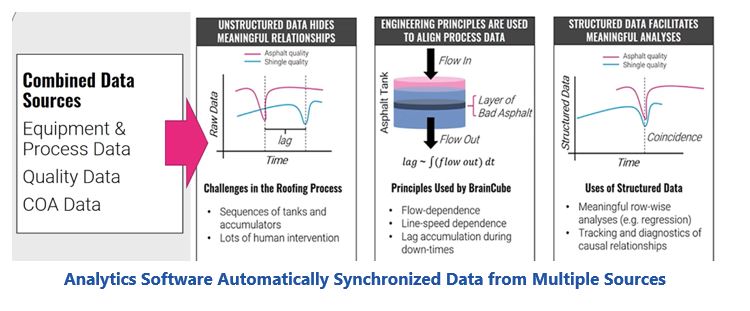
Emily Grams, Process Analytics Engineer, Owens Corning works with manufacturing plant engineers and operations to implement analytics solutions that aid in process optimization and upset prediction. Most notably, she led deployments of a digital twin analytics software within two of Owens Corning’s residential roofing lines driving productivity through data solutions.
During ARC Industry’s virtual Forum session exploring digital twins in plants, Emily’s presentation provided the Owens Corning case story. She presented the development, application, and benefits of a performance digital twin for predictive maintenance using the Braincube software. Braincube is an Industrial IoT platform suite with business and expert apps designed for manufacturing.
Emily’s presentation is available on YouTube (8:31 minutes) at:
ARC Advisory Group clients can view the complete report at ARC Client Portal
If you would like to buy this report or obtain information about how to become a client, please Contact Us
[1] Leading Industrial Organizations Improve Asset Management with Industrial IoT, Ralph Rio, ARC Strategy Report, Oct. 2016, page 8