Representative End User Clients







Representative Automation Clients







Representative Software Clients









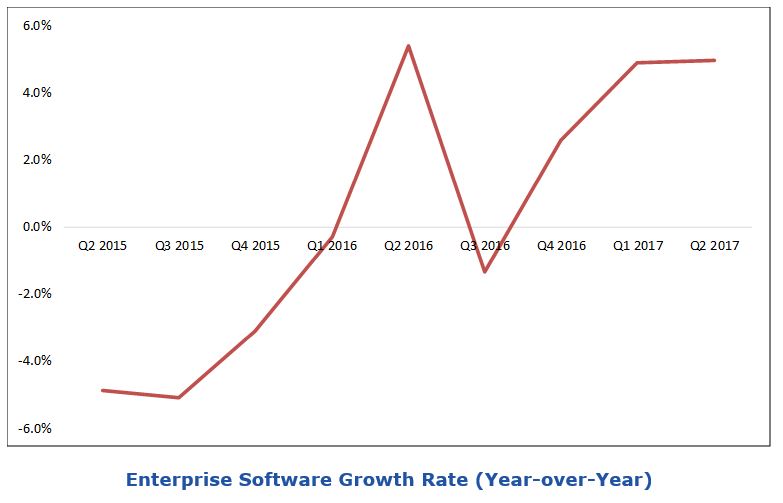
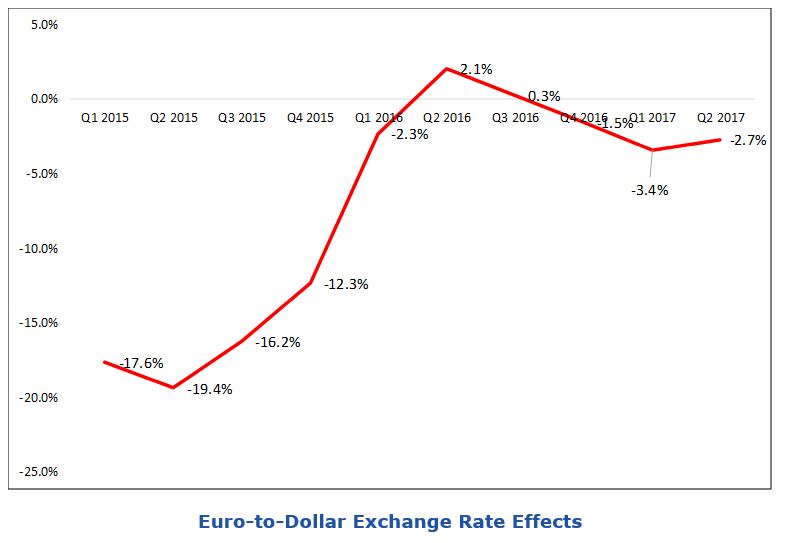
The worldwide enterprise software market displayed growth in the second quarter of 2017. This market expanded on 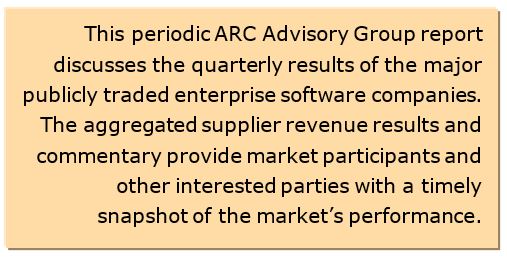 the back of relentless innovation and available capital. Once again, exchange rates played a role, with the marginal weakening of the euro relative to the dollar. This 2.7 percent exchange rate fluctuation provided a slight lift to revenues reported in euros that ARC subsequently translated to US dollars for this report.
Suppliers included in this report recorded combined quarterly revenue of slightly over $21.6 billion, representing 5.0 percent year-over-year growth.
This ARC Advisory Group report discusses the most recent quarterly revenue results of the major publicly traded enterprise software companies. We translated financial results reported in foreign currencies to US dollars using an average exchange rate for the given reporting period. The suppliers’ reporting period for this analysis was the quarter ending in June 2017, unless stated otherwise.
While this report focuses on the enterprise software portion for the respective companies mentioned, the R&D expenses shown are a factor of total company revenues.

American Software (Logility) reported total revenue of $26.9 million for the quarter ended July 2017. This represents a decline of 1.9 percent from the same period last year. License revenues declined by 12.7 percent to $4.0 million. Services and other revenues also decreased slightly by 1.3 percent to $12.0 million and maintenance revenues increased by 2.2 percent. Cloud Services Annual Contract Value (ACV) increased approximately 92 percent to $7.7 million for the quarter compared to $4.0 million in the same quarter of the previous year.
Autodesk reported total revenue of $501.8 million for the quarter ended July 2017. This represents a decline of 8.9 percent from the same period the previous year. Revenue from the Platform Solutions and Emerging Business (PSEB) 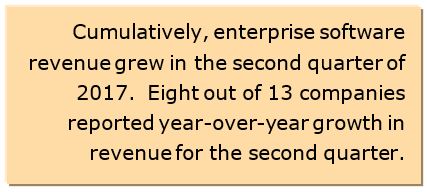 segment, which includes the Autodesk Design Suite, increased by 32.0 percent to $96.5 million. Revenue from the Architecture, Engineering, and Construction (AEC) segment declined by 17.5 percent to $208.8 million. Finally, the Manufacturing segment experienced a 16.9 percent decline to $147 million. EMEA revenue was $199.3 million, Americas $214 million, and APAC $88.5 million. Total GAAP spend (cost of revenue plus operating expenses) was $609 million, a decrease of 1.0 percent compared to the second quarter last year. Subscription plan annualized recurring revenue (ARR) was $784 million, an increase of 98 percent compared to the same period last year. Total ARR was $1.83 billion, an increase of 23 percent compared to the second quarter last year as reported.
Dassault Systèmes achieved total revenue of $891.1 million for the quarter, representing a 4.6 percent year-over-year growth rate. Software-related revenue (new and recurring licenses and maintenance) increased by 5.1 percent to $794.5 million. Services revenues increased by 1.1 percent to $96.6 million. By product line in euros, CATIA revenues increased by 2.3 percent, ENOVIA increased by 3.3 percent, and SOLIDWORKS increased by 16.1 percent. Geographically, revenues from the Americas increased by 10.8 percent, Europe by 5.3 percent, and Asia by 7.2 percent in reporting currency. The company’s strong revenue results are due to industry diversification and positive contributions by all product lines.
Descartes reported revenues of $57.3 million for the quarter ending in July 2017. This represents 13.5 percent growth over the same period in the prior year. Services revenues of $55.1 million represent a 13.4 percent year-over-year increase. Quarterly revenues from the US increased from $26.6 million to $31.5 million, EMEA increased slightly from $18.6 million to $18.9 million, and Canada from $3.2 to $4.1 million. APAC increased from $2.1 million to $2.8 million.
Hexagon’s Industrial Enterprise Solutions (IES) division consists of the manufacturing- and engineering-focused businesses: Hexagon Metrology and Intergraph PP&M. The division focuses on engineering software for creating and leveraging information critical for planning, constructing, and operating plants and process facilities, as well as for CAD (computer-aided design) and CAM (computer-aided manufacturing) software and metrology systems. The division reported $488.0 million in revenue for the quarter. This represents an increase of 8.9 percent year over year. In reporting currency (euro), the company increased its revenues by 11.9 percent. Geographically, 33.6 percent of revenues came from the Americas, 36.8 percent from EMEA, and 29.6 percent from Asia. The company acquired MiPlan Ltd, a provider of mobile software applications to increase productivity in mines, based in Australia; and MSC Software, a US-based provider of computer-aided engineering (CAE) solutions. Hexagon also acquired Catavolt, a US-based mobile app platform provider that offers an end-to-end platform from mobile application development and delivery, secure cloud orchestration and edge computing; and VIRES GmbH, a Germany-based provider of simulation software solutions.
IBM’s Software segment reported revenue of $4.6 billion in external sales for the quarter. This represents a decline of 2.5 percent over the same period last year. Under the company’s new segment reporting structure, total software no longer exists as a segment. Instead, the company’s software revenue is included within the technology services & cloud platforms, cognitive solutions, and systems segments. Given the current focus on IBM’s software revenue performance, the company will continue to report total software revenue performance throughout 2017. It consists of solutions software, which declined by 3.7 percent. Integration software, part of technology services & cloud platforms, decreased by 5.1 percent. Operating systems software, part of the systems business, declined by 10.4 percent.
IFS reported $103.4 million in revenue for the quarter, which represents a 0.4 percent year-over-year decline. License revenue declined by 0.9 percent, Maintenance declined by 1.3 percent while Consulting revenue increased by 0.4 percent. North Europe contributed most to the consulting revenue in the reporting currency, which was adjusted for revenue coming from the acquisition of VisionWaves.
Infor reported revenue of $759.7 million for the quarter ending July 2017. This represents an 8.3 percent growth from the prior year. Revenues from license fees increased by 21.5 percent, product update and support declined by 0.5 percent, and consulting services and other fees increased by 13.4 percent. From a regional perspective, revenues from the Americas contributed 63.0 percent, EMEA 31.0 percent, and Asia Pacific 6.0 percent to Infor’s revenues.
Manhattan Associates’ revenues decreased by 0.5 percent year over year to $154.1 million. Revenues from the Americas declined by 6.0 percent, EMEA increased by 21.0 percent, and APAC increased by 49.0 percent. Digital commerce and technology modernization programs continue to drive significant long-term growth opportunities for the company. Management stated that the demand for omni-channel, store, and distribution management solutions continued to increase. Global license revenues increased by 8.8 percent to $22.4 million. Services revenues decreased by 2.5 percent to $116.8 million. Hardware & other revenues increased by 3.1 percent to $14.9 million.
Oracle’s Software segment recorded $7.38 billion in revenues for the quarter ending August 2017. This represents 8.7 percent increase over the same period the previous year. New software licenses declined by 6.2 percent to $966 million, and cloud software subscriptions and platform services grew by 62.4 percent to $1.06 billion. Infrastructure-as-a-Service (IaaS) revenues increased by 28.2 percent to $400 million. From a regional perspective, total software revenues increased by 9.8 percent in the Americas, by 6.1 percent in EMEA, and by 9.6 percent in Asia Pacific.
PTC reported revenues of $291.0 million for the quarter ending in June 2017. This represents a nominal increase of 0.8 percent year over year. Subscription & license revenue increased by 39.7 percent to $107 million. Support revenue declined by 13.2 percent. Professional services declined by 13.3 percent. In fiscal 2016, PTC launched Navigate, a ThingWorx-based IoT solution for PLM. In fiscal 2017, revenue and bookings for Navigate are being allocated 50 percent to Solutions and 50 percent to IoT.
QAD reported total revenue of $76.0 million for the quarter ending in July 2017. This represents an overall increase of 8.9 percent from the same period the previous year. QAD’s license revenues increased by 5.1 percent, subscription revenues grew by 41.4 percent. Revenues from professional services were $19.8 million vs. $17.8 million last year, an increase of 11.5 percent. Maintenance and other revenues declined by 3.9 percent. By vertical, high tech and industrial represented 33 percent; automotive 32 percent; consumer products and food & beverage 21 percent; and life sciences 14 percent. By geography, North America represented 46 percent, EMEA 30 percent, Asia Pacific 17 percent, and Latin America 7 percent of total revenues.
SAP’s quarterly revenue increased by 7.5 percent to $5.8 billion. Software licenses and support revenues increased by 2.5 percent to $3.0 billion. Meanwhile, cloud subscriptions and support revenues increased from $813 million to $1.02 billion. In reporting currency (euro), the company’s total software, cloud, and services revenues increased by 10.4 percent. From a regional perspective, revenues in the Americas increased by 10.3 percent, Asia Pacific Japan (APJ) region by 15.8 percent, and EMEA by 8.3 percent.
Most enterprise software suppliers included in this report experienced year-over-year growth during the second quarter of 2017. While some of the on-premise revenues continue a downward trend, cloud/subscription-based revenues continue to grow. The relationship between the euro and the US dollar appears to have stabilized. Some of the industry trends affecting revenues include a widespread transition from perpetual licensing to subscriptions, industry consolidation through mergers and acquisitions, and corporate technology investment cycles. With increasing global competition and rising awareness of enterprise software, the enterprise software market is expected to grow in the future quarters.
ARC will continue to monitor these trends and associated supplier performance in the coming quarters.
If you would like to buy this report or obtain information about how to become a client, please Contact Us
Keywords: Enterprise Software, Quarterly Supplier Revenues, Asia Pacific, Europe, Middle East & Africa, Latin America, North America, ARC Advisory Group.