Representative End User Clients







Representative Automation Clients







Representative Software Clients








How important is digital transformation for industry in the EU and worldwide and what role can politics play? What are the EU digital transformation challenges? This was the focus of the speeches made by EU Commissioners Guenther Oettinger and Elżbieta Bieńkowska’s at the European Commission  Conference on "Digitizing European Industry" at the Hanover Fair on April 25, 2016.
Currently, the need to handle the refugee crisis in a joint European manner is shaking the political landscape in Europe. Also, the possible exit of Great Britain from the EU, the partly unsolved Greek financial crisis, and the complicated relationships with Russia and Turkey enter into the political picture. However, rather than focusing on these political issues, Oettinger concentrated on economic challenges in his speech.
From an economic point of view, the European Commission is concerned that the European member states could fall behind countries like the US, China, and South Korea in terms of digital transformation. In his speech, Guenther Oettinger highlighted the main challenges and gave advice on how to handle those challenges. In her speech, Elżbieta Bieńkowska provided more details about the actions the European Commission will take to support industry. Both commissioners stressed the importance of a single market and the need for cross-border industrial and political cooperation.
Guenther Oettinger, the European Commissioner for Digital Economy and Society, warned about several challenges that politics and industry currently face. In his opinion, the economic and political landscape has rapidly changed and the current situation is “in an even more difficult place than last year,” while the underlying issues and challenges have remained nearly the same.
First the commissioner highlighted that investments in the EU are far too low, especially in new technologies and innovative business models. This provides an opportunity for global competitors to catch up rapidly, even in areas where European companies have traditionally been strong.
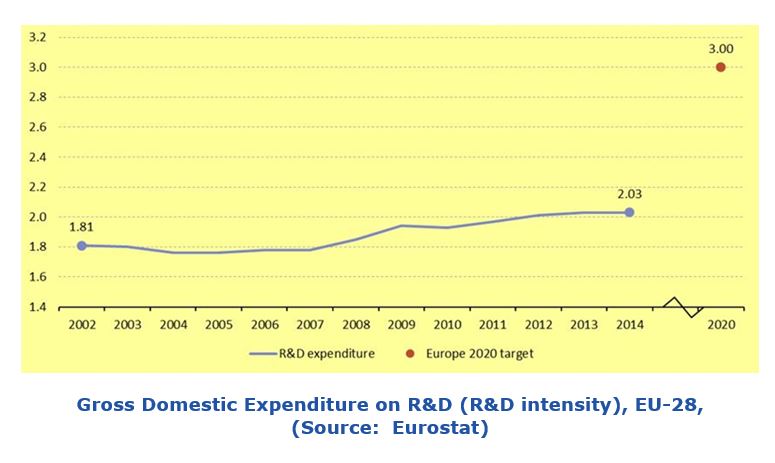
A Eurostat article from March 2016 underscores Oettinger’s concerns. The Europe 2020 strategy sets an ambitious target for improving the conditions for innovation, research and development. The goal is to increase combined public and private investment in R&D to 3 percent of GDP by 2020. Between 2002 and 2007, the gross domestic expenditure on R&D as a percentage of GDP was 1.8 percent in the EU. Since then, it has only grown marginally, reaching 2.03 percent in 2014.
The recently published annual innovation survey, “Innobarometer,” conducted by European Commission, revealed additional issues in the EU. According to the survey, innovation activity by European SMEs is declining and low rates of adoption of new technology are the reality. Companies that had introduced at least one innovative product or service since 2012 were asked the relative importance of a range of issues in commercializing their innovation(s).
The majority (65 percent) of companies claim that a market dominated by established competitors is the major concern. Followed by:
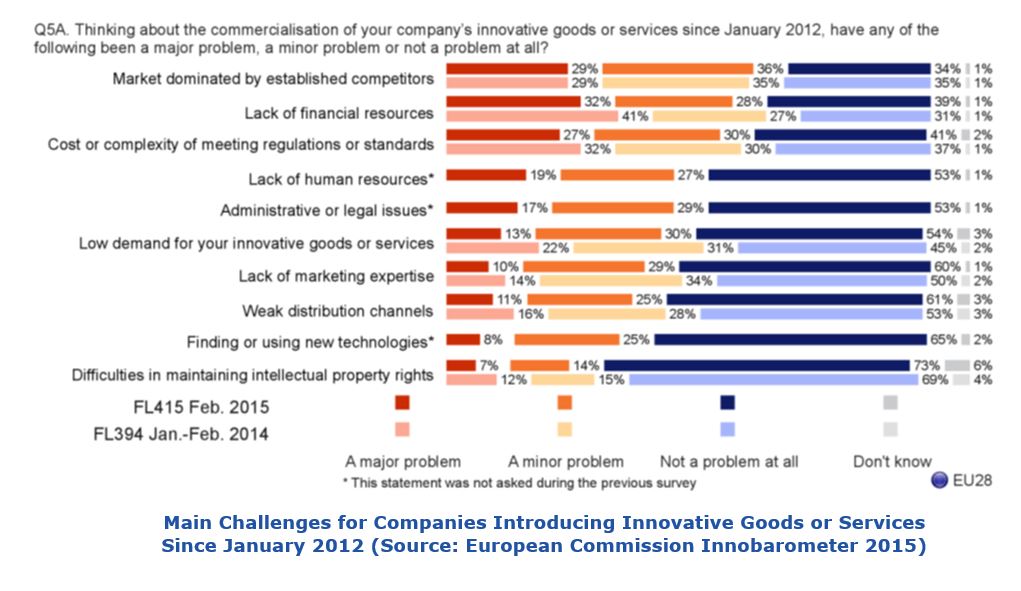
Less-cited concerns were:
Thirty-three percent of the EU companies surveyed indicated that finding or using new technologies is not a major concern. This compares to just 24 percent of companies in the US.
To illustrate the significance of the challenges, Oettinger used Big Data and platforms as an example. According to a recent report by the Strategic Policy Forum on Digital Transformation, the application of these technologies shows enormous potential, but companies still hesitate to use these platforms and their possibilities, even if they are aware of them. According to the report, more than two-thirds of companies in Europe expect to achieve an advanced level of  digitalization within the next five years. Today, less than a third of companies have already achieved advanced levels of digitalization.
Oettinger mentioned other big tasks that hinder the deployment and usage of IIoT-technologies in the EU. There are technical barriers such as lack of and inconsistency of standards and the fear about intellectual property protection. The lack of people with adequate digital skills in Europe is also a big concern.
The potential of Big Data is obvious for the European Commission in terms of efficiency, performance improvements, quality management, and -- above all -- services. Oettinger mentioned the following European Commission plans to address the challenges.
The released ICT Standardization Plan of the European Commission sets out a political and strategic approach based on five key areas:
The European Commission is aware that digital technologies and systems need to work together seamlessly. But to achieve this, they have to bring together the industry and the standardization communities on a global level. They also have to discuss and agree on an efficient licensing system, Oettinger said. The IoT Large Scale Pilots (LSPs) initiated by the Alliance for IoT Innovation (AIOITI) and scheduled to come on-line next year should help identify standardization issues.
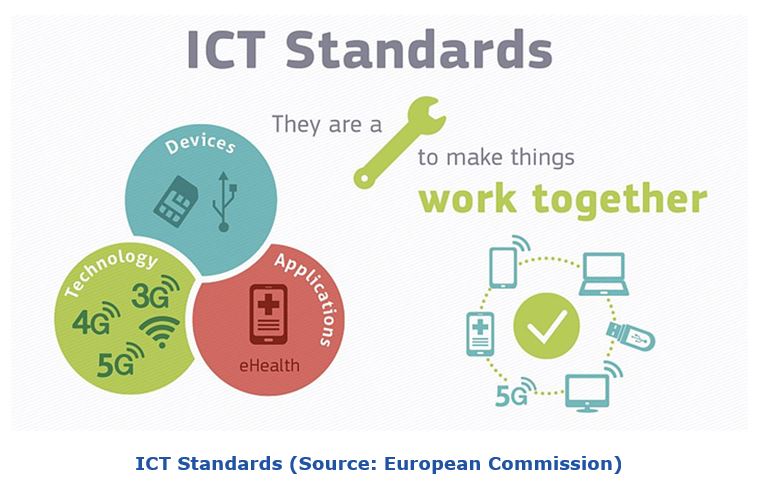
The European Commission is aware that legal uncertainties are a main inhibitor for industry concerning the usage of Big Data in digitalization. He mentioned that the European Commission will propose how to address the rights on the access and exploitation of data, by the end of this year. The “Digital Single Market” is part of the EU “Single Market Strategy.” The European Commission will work on a standardization plan to identify and define key priorities for standardization with a focus on new technologies and domains critical to the Digital Single Market.
Oettinger announced the start of a “Smart Specialization Platform on Industrial Modernization and Investment” in summer 2016. Its aim will be to support cross-regional partnerships to create a continuous pipeline of investment projects for the industry.
With the understanding that there is no dividing line between the digitization of industry and other sectors, the European Commission focuses on practical delivery. Oettinger does not look at digitalization in isolation, but instead considers the topic in the context of clean technologies, the joint provision of services, information and control technology (ICT), and so on. Policies across those topics need to be aligned, which is why the European Commission recently adopted a Circular Economy package and will shortly release a Communication on “collaborative or sharing economy.” This will provide clarity on rights and obligations of industry and citizens.
Oettinger closed his speech by underlining the necessity of partnerships. It will be important to stimulate partnerships between industry and legislators and beyond borders. These partnerships are essential to create jobs, because while the industry can create jobs and growth, politics can only make propositions. For a successful digitalization he called upon his political colleagues and his industry partners to avoid creating unnecessary bureaucratic hurdles and support progressive, applicable packages to help overcome concerns wherever they may occur.
In her speech, Elżbieta Bieńkowska, European Commissioner for Internal Market, Industry, Entrepreneurship and SMEs, announced that the results of the report on Big Data prepared by the Strategic Policy Forum on Digital Entrepreneurship had been published. This forum was implemented in 2014 to outline the short- and long-term strategies for digital entrepreneurship in Europe, implement the strategy, and advise the European Commission on key priorities.
The report assesses key success factors, provides recommendations on how to overcome existing problems, and how to speed up the modernization process in three major industries: automotive, healthcare/pharma, and mechanical engineering. The recommendations for accelerating the digital transformation are based on four areas:
Several examples and figures in the report emphasize the current importance of digital platforms. According to the report, 81 percent of executives believe that platform-based business models are key for their growth strategy. Ninety percent of chief executives in the automotive and healthcare sectors recognize that data analytics have high-value potential. The report states that digital platforms are approaching a total market value of 4 trillion euros.
The report also exposed other challenges in the EU. The investment gap in ICT with the US is big. To close the accumulated gap, the EU would have to invest 335 billion euros, the report claims. Also the digital skill and entrepreneur gap is highlighted. Seventy-seven percent of companies see missing digital skills of people as the key hurdle of their digital transformation. According to the report, 54 percent of European jobs are at risk of being computerized because of key technology advances and an additional 20 million euros would need to be invested in early stage entrepreneurship to close the gap with the US.
In their speeches, Commissioners Oettinger and Bieńkowska urged industry and authorities to shoulder their responsibilities. Both parties must think thoroughly and act quickly. Investments from the public and private sector will be key enablers, especially for new technologies, reskilling the workforce, and innovative business models. The same applies to (at a minimum) EU-wide standards for digital technologies and systems. To benefit fully from the new technologies, standards have to be implemented that allow data to flow seamlessly, which could help overcome existing problems and accelerate the modernization process in the industries.
The successful application of industrial IoT will help improve the competitiveness of European industry and its relative growth (or stagnation) compared to other regions.
If you would like to buy this report or obtain information about how to become a client, please Contact Us
Keywords: Digital Transformation, Hanover Fair, European Commission, ARC Advisory Group.