Representative End User Clients







Representative Automation Clients







Representative Software Clients









The face of manufacturing is rapidly moving into an era in which emerging IIoT-based technologies, new materials, advanced fabrication approaches, and digitalization are converging to change the face of production systems, manufacturing processes, supply chains, and even the work force. Digital transformation affects all stages of the product lifecycle; from design, simulation, production, maintenance, to service in the field.
At the recent ARC Industry Forum in Orlando, Florida, the theme, “Industry in Transition: Realizing the Digital  Enterprise,” was very evident in the Advanced Manufacturing Technology for the Factory of the Future session. This session featured a presentation by an automotive company with radical new designs, a new manufacturing model, and new go-to-market strategy; plus a call to develop the next generation of manufacturing workers by an industry institute.
The session examined emerging manufacturing technologies like additive manufacturing and hybrid machine tools, applied materials science, advanced predictive and prescriptive analytics for manufacturing that use machine learning, operational intelligence, cloud-based connectivity for production equipment, IIoT, the digital twin, virtual reality and augmented reality, advanced simulation solutions, and more.
Advanced manufacturing technology is bringing significant changes and improvements to production systems and services. It is also bringing about the complete re-thinking of new business models based on IIoT, the digital twin, and factory/supply chain ecosystems. Leading PLM and other design/build solution suppliers, along with production automation and controls suppliers, are working closely with manufacturing technology adoption leaders to lead the way for industry as a whole.
David Woessner, General Manager at Local Motors presented a look at the future of automotive manufacturing. While Local Motors manufactures vehicles for the automotive market, any resemblance to other automotive industry  participants stops there. Local Motors represents a true disruption to the vast global automotive market that mass produces millions of vehicles per year.
To start with, the company manufactures custom vehicles, with the vehicle body and other components 3D printed from composite polymers. These bodies are then fitted with electric drive trains. Vehicles can roll off the company’s geographically distributed “micro” factories in anywhere from 18 to 24 hours to three to four days from start to finish, depending on the design configuration.
The company’s factories are easily set up within a matter of weeks to months (as opposed to years for conventional automotive assembly plants). Seven are up and operating already, with more planned in the US and Europe. Beyond 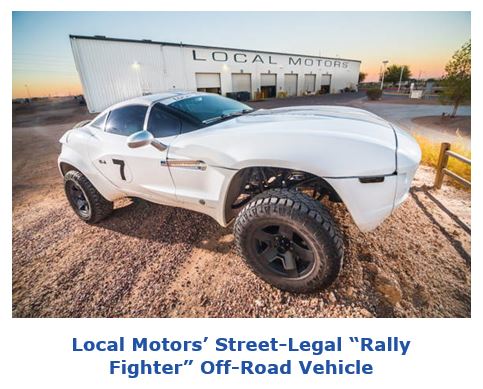 disrupting the entire automotive industry, Local Motors has an even larger vision/mission: to create a better world through hardware. This involves using new materials, design methods, and advanced manufacturing processes to create technology-forward products that inspire, empower, and nurture humanity.
Local Motors is also “breaking the mold” when it comes to product design. Rather than design its vehicles with an established in-house engineering organization, the company has adopted a co-creation design approach. This is based on the concept of a design community. A vehicle design can represent the combined effort of a global community of designers, with many engineers from both inside and outside the company. Once their designs have been accepted, designers are compensated based on a percentage of royalties paid on vehicles produced. In some cases, the company holds design competitions, with the best design selected for production.
Local Motors manufacturing and business model can significantly reduce the development time for a new vehicle from an industry average of around four to five years, to one to two years, and shrinking. The company aims to design and make cars in drastically less time, with less capital and investment, in smaller production facilities, using the combined design talent of a lot more people.
Jacob Goodwin, Chief Membership Officer for the Advanced Robotics Manufacturing Institute (ARM), presented a look at the current state of robotics in manufacturing, manufacturing jobs, and the outlook for the future.
Mr. Goodwin pointed out that ARM’s mission focuses on several areas:
 Mr. Goodwin stated that the ARM’s overall mission is to assess the current status of US manufacturing relative to the use of robotics and to research and develop new classes of robotics for manufacturing. One goal is to place these more collaborative (working side-by-side with humans), next-generation robots into small to medium manufacturers (SMEs) to help them become more efficient, productive, and competitive.
Here, robots would not replace workers; but instead increase a company’s production volumes and quality, creating more work downstream for appropriately skilled people.
The ARM Institute represents a collaboration between government, education, and industry to fund research, identify manufacturing requirements, and use resources offered by universities for researching and developing robotics and other advanced manufacturing technologies.
The emerging technologies that will drive tomorrow’s advanced manufacturing are already upon us. Companies competing for new business will increasingly depend on these technologies to bring new and innovative products to the market and improve their production operations to achieve new levels of efficiency and productivity.
As in the past, it will be the early adopters that will lead. The more cautious and conservative companies will typically wait for new technologies and processes to become mainstream before adopting them. While, on the surface, this prudent approach appears to make business sense; the pace of technology change and potential associated advantage gained by the early adopters creates an ever-widening gap that is putting some companies in almost permanent leadership positions; with others relegated to follower status.
Manufacturers need to be constantly aware of the increasing pace of technology advancement and develop business strategies to adopt technologies that will offer them the most opportunities to improve competitiveness.
If you would like to buy this report or obtain information about how to become a client, please Contact Us
Keywords: Emerging Technologies, Advanced Manufacturing, Workforce, Digital Transformation, Hybrid Additive Manufacturing, New Business Models, ARC Advisory Group.