Representative End User Clients







Representative Automation Clients







Representative Software Clients








KEYWORDS: Small-Medium Manufacturers, SMB, Production Transparency, Digital Transformation, Shop Floor Visibility, Operational Efficiency, Siemens Xcelerator, Modular Digitalization, Partner-Led Deployment
SMBs face rising costs, labor shortages, growing demands for flexibility, and increasing operational complexity, yet many still lack the budget, skills, and time for conventional digital transformation programs. The barrier is usually not lack of interest, but the absence of practical, affordable pathways that deliver results quickly. Many need a focused starting point tied to an immediate operational problem rather than a broad transformation agenda. Production transparency is emerging as such an entry point because it reveals downtime, inefficiencies, changeover losses, and cost drivers hidden in fragmented or delayed data.
This ARC View examines why production transparency is a practical starting point for SMBs and how Siemens Xcelerator is being positioned to support it.
Production transparency is emerging as an entry point for SMBs because it reveals downtime, inefficiencies, changeover losses, and cost drivers hidden in fragmented or delayed data. This ARC View examines how Siemens Xcelerator is being positioned to support it.
SMBs are not simply smaller versions of large enterprises. They operate with lean teams, limited specialist resources, and tighter financial constraints while facing many of the same disruptions as larger plants. These pressures translate into harder-to-diagnose downtime, fragmented machine and shift data, inconsistent execution, delayed visibility into cost deviations, and slower responses to production problems. In many cases, the underlying issue is incomplete, delayed, or fragmented production information.
The challenge is also organizational. Many SMBs are building digital capabilities while balancing lean teams, limited IT and automation resources, and pressure to justify every investment. Long decision cycles, uncertainty about where to begin, and prior experience with overly complex solutions further complicate adoption. As a result, SMBs need solutions that are right-sized from the outset, easy to deploy and manage, modular enough to scale, and backed by strong partner support, practical guidance, and integration assistance.
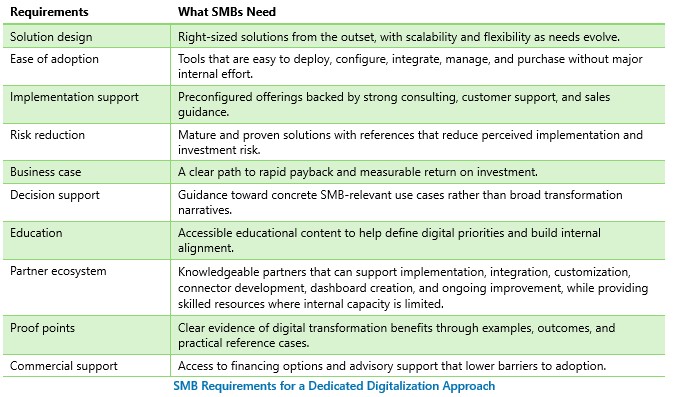
Siemens Xcelerator is an open digital business platform that combines IoT-enabled hardware, software, digital services, a certified partner ecosystem, and a marketplace. In manufacturing, its relevance lies in linking operational technology and information technology through interoperable software, data services, edge capabilities, and partner-delivered solutions. For SMBs, the platform matters less because of its breadth than because it can be packaged into modular, easier-to-adopt solution paths.
For SMBs, production transparency is often the point at which digital strategy becomes operationally and economically credible.
This architecture is relevant to SMBs because the issue is often not access to technology in principle, but access to technology in a form they can realistically adopt. Traditional industrial software projects often require long specification cycles, specialized integration work, and significant upfront commitment. Siemens presents Xcelerator as a more incremental model, emphasizing modularity, commercial flexibility, and access to partners that can supplement limited internal resources.
Siemens’ initiative recognizes that SMBs require a different go-to-market model and solution architecture. The focus shifts away from broad transformation narratives toward targeted, tangible use cases that solve business problems quickly while remaining connected to the broader Siemens ecosystem. For SMBs, success depends on reducing perceived risk, simplifying adoption, and proving value early through outcomes such as reduced downtime, faster changeovers, higher throughput, improved efficiency, and better cost visibility.
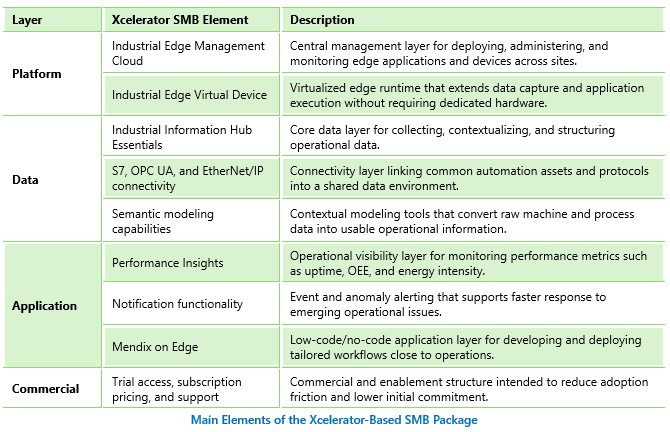
The starting point is production transparency because it addresses the information gap behind many daily operating problems. SMBs do not typically need to begin with a large transformation program; they need clear visibility into what is happening across machines and lines. The SMB-oriented production optimization package uses Industrial Edge capabilities to connect existing assets, capture machine, energy, and process signals, harmonize this data, and present insights through dashboards, alerts, and baseline metrics such as uptime, OEE, and energy per part. This creates a foundation for later steps such as root-cause analysis, digital workflows, anomaly detection, and energy optimization.
Siemens’ Xcelerator-based solution for SMBs combines Industrial Edge Management Cloud, Industrial Edge Virtual Device, Industrial Information Hub Essentials, connectivity for S7, OPC UA, and EtherNet/IP, semantic modeling, performance insights, notifications, and low-code application support via Mendix on Edge. Together, these components support a modular architecture that remains preconfigured enough to reduce engineering effort. The solution is also designed to work with existing machines, helping avoid costly upgrades. Partners can support deployment, integration, customizations, additional connectors, dashboards, and workflow applications. For SMBs with limited engineering or IT resources, this ecosystem can be as important as the software stack itself. The commercial model further reduces friction through trial access, subscription pricing, technical support, and self-paced training.
Beyond technology and economics, many SMBs look for external validation before committing to digital initiatives. Adoption becomes easier when decisionmakers can point to similar companies that have implemented a solution successfully and demonstrated practical outcomes. In that context, Xcelerator’s ecosystem may provide an advantage through partners, advisors, peer examples, and reference cases that reduce uncertainty and strengthen the business case.
Another important factor is the support structure around the technology. SMBs often lack the internal teams needed to manage architecture, integration, customization, connector development, cybersecurity, training, and continuous improvement on their own. As a result, the partner ecosystem is central to whether adoption can scale beyond the initial sale. System integrators, distributors, and regional support organizations provide implementation capacity and help customers integrate existing systems, extend connectivity, tailor workflows, and build dashboards or applications with tools such as Mendix. Maturity assessments, educational content, case examples, and a dedicated SMB hub can further guide prospects toward a practical initial use case.
This approach better matches the economic and organizational reality of SMBs. Rather than requiring an upfront commitment to a broad enterprise-wide program, Siemens is framing an initial operational use case that may be easier to justify and evaluate. If the first deployment improves visibility and delivers measurable results, the manufacturer is then in a stronger position to extend adoption toward broader analytics, workflow standardization, application layering, and eventually AI-based optimization.
For SMBs, the most credible digital strategies begin with a clearly defined operational problem, deliver measurable value quickly, and create a manageable path toward broader improvement over time. In that respect, an approach centered on production transparency, modular software components, partner-supported deployment, and lower-friction commercial models is well aligned with the practical constraints of this segment. The key question is whether this model can remain simple across positioning, implementation, and lifecycle support. If that discipline is maintained, Siemens Xcelerator could provide a viable path for expanding digital transformation adoption among SMBs.
ARC Advisory Group clients can view the complete report at the ARC Client Portal.
Contact Us if you would like to speak with the author.
Obtain more ARC In-depth Research Market Analysis.