Representative End User Clients







Representative Automation Clients







Representative Software Clients









Keywords: Hybrid Industrial Data Infrastructure, Analytics, Digital Transformation, Sustainability, Operational Resilience, Operational Excellence, Industrial AI, Asset Management, IIoT, ARC Advisory Group.
Industrial companies continue to face significant headwinds as they roll out digital transformation across their operations. It becomes increasingly difficult for companies to achieve year over year improvements after recording initial gains, particularly as their systems become more powerful and complex. Companies that consistently reach new levels of resilience and sustainability often find that best results are achieved using a fully integrated hybrid data infrastructure, which can be a catalyst to reaching new levels of operational resiliency and sustainability. ARC advises its clients to ensure that data collection is reliable, secure and immediate; data platforms are vendor-neutral and feature a hybrid industrial data infrastructure integrated from edge to plant to cloud; and data can be easily consumed by a wide range of analytic solutions developed in-house or offered by trusted partners and service providers.
Industrial companies face more pressing issues and challenges today than ever before, including the need to respond to sustainability demands, which include decarbonization, GHG tracking, ESG reporting, circular economy, energy management, ethical sourcing and tracking, and environmental and social citizenship. Decision makers must also address the need for operating resilience, which includes protecting against unscheduled downtime and asset failures, ensuring product fulfillment, protecting personnel, sustainably managing workforces, and enhancing cybersecurity architectures. Improving resilience requires that companies break down physical and organizational boundaries to better serve their workforces, connect teams, and enhance real-time collaboration between operations and other stakeholders such as leaders of digital transformation, sustainability, asset maintenance and energy management. Industrial operators must also find solutions that help supply chains maintain their integrity, agility, and flexibility in the face of constant change, enabling the company to respond immediately to market demand and shifts in material availability.
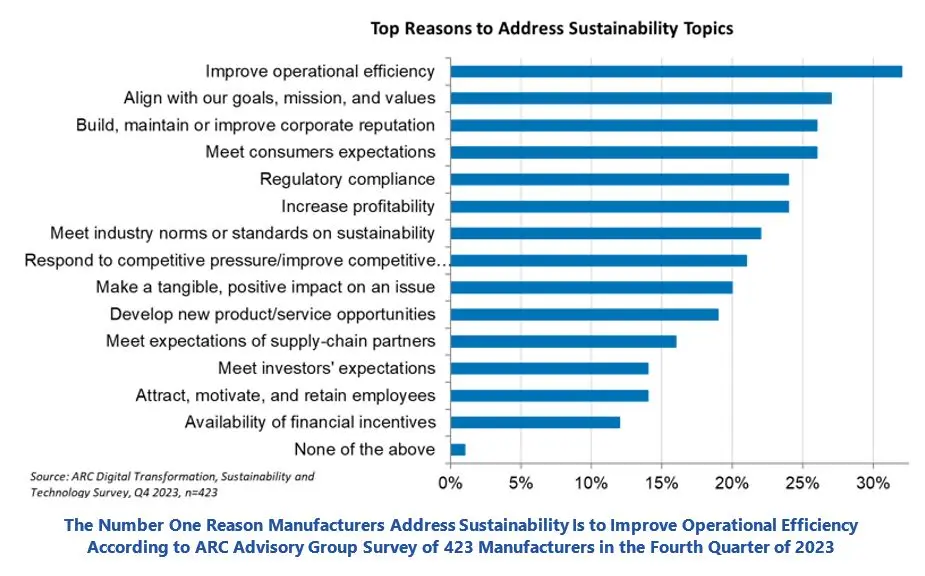
These pressing issues and challenges also include the increasing complexity of manufacturing processes, driven by an ever-growing number of product and packaging variants, growing regulations that differ by country for products with global markets, and increasing requirements for traceability. The management challenge is compounded by the shift to a smaller and less experienced workforce in need of easy-to-use productivity tools, such as for knowledge capture and deployment of new workflow. According to a recent ARC Advisory Group survey, the net result of addressing issues such as sustainability, operational resilience and increasing complexity is the opportunity to substantially increase operating efficiency. This is because the desire to achieve year over year improvements in KPIs such as OEE, financial performance and productivity will drive innovation and lead companies to try new optimization techniques that once seemed unnecessary.
Learning when and where to apply technology solutions is key to overcoming pressing issues and challenges. The ability to make informed decisions faster and respond to changes in real time is based on having accurate, relevant, and contextualized information. Additionally, data-driven automation can streamline workflows, freeing up human resources to focus on more creative and strategic endeavors. Market leaders will be the first to effectively apply smart technologies such as industrial AI to deliver actual results such as automating routine tasks, analyzing large datasets, and deriving actionable insights with greater speed and accuracy.
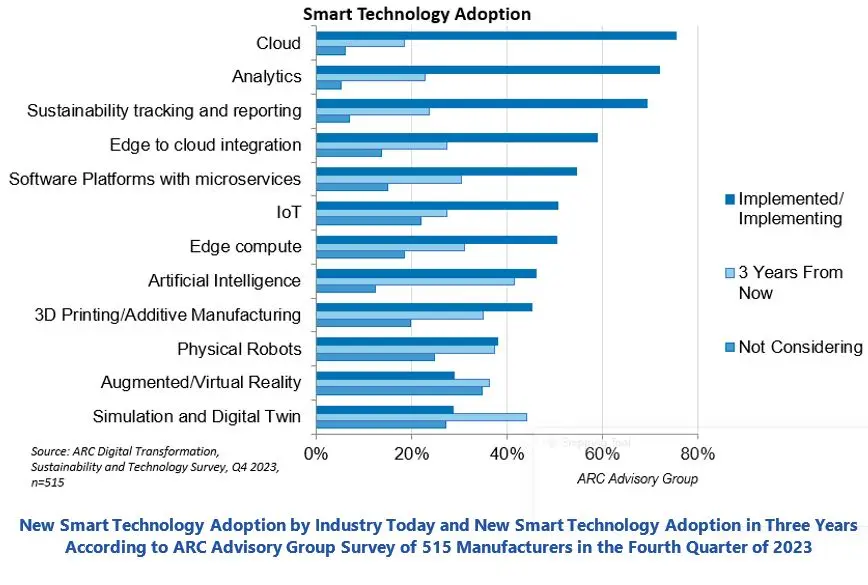
Today’s smart technologies have the power to deliver a better employee experience and give less experienced decision makers the benefit of existing industrial intelligence. For example, industrial AI adoption across IT, OT, and ET systems, processes, and teams will likely be used to help fill workforce gaps and prepare new workers. Delivered on wearable devices using technologies such as Augmented Reality, Virtual Reality, or a Mixed Reality combo of both, these technologies will encourage companies to invest in, and value, high quality.
Automation and control system modernization remains one of the major issues faced by manufacturers, which requires fully integrated hybrid data infrastructure and management to implement. Legacy installed systems often do not meet the requirements to leverage technologies such as digital twin, cloud computing, advanced process control, predictive and prescriptive analytics, AR/VR, AI/ML, edge computing, and remote and autonomous operations. Cloud-based solutions are virtually essential for meeting the challenges of modern industry. Organizational and systems convergence, the pressure to reduce risk, expenditures, and carbon footprint, plus other factors are driving companies to seek out partners who can help them modernize their operations to address sustainability, operational resilience, and manage the increasing complexity of manufacturing processes.
Industrial leaders are driving ROI and achieving strong year-over-year results through digital transformation, IT and OT convergence, and flexibility of the underlying infrastructure that adapts to new use cases. Optimizing operational excellence results in fewer process upsets, production improvement, and a more reliable supply chain. Progressing towards sustainability, Net Zero and ESG goals results in lower energy consumption, fewer product reruns and less rework, more efficient raw material usage, improved waste elimination, and meeting circular economy initiatives. Democratizing data usage is a direct result of the convergence between IT and OT, as an example, which provides an integrated, digitalized approach that increases interoperability and flexibility, reduces CAPEX and OPEX expenditures, increases production efficiencies, decreases unscheduled downtime, and improves overall profitability. Integrating data with analytics facilitates a faster proactive response to changing conditions with digital transformation accelerating, for example, data visualization that allows for faster interpretation and better decision making. Integrated data with analytics supports on-the-spot data and information analysis leveraging complex analytics and provides a presentation format that optimizes user comprehension. None of the industry challenges that are addressed via Industry 4.0, digital transformation and smart technologies can be deployed without the convergence of IT and OT. This convergence is helping these plants address legacy automation assets that often need IIoT technology to be connected to the cloud or to act as edge devices, often by the addition of smart embedded devices to the asset.
Obtaining quality data is key to successful digital transformation and fully integrated hybrid data infrastructure and management is quality data. There is no digital transformation, and you cannot achieve the single version of the truth without quality data. For example, asset management and reliability are areas that have seen a significant increase in investment in recent years, as the benefits of extending asset life, avoiding outages, and reducing rework are so impactful to the bottom line.
With the rise of the Internet of Things (IoT), new challenges have emerged in collecting and advanced analytics; asset managers must collect and analyze vast amounts of data in real time, which has revolutionized the way they approach maintenance and reliability. By using sensors and other connected devices, they can monitor the health and performance of assets in real time and use predictive analytics to forecast when maintenance will be required. Predictive maintenance helps companies save time, reduce costs, and improve the overall reliability of their assets. Another key area of digital transformation in asset management is the use of Industrial AI. AI can be used to analyze larger data sets and identify patterns and anomalies that may not be immediately apparent. By using AI, asset managers can identify potential issues before they become critical and take corrective action before the asset fails.
Data platforms must be vendor-neutral and feature a hybrid industrial data infrastructure integrated end-to-end from the plant to the cloud; and data that can be easily used by a wide range of solutions in-house as well as by trusted partners and service providers. Industrial companies seek platforms that are open and vendor agnostic, not platforms that are proprietary to any vendor, and can communicate with all operations technology and information technology assets. Hybrid is also critical as most industrial companies have a combination of data stored on the plant floor, edge devices, on-premises servers, and the cloud, which make it critical that data platforms can be integrated from the plant floor to the cloud.
The convergence of information technology and operations technology (IT/OT convergence) is progressing rapidly as industrial organizations realize real-time performance data is not only critical to engineers on the front lines of operations, but also to analysts looking for economies or sustainability improvements at the enterprise level. Rather than a trend, ARC Advisory Group believes that this convergence between IT and OT will become permanent, representing a true technology fusion. Collaboration with real-time data sharing between decision makers in OT and IT is essential for businesses to compete. A single, hybrid industrial data infrastructure can deliver true IT/OT convergence. Manufacturers and other industrial organizations today face the increasing demand for tighter, data-driven integration with suppliers, service providers and customers.
Addressing the pressing issues and challenges that industrial company’s face in sustainability, operational resilience, increasing complexity of manufacturing processes, and increasing operating efficiency requires fully integrated hybrid data infrastructure and management, edge-to-cloud community, and hybrid data infrastructure for industrial operations. ARC Advisory recommends the following to ensure there is a strong industrial data foundation.
Connect data, apps, and people. Ensure your industrial data platform has the power to dynamically transform raw industrial data into information formatted specifically for use by other digital assets and people with a broad range of backgrounds, to make the best possible decisions. Look for platforms that leverage a library of algorithms and methods for tasks such as data cleansing, reconciliation, analysis, and transformation.
Commit to neutrality. Select a data platform that is capable of integrating data from disparate proprietary and operationally focused systems that can range from state-of-the-art to 30-40 years old and from a wide range of vendors. Creating a single source of truth is the foundation your operations engineers and data analysts need to develop insight.
Ensure edge visibility. Real-time data ingestion, scalability, and standardization are as essential at the edge, as they are on-premises. No critical operation, no matter how remote, should be left out of the picture. Integrate data at the edge, as close to the raw data as possible.
Maintain strict enterprise security. With increasing integration of cloud infrastructure into operations and IT/OT convergence, IT organizations must be consulted to ensure critical data is protected from unauthorized access and local regulations on data storage are followed.
Integrate with analytics. Data alone can go only so far. Put data-driven insight to work through integration with purpose-built analytics tools that allow companies to detect anomalies, model relationships, and gain operational efficiency. Explore automation to reduce the time from analysis to results.
ARC recommends that industrial companies implement a hybrid data infrastructure that is open and agnostic; capable of seamlessly connecting data, analytics, and applications; and allows users in different functions to easily turn data into decision-ready information that drives results.
ARC Advisory Group clients can view the complete report at the ARC Client Portal.
Please Contact Us if you would like to speak with the author.
Obtain more ARC In-depth Research at Market Analysis