Representative End User Clients







Representative Automation Clients







Representative Software Clients








Industrial companies have been navigating their digital transformation journeys for several years. ARC conducted a survey examining the adoption and use of digital transformation and sustainability initiatives and technologies. The respondents were end users with influence, decision making power and/or knowledge within their industrial organizations. The survey results provide valuable insights into the progress, challenges, priorities and outcomes associated with these efforts. Key findings from the survey demonstrate significant strides have been made in the evolving landscape of digital transformation:
Progress despite challenges: The majority of industrial companies have made notable progress in their digital transformation efforts, even in the face of substantial challenges. These challenges may include technological complexities, resistance to change, and the need for significant financial investment. However, many companies report that they have or are overcoming initial hurdles and are advancing along their digital transformation journey.
Aligning goals and priorities: Industrial companies are aligning their digital transformation goals and priorities to more effectively address the challenges they face. This alignment is crucial for maintaining focus and ensuring that transformation and initiatives are strategically targeted. By clearly defining objectives and prioritizing initiatives, companies are better equipped to navigate obstacles and drive their transformation agendas forward.
Impact of technologies and business processes: The integration of advanced technologies and the reengineering of business processes are fundamentally transforming the industrial landscape. Key technologies, such as IoT, AI, and advanced analytics are being leveraged to enhance operational efficiency, improve decision-making, and drive innovation.
Sustainability initiatives yield positive outcomes: Survey respondents anticipate significant positive business outcomes from sustainability initiatives. These initiatives are not only environmentally beneficial but also offer economic advantages, such as cost savings from reduced resource consumption and improved regulatory compliance. The emphasis on sustainability is becoming a pivotal component of digital transformation strategies, driving both ethical and financial gains.
Essential investment in digital transformation: Investment in digital transformation is increasingly seen as essential rather than discretionary. Companies recognize that staying competitive in the modern industrial landscape requires an ongoing commitment to digital innovation. As a result, budgets for digital transformation initiatives are being prioritized, with a clear understanding that these investments are critical for long-term success and growth.
ARC Advisory Group conducted an online survey between November and December 2023. A total of 515 respondents from North America participated. The respondents were end users with influence/decision making power and/or knowledge of their organization’s adoption and use of digital transformation and sustainability initiatives and technologies.
Refer to the appendix to see detailed demographics of n=515 survey participants.
The digital transformation journey of industrial manufacturing companies has been an evolution over the past two decades. Long gone are the days when processes were largely manual and dependent on analog technologies. ARC Advisory Group has been following the advent of digital technologies and the way they have revolutionized this sector, leading to increased efficiency, productivity and innovation. When asked about digital transformation maturity, it has become clear that most industrial companies have made progress along their journey.
Only a small percentage (7 percent) of survey respondents said they have done little to no work regarding digital transformation. These companies are still primarily reliant on traditional manual processes with minimal integration. They may be hesitant or slow to adopt new technologies due to factors, such as cost concerns, lack of expertise, or resistance to change. As a result, they may face challenges related to inefficiency, low productivity and difficulty in keeping up with competitors who have embraced digital transformation.
The companies who are just beginning to coordinate their digital transformation activities, but not in a coordinated fashion, recognize the need for transformation and have started to invest in basic automation technologies. While they are making progress, they may still be in the early stages of understanding how to fully leverage these technologies to drive meaningful improvements in efficiency and productivity.
The majority of respondents feel as if they are well underway or at an early stage of their digital transformation journey. Early-stage companies are beginning to integrate various technologies across their operations. They are investing in advanced automation systems, data analytics, and real-time monitoring tools to better optimize their manufacturing processes. Companies that are well underway on their journey have successfully integrated technology to connect people and devices as part of their business objectives.
Only a minority of respondents feel as if they have gone beyond integration and are now leveraging real-time insights to drive optimizations in processes and workflows to yield business results. This progression beyond basic integration involves several key aspects, including successful business process outcomes and cultural and organizational changes around collaboration and continuous improvements.
In summary, the survey highlights that while many organizations are integrating digital technologies, only a minority are harnessing the full potential of real-time data to drive significant business improvements. These organizations set themselves apart by using real-time insights to enhance their operations, making them more efficient, responsive, and competitive in the market.
Industrial manufacturing companies encounter a myriad of challenges that shape their operational landscape. One of the foremost hurdles is maintaining efficiency amidst increasing demands for productivity and quality. Striking a balance between cost-effectiveness and innovation remains a perpetual challenge, especially in ever-evolving markets. Technological advancements, while offering opportunities for optimization, also introduce complexities in adapting to new systems and processes. Moreover, navigating regulatory compliance and sustainability requirements poses significant hurdles, necessitating substantial investments. Additionally global competition and supply chain challenges underscore the need for agility and resilience.
When asked about initiatives that will be significant in driving investments in 2024, delivering quality products and services in an operationally effective way were most cited. Successfully navigating the challenges industrial companies face requires a strategic approach that integrates innovation, flexibility, and sustainability into the fabric of manufacturing operations.
Technologies and business processes are revolutionizing the landscape for industrial manufacturers, driving new levels of efficiency, innovation and competitiveness. The integration of advanced technologies such as Internet of Things (IoT), artificial intelligence (AI), and robotics is enabling manufacturers to streamline operations. The adoption of smart manufacturing processes and methodologies is transforming traditional workflows, fostering greater agility and responsiveness to market demands. These advancements are not only optimizing production but also opening new avenues for customization, sustainability and greater customer engagement. Embracing transformative technologies and processes have become a crucial part of successful companies.
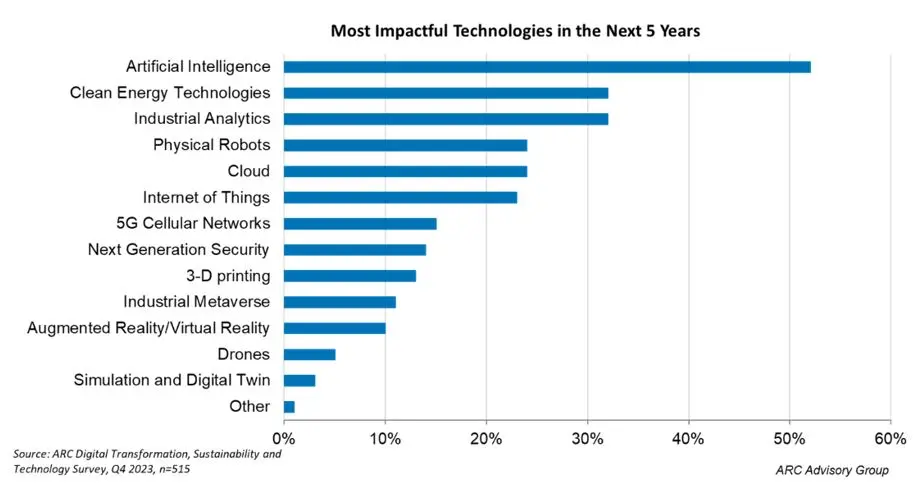
Industrial companies expect artificial intelligence, clean energy technologies, and analytics will have significant impacts on production operations by 2029.
By now, it should be no surprise that AI stands on the brink of revolutionizing industry. AI offers unprecedented opportunities for optimization, automation and innovation. AI can enhance many aspects of the manufacturing process, from predictive maintenance and quality control to supply chain management and product design. (ARC Advisory Group is covering the topic of AI extensively: www.arcweb.com). By analyzing vast amounts of data in real time, AI is enabling manufacturers to make data-driven decisions, optimize production schedules, optimize supply chains, train workers and minimize downtime, to name a few. AI-driven design tools are facilitating the development of more efficient sustainable products and processes.
Executive Overview
ARC Survey Methodology and Demographics
Despite Challenges, Most Make Progress in Their Digital Transformation
Journey
Overcome Business Challenges with the Right Digital Transformation Goals
and Priorities
Technologies and Business Processes Are Changing the Game
Investing in Digital Transformation Is No Longer Viewed as Discretionary
Recommendations
Appendix
ARC Advisory Group clients can view the complete report at the ARC Client Portal.
Please Contact Us if you would like to speak with the author.
Obtain more ARC In-depth Research at Market Analysis