Representative End User Clients







Representative Automation Clients







Representative Software Clients








Keywords: SAS, Industrial AI, Data
Artificial Intelligence (AI) has revolutionized the way we approach problem solving and decision making in various industries. Often described as prediction machines or inference engines, AI systems are designed to analyze data, recognize patterns, and make predictions about future events or outcomes. This predictive capability is central to AI's value proposition, enabling businesses to anticipate trends, optimize processes, and make informed decisions. For instance, in the industrial sector, the most widely deployed AI use case involves predicting equipment failures before they occur, allowing for proactive maintenance and reducing downtime.
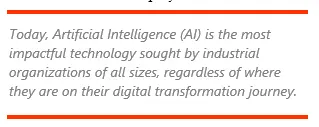
The surge in investment in AI infrastructure is a testament to the technology's transformative potential. Investment banks like Goldman Sachs have highlighted the rapid growth in AI investment since the breakthrough of Generative AI (Gen AI) with OpenAI’s ChatGPT 3.5, with projections indicating a global spend nearing $200 billion by 2025. Over the longer-term, AI-related investment could peak as high as 2.5 to 4 percent of GDP in the U.S. and 1.5 to 2.5 percent of GDP in other major AI leaders, if Goldman Sachs Research’s AI growth projections are fully realized. This investment is driving down the cost of AI solutions, making them more accessible and enabling a broader adoption across the industrial sector, hungry to apply the technology to address growing skills gaps, control spiraling energy costs, and meet demand for more sustainable products and services, with more resilient supply chains.
For many industrial organizations that accelerated investments in digitizing data, and digitalization of processes during the pandemic, connecting sensors, machines and factories with Industrial IoT platforms, the opportunity now is to mine their vast quantities of data to achieve new insights, productivity, and business value.

The industrial sector's challenges are not just about the volume but also the complexity and fragmentation of data generated by sensors, machines, and smart factories. This data is often disconnected and scattered across various applications, making it difficult to harness for insights and decision making.
Each Industrial AI use case requires specific datasets and may necessitate different tools and techniques. For instance, predictive maintenance relies on sensor data to forecast equipment failures, while generative design uses parameters like materials and cost constraints to create product designs. Product quality optimization use cases may require analysis of visual inspection data in near real time on the factory edge, using insights extracted from online analyzers or laboratory test data, and supplier materials and final product quality data in LIMS (Laboratory Information Management Systems), Quality Management and ERP systems. A "big bang" approach, applying a one-size-fits-all AI solution, is not viable in an environment where industrial-grade solutions are needed to meet health, safety, and sustainability goals.
Industrial AI solutions must be robust, explainable, and aligned with mission-critical applications. They need to incorporate rigorous analytical technologies, often referred to as “Rocket Science,” to ensure reliability and accuracy in high-stakes environments. These solutions must also adhere to strict verification and validation processes to maintain the highest standards of quality, governance and auditability.
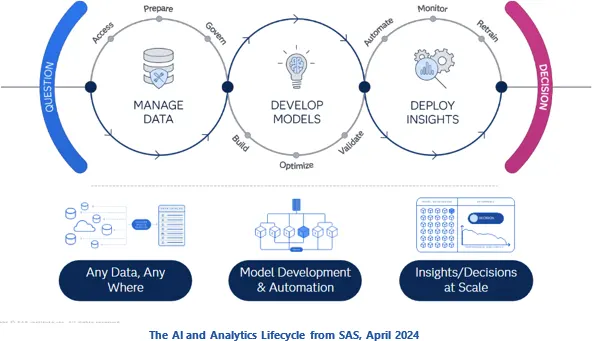
The “AI and Analytics lifecycle” is a critical framework that guides the transformation of “good enough” data into insights and actions for each Industrial AI use case. It involves:
This lifecycle is essential in the industrial sector, where timely and accurate decisions can significantly impact production efficiency, safety, sustainability, and profitability.
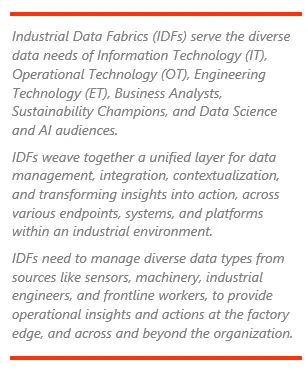
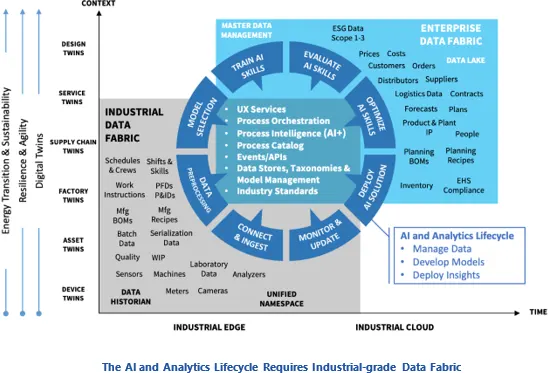
Data fabrics can simplify the AI and Analytics lifecycle for enterprises by weaving together a unified layer for data management and integration across some of the endpoints within an industrial environment. However, existing enterprise data fabrics may not be “industrial grade” enough for many Industrial AI use cases. They often require a “big bang” approach of migrating and standardizing data in cloud-based data lakes and may not handle the complex data types encountered on the industrial edge—data that is often unstructured, time-sensitive, and critical for real-time decision making in industrial AI use cases.
According to ARC Advisory Group, a new category of industrial-grade data fabrics will eventually emerge to meet the unique needs of industrial settings, and software alliances are already being forged to bring them to fruition. They must support the full AI and Analytics Lifecycle to unlock the full scope and value of Industrial AI use cases. They will need to go beyond traditional enterprise data fabrics, which are optimized for cloud environments, to embracing industrial data, developing models and deploying insights that can operate effectively on the factory edge or the enterprise cloud.
However, industrial organizations don’t need every sensor, machine or factory to be connected, nor do they need perfect data quality, nor to wait for the emergence of comprehensive Industrial-grade Data Fabrics, to realize value from AI. In a survey of 525 industrial organizations in ARC’s January 2024 Report on how Leaders Are Embracing Industrial AI, ARC found the respondents had already been realizing value across a wide range of 25 Industrial AI use cases, with predictive maintenance and quality management as the leading use cases.
Breakthroughs in Gen AI have expanded the Industrial AI toolset - especially for use cases that address the sector’s skills gaps by enhancing knowledge retention and transfer and augmenting the workforce with “Assistants” and “Copilots” - and promise to have a sweeping impact on the way users across every industry interact with complex technology. Although perceived itself as an expensive AI solution, the wave of investments triggered by Gen AI is driving innovation and lowering costs across the broader AI landscape, offering new opportunities for scale deployment of tried and tested AI modeling techniques trained on each organization’s own industrial datasets.
Compiling insights from many leading industrial organizations and their technology suppliers, here's a framework to guide industrial organizations to avoid the waiting game and make progress:
By following this decision framework, industrial organizations can make informed choices about which AI approach will best serve their strategic goals and operational needs for each Industrial AI use case.
The industrial sector’s prioritization of AI as its most impactful technology over the next five years, has shone a spotlight on the Industrial AI and Analytics Lifecycle. Value realization needs effective governance of data and AI. Industrial leaders aren’t waiting for completion of digitization and digitalization efforts, perfect data, or Industrial-grade Data Fabrics. Leaders are making progress with tried and tested technologies and approaches such as the AI and Analytics Lifecycle, realizing incremental value one use case at a time. Industrial leaders aren’t blindly following the Gen AI hype, they are adding Gen AI to their Industrial AI toolbox and working with their industrial software ecosystem – partners with industrial-grade data scientists who understand Industrial AI use cases - to achieve business value safely and securely. One such partner working with industrial leaders that are using AI to accelerate transformation is SAS.
From the edge to the cloud, SAS Industrial AI capabilities help organizations integrate data from various sources, apply sophisticated algorithms, deploy models at scale and deliver actionable insights, driving faster, smarter, more efficient, and more predictive industrial operations. Powered by SAS Analytics for IoT, organizations can expect a world-class experience across the AI and Analytics Lifecycle, including the most breadth and depth in analytic modeling capabilities as well as unparalleled design time scalability and performance across the run time landscape.
SAS capabilities accelerate results in areas such as:
Predictive Maintenance: By analyzing historical and real-time data from equipment sensors, SAS Industrial AI predicts when machinery is likely to fail. This helps in scheduling timely maintenance, minimizing downtime, and reducing unexpected repairs.
Product Quality: The AI models can detect anomalies and defects in products by analyzing images and sensor data. This enhances product quality and reduces waste by identifying issues early in the production process.
Operational Efficiency: SAS Industrial AI provides insights into production processes, identifying bottlenecks and inefficiencies. It helps in optimizing workflows, adjusting schedules, and improving overall operational efficiency.
Energy Optimization: By analyzing energy consumption patterns, SAS Industrial AI identifies opportunities for reducing energy usage and costs. It helps in optimizing energy consumption based on operational needs and predictive analytics.
Worker Safety: The AI tools help in monitoring compliance with safety regulations by analyzing data from various sources. It can predict potential safety hazards and ensure that operations adhere to industry standards and regulations.
Process Optimization: Through advanced analytics, SAS Industrial AI helps in fine-tuning industrial processes to achieve higher efficiency and better outcomes. It can simulate different scenarios to find the most effective operational strategies.
Advanced Analytics and Reporting: The platform provides robust analytics capabilities, offering detailed reports and visualizations. This enables decision makers to understand trends, make data-driven decisions, and track performance against key metrics.
With a rich legacy in data management, analytics, and AI, both at the industrial edge and in the cloud, SAS is uniquely positioned to help industrial organizations unlock the full breadth of Industrial AI use cases.
Here are some actionable recommendations for organizations to start reaping immediate and future-proof returns from their investments in Industrial AI with SAS:
By following these recommendations, organizations can not only start realizing immediate returns from their Industrial AI initiatives but also ensure that their investments remain future proof. SAS, with its rich heritage and customer-centric approach, is an ideal partner for this journey.
ARC Advisory Group clients can view the complete report at the ARC Client Portal.
Please Contact Us if you would like to speak with the author.
Obtain more ARC In-depth Research at Market Analysis