Representative End User Clients







Representative Automation Clients







Representative Software Clients








Declining natural gas prices and environmental concerns mean we could witness increased competition between coal,  fuel oil, and natural gas as the primary fuel choice for power generation. Although still more expensive than coal and oil, natural gas combustion creates less greenhouse gas emissions and emits less sulfur than either coal or fuel oil, so is generally considered to be more environmentally acceptable. LNG Transport Market to see an uptick, because natural gas-fueled plants can also be operated with more generation flexibility than either coal- or oil-fueled plants, which make them better suited to meet peak demand and/or pick up the shortfall from renewable power generation when the sun isn’t shining and/or the wind isn’t blowing.
For the above reasons and more, according to a recent report prepared by ExxonMobil, global demand for natural gas is expected to double by 2040, more than for any other kind of fuel.
This is likely to have favorable impact on the midstream oil & gas sector, particularly on the segment that supports the extensive and capital-intensive LNG supply chain, which encompasses natural gas processing, pipelines, tank farms, LNG liquefaction/shipping terminals, LNG carriers, and – finally - LNG regas/receiving/distribution terminals.
In particular, large, seaborne LNG carriers, which provide a relatively economical solution for transporting natural gas in highly compressed liquefied form across oceans should experience strong business tailwinds following several years of extreme instability.
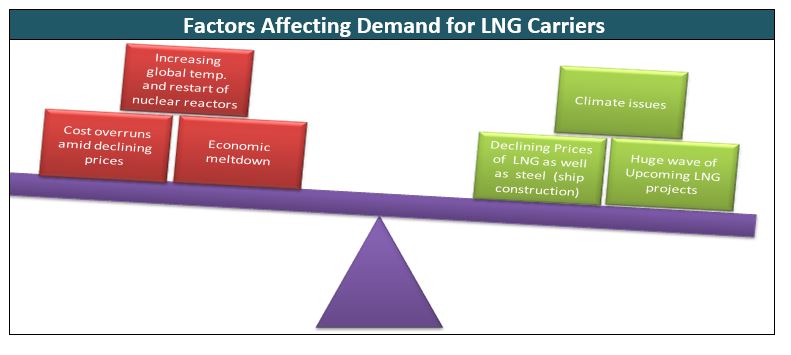
A huge wave of upcoming LNG projects across Oceania and North America is likely to increase future demand for LNG carrier capacity. The shale gas revolution in the US has completely upturned the natural gas supply scenario. The US, which used to be one of the largest importers of LNG, is now actively converting its receiving (re-gasification) terminals into exporting (liquefaction) terminals. At least four LNG export terminals with a combined capacity of more than 6 Bcf/d are under construction and expected to be fully online by 2021. Once completed, these projects, along with seven LNG projects in Australia expected to come online by 2020, will almost certainly push the demand for new LNG carrier capacity.
Despite many positive factors, market headwinds such as the economic slowdowns in China and some European economies, restart of some nuclear reactors in Japan, and regular cost overruns for many LNG megaprojects, against a backdrop of volatile energy prices, results in delays in the scheduled start dates for LNG projects. These, in turn, are likely to delay the demand for new LNG carrier capacity.
Major players in global LNG carriers market include Asian companies such as Samsung Heavy Industries, Daewoo Shipbuilding & Marine Engineering Co., Ltd, Hyundai Heavy Industries Co., Ltd., STX Offshore & Shipbuilding Co., Ltd., and others.
Significant changes in the LNG sector over the past decade have affected LNG shipping, particularly in the Pacific Basin. The LNG shipping sector, like most shipping markets, is cyclical in nature and 2015 marked a new highpoint for overcapacities in tonnage. Estimated average spot charter rates fell to as low as ~$20,000/day for steam vessels and $27,000/day for dual-fuel diesel electric (DFDE) and tri-fuel diesel electric (TFDE) tankers in 2015 as LNG shipping demand declined. The continuous wave of newbuilds hitting the market in 2016 pushed the LNG shipping market deeper into a period of overcapacity. This is likely to continue the current trend for spot charter contracts in the near term, as opposed to the long-term, fixed-rate contracts more typical of years past. The charter market has evolved into a clear two-tier market, with older steam vessels competing with generally larger and more efficient newbuilds. However, with today’s lower oil prices, the cost spread has narrowed, diminishing the competitive advantage of the more fuel-efficient vessels.
Several evolving developments, including new onshore liquefaction capacity, floating LNG (FLNG) projects coming online, and the uncertain future for LNG demand in Europe and Asia could have a significant impact on the LNG shipping market.
FLNG projects utilize various development concepts, each with certain advantages. In terms of project economics,  smaller-scale FLNG projects, including those based on barges or vessel conversions, have lower cost structures and the potential to be diverted to other markets. As a result, FLNG projects in Cameroon and Equatorial Guinea based on the vessel conversion concept have made commercial progress; Cameroon FLNG reached final investment decisions in 2015, with startup scheduled for this fall. Numerous other floating proposals, especially those in North America, have yet to find buyers and are longer-term opportunities. The commissioning and operational timelines of the several larger FLNG vessels under construction will set benchmarks as to the scale and pace at which FLNG could progress.
Europe’s LNG imports are poised for a second year of growth following several years of decline from 2011 to 2014. Europe’s role as a key backstop for excess cargoes in the global LNG market is likely to expand as other consuming regions are unable to absorb new demand as quickly as supply is being added. Preparing for the influx of LNG into the market, several European utilities and aggregators sought direct and re-contracted volumes from US LNG off takers in  2015 to lock in expected deliveries for the coming years.
The introduction of US-produced LNG in 2016 marks the launch of another supply source for Europe; given that the Pacific Basin is better balanced in the second part of this decade and US LNG is regarded as highly flexible. It will be interesting to see how the market reacts. Will supply continue to flow at unhindered rates, or will a low oil price see reduced deliveries? Will gas demand rebound due to low prices?
EU policy formation regards energy security as a cornerstone and is expected to call on more gas and LNG. New policies by the European Commission will address the role of LNG in helping to meet EU energy security. The final strategy document is anticipated to call for expanded use of LNG, particularly in eastern and southern Europe, where markets are less diversified. This may require new import terminals, pipeline connections and a diversified portfolio of sellers.
Japan and South Korea, the world’s two largest consumers of LNG, reduced their imports by 7 MT in 2015. This decline offset all growth from the rest of the Pacific Basin, leading to the first year-on-year fall in Asian LNG demand since the 2009 recession. How these major markets develop is critical not only for short-term oversupply, but also for LNG projects seeking long-term contracts to underpin new development projects. Overall, it appears unlikely that demand in this region will fully recover in the near term.
Japanese buyers face great uncertainty in assessing their LNG needs. While uncertainty about the nuclear power plant re-starts depends greatly on regulatory and legislative issues, weakening electricity consumption growth remains a chief structural threat to LNG demand in the years to come. Japan is increasingly focused on improving energy efficiency. The reduced LNG demand is also due to weak manufacturing growth. Moreover, solar power continues to expand in  Japan. In response to the near-term LNG oversupply, Japanese buyers have resorted to re-selling LNG volumes both domestically and internationally to reduce their individual exposure.
Following rapid growth through 2013, expectations for South Korea’s LNG demand have been reset. The Ministry of Trade, Industry and Energy’s 7th Basic Plan for Long-term Electricity Supply and Demand, published in July 2015, confirmed the favored role of coal in meeting incremental electricity needs over the next five years. With power consumption growth below expectations, and high nuclear availability, utilization of gas-fired generation plants is expected to continue to fall. In addition, economic growth has slowed more than anticipated, further impacting overall power demand. These factors suggest that the decline in South Korea’s LNG imports in 2015 is unlikely to be reversed over the next six to eight years.
Taiwan provides a bright spot for LNG demand in Northeast Asia – but not enough to offset the weak outlook for Japan and South Korea. With less reliance on nuclear power, Taiwan plans LNG imports to drive growth in its power sector.
LNG contract ramp ups are already in full swing for China. However, this occurs at a time when natural gas demand growth has been significantly weakened by broad macroeconomic challenges as well as reforms that have increased local gas prices. As a result, China’s national oil company (NOC) buyers will need to employ several different strategies to minimize their exposure to potentially large financial losses if enough local demand cannot be created. In response, the National Development and Reform Council has already lowered domestic wholesale prices to encourage increased demand.
It’s been reported that the Chinese NOCs have limited their gas production at several major conventional fields in the past year to help balance supply and demand. In terms of pipeline imports, China imported noticeably less from its Central Asian suppliers. However, contractual and financing terms will prevent such extreme deferments from occurring in the future.
India’s LNG demand has fared relatively well despite general economic weakness in Asia. The underutilized gas-fired power sector saw much improved performance in 2015 on the back of subsidies for LNG imports. Although how long this can be sustained is a major uncertainty. Nevertheless, in a low short-term price environment, Indian consumers have absorbed additional volumes from the global LNG market.
The large ramp-up of US volumes (which requires more shipping tonnage per ton of LNG delivered because of the longer distance from markets), plus the new LNG liquefaction projects coming on line in Australia and Africa, may eventually help balance the current overcapacities in the global LNG shipping market. However, these factors are not expected to outweigh the large number of ship deliveries through the second half of 2017. In the meantime, some vessels could be used for alternative uses such as floating storage.
If you would like to buy this report or obtain information about how to become a client, please Contact Us
Keywords: LNG Carriers, Carbon Emissions, Oil Prices, Climate Change, Floating Liquified Natural Gas (FLNG), Oversupply, ARC Advisory Group.