Representative End User Clients







Representative Automation Clients







Representative Software Clients








Keywords: Digital Twin, Machine Learning, AI, LTTS, PdM Digital Twin, Plant Digital Twin
A digital twin is a dynamic virtual representation of a physical entity using real-world data synchronized from multiple sources. The nature of a digital twin tends to change as the target asset scales up from small equipment level models to large models that can represent a plant, a campus, or even a city. Small digital twins are often an algorithm for predictive maintenance (PdM), equipment operating performance (operator guidance), and/or energy management. Plant or city twins usually involve an enterprise application for information sharing, business process automation, and collaboration using a 3D model as the user interface and navigation.
Many providers tend to focus on one type of digital twin or another. For example, many engineering software companies tend to focus on plant level digital twins, while others tend to focus on digital twins for assets and predictive maintenance applications. L&T Technology Services (LTTS) is one engineering provider that is combining its expertise in engineering with its considerable software expertise to offer a wide range of digital twin capabilities that can address everything from asset level predictive maintenance applications to modeling entire process plants and facilities. Most recently, the company is driving its expertise in AI and machine learning with advanced techniques like physics informed neural networks and reduced order models to speed the deployment of digital twins and achieve return on investment faster.
Digital twins are not simply 3D models; they are dynamic, data-rich replicas that capture the behavior and characteristics of the physical asset. They rely on real-time data streams from sensors, IoT devices, and other sources to maintain their accuracy and reflect the current state of the physical asset. Digital twins are used for various purposes, including:
Types of Digital Twins:
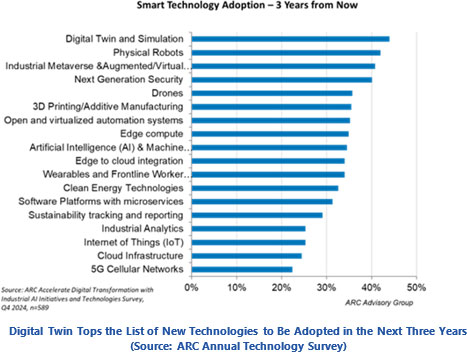
Many end users are adopting digital twins today, and the market for digital twin software is growing rapidly. According to the recent annual ARC technology survey, digital twins topped the list of new technologies to be adopted over the next three years. End users, however, still face challenges deploying digital twins. Most of these challenges involve poor data quality, lack of in-house expertise, and lack of ability to internally support the digital twin model in the long term.
AI is transforming the world of digital twins just as it is for most domains of industrial software. To achieve the desired model accuracy, plant data is used to calibrate these digital twin models to observe plant conditions and performance. Since effective model calibration requires considerable process expertise, AI and machine learning are built into the solutions and can help accelerate the ability to calibrate first principles models and create data-based models and processes quickly. AI has the potential to lower the expertise bar needed to model process systems. However, human domain expertise is still needed to create the real-world “guardrails” that make the models work safely and reliably.
Machine learning can automate the building of diagnostic models for data analysis. It is a branch of artificial intelligence where systems learn from data, identify patterns, and make assessments with minimal human intervention. Machine learning algorithms build a mathematical model based on historical data without being explicitly programmed. There are several types of machine learning including neural networks, decision tree learning, support vector machines, regression analysis, Bayesian networks, and genetic algorithms.
Digital twin applications deployed in industrial plants by end users often focus on one or a few instances of a piece of equipment. With a small number of machines, an acceptable business case requires relatively low development cost, for which machine learning helps. High-quality historical data can help augment the effort and shorten the training period, but this data is not always available.
L&T Technology Services (LTTS) is a leading engineering firm from India that offers a wide range of engineering capabilities across industrial, manufacturing, and critical infrastructure applications. LTTS is unique both in terms of its scope of engineering expertise and its substantial software business, which sets the company apart from more conventional engineering firms. In addition to these capabilities, LTTS has been developing a considerable business around industrial AI and its impact on industrial applications.

The combination of this engineering and software expertise has resulted in a burgeoning digital twin business for LTTS, which provides both software and services to implement a total solution across multiple industrial and critical infrastructure segments. LTTS’ digital twin and AI solutions businesses are part of the company's Digital Manufacturing Services business unit. In 2022, LTTS established a digital twin center of excellence in collaboration with partners such as Microsoft, Bentley, and Ansys.
LTTS offers digital twin solutions across various industry verticals, including automotive, consumer goods, food and beverage, oil and gas, as well as critical infrastructure and buildings. The company develops solutions based on specific customer requirements, leveraging reusable configurable products to implement these solutions effectively. The LTTS framework facilitates user interface customization, whether commercial or non-commercial, utilizing platforms from partners like Altair, SYS, NVIDIA, Microsoft, and Bentley. LTTS adopts an end-to-end solution methodology, defining problems, implementing DMAIC approaches, and demonstrating ROI through integrated predictions and actual field behavior.
In the engineering domain, data can be complemented with existing equations and models derived from various technologies, such as computer engineering system-level models. Physics Informed Neural Networks (PINN) used by LTTS are highly effective for addressing industry challenges and can provide insights into the behavior of systems and components across different sectors.
One benefit of these models is their ability to compensate for the lack of historical data by running various scenarios and generating outputs. These models are thoroughly correlated before being used to predict outcomes. For instance, a Multiphysics model of a drive system can be converted into a physics model, verified with actual drive system data, and subsequently utilized to predict outcomes based on real-time data. This approach can function as a virtual sensor, especially when physical sensors are limited or unavailable.
Reduced order models (ROMs) offer instantaneous output with the same fidelity as physics models, allowing for precise determination of output locations even without sensors. ROMs can simulate parameters that are difficult to measure directly, such as electromagnetic forces, by interpolating conventional measurements.

In cases where sensor data deteriorates over time or due to noise, the ideal behavior predicted by fixed models can be compared with real field data to ensure accuracy. Large-scale infrastructure projects, such as airport baggage handling systems, benefit from this approach by using minimal sensors combined with Multiphysics models to manage vast volumes of data efficiently and cost-effectively.
A good case study illustration of how LTTS can provide real economic value with its digital twin solutions is with a wind farm operator who owns several types of gearboxes from various vendors, but lacks complete design details, as the vendors supply them according to specifications without providing drawings or detailed information. All of these gearboxes need to be tested and certified for certain operational cycles. Due to the different designs, despite having the same specifications, some gearboxes fail much earlier than expected cycles. The absence of design details makes it challenging to identify the exact cause of these failures.
To address this problem, LTTS employed a digital approach where data is continuously collected from strain gauges mounted on the pinions and vibration sensors on the gearbox body. Additionally, torque sensors serve as a redundant data acquisition system. Strain gauges are prone to damage due to deteriorating oil conditions and other external factors, which can lead to failure at any time. However, the system ensures continuous data collection. In the event of strain gauge failure, data can still be obtained from the torque sensor, allowing LTTS to correct and validate the numbers.
Through this asset level digital twin, LTTS can identify potential weak points in the design where crack initiation typically starts, even if it is not feasible to place a sensor directly at those locations. Instead, LTTS use correlation techniques to predict crack initiation accurately based on sensor data from between the gear teeth. This method has shown a predictive accuracy close to 90 percent, matching the actual failure cycles observed.
The data collected from multiple gearbox tests were used to create predictive models, enabling the customer to significantly reduce testing time by approximately 75 percent. These models provided certification accuracy close to traditional methods, benefiting the customer by streamlining the testing process while maintaining high reliability. The models allow early prediction of gearbox condition, identifying whether a gearbox is in good working order or showing signs of potential problems.
Many end users view the world of digital twins as overburdened with complexity that makes long-term sustainability of digital twins even more of a challenge. Despite the considerable implementation effort, end users find that many digital twins are ultimately not sustainable or not valuable in operations and maintenance. LTTS has taken high fidelity multi physics models and are using them in the process industries in a unique way to make digital twins easier to implement, more sustainable, and able to produce a significant return on investment. LTTS also features many use cases across the digital twin spectrum that could not be included here.
The digital twin can also be used for process changes, and integration between PLM, automation systems and MES, facilitating a smooth transfer of virtual product and production information from the design and engineering departments to manufacturing operations. This enables operators to monitor and simulate equipment and processing lines and generate operational predictions based on different simulation scenarios. Digital twins can enable better and faster process set up times by showing causal relationships and removing potential bottlenecks and other obstacles prior to startup.
LTTS’ use of multi physics simulation and data from the manufacturing line can help end users determine that performance is according to specifications, and how the systems are performing. In addition to creating a digital twin of the production process, LTTS can also create virtual models of the material being produced, which can be quite valuable in processes for industries like consumer goods.
ARC Advisory Group clients can view the complete report at the ARC Client Portal.
Contact Us if you would like to speak with the author.
Obtain more ARC In-depth Research Market Analysis.