Representative End User Clients







Representative Automation Clients







Representative Software Clients








OPC UA is a vendor-independent communication protocol designed for industrial use. TSN (time-sensitive network) is a 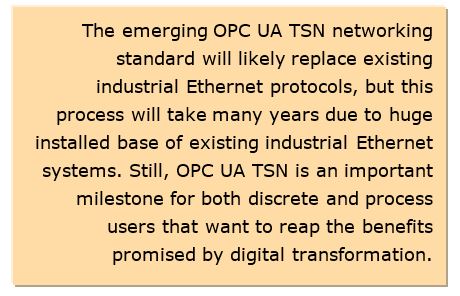 further development of the IEEE Ethernet standards. Together, they aim to offer the first truly vendor-independent real-time, deterministic Ethernet communication standard. As the technologies receive increasing media attention, experts in the automation arena are asking: Will OPC UA TSN supersede existing industrial Ethernet networks?
It's widely believed that the market will decide whether OPC UA TSN will replace existing industrial Ethernet fieldbuses. But this raises the question: Who are the market participants and why would they switch from industrial Ethernet to OPC UA TSN?
In automation, there are three types of market participants: 1) suppliers of automation and drives equipment, 2) machine builders for factory automation and equipment suppliers for the process industries, and 3) end users. The automation suppliers that developed today’s variety of industrial Ethernet fieldbuses began their developments by seeking to implement a standard protocol. But when it came to time-critical applications like high-speed motion control using servo drives, they developed the solution beyond standard Ethernet and often made hardware modifications to automation and drive devices to achieve the required reliability and robust, real-time performance. Furthermore, these suppliers often followed a proprietary strategy, adding to the burden of machine builders that were forced to adhere to the differing requirements of their end users. Dealing with many different fieldbus protocols turned out to be a real problem, even with the various groups of suppliers supporting certain “standards” like Profinet, EtherNet/IP, SERCOS, Powerlink,  EtherCAT, and CC-Link IE.
Automation suppliers must follow major trends, thus will almost certainly implement OPC UA TSN Ethernet-based protocols. However, due to the huge investments and the large installed base of the existing industrial Ethernet fieldbuses, these systems will remain in place for many years to come. We expect that automation suppliers offering fast servo drive applications will test whether OPC UA TSN fulfills today’s requirements for hard-real-time servo drive applications. These include requirements for safety, robustness, maximum cable length, and number of connectable drives. Once OPC UA TSN has been tested successfully and safety features are approved by the appropriate authorities, implementation will take place in parallel with the development of new series of devices – an incremental and evolutionary process that will follow the pace of acceptance.
Machine builders for discrete automation and suppliers of process automation equipment are in somewhat different positions in respect to OPC UA TSN.
Machine builders typically focus on machine functionality, e.g., fast machine reaction times. If we view a production machine as a functional island and consider the current lack of automation and drives offerings with OPC UA TSN, it’s clear that machine builders have little if any reason to rush into replacing their current industrial Ethernet-based fieldbus systems.
To meet the data communication requirements of IIoT/I4.0 and deliver data from the machine to an upstream IT architecture, machine builders are adding new sensors and extracting more data from controllers and drives and delivering these data to the IT network via gateway or edge computer. Ultimately, this could be accomplished via an OPC UA TSN interface built into the PLC or IPC. Using a standard protocol to achieve interoperability would help to reduce engineering costs to a significant degree.
The market for production machines with discrete automation is highly fragmented, as is the end user customer base. Except for automotive and a few other special segments, strict requirements from end users to machine builders are rare, so implementation of OPC UA TSN will only begin after the major automation suppliers offer a substantial portfolio of enabled products.
Equipment providers for process automation supply a market that includes large end user organizations such as BASF, Bayer, Dow Chemical, ExxonMobil, Shell, and others. Compared to the discrete automation market, the number of suppliers of DCS and process automation sensors and actuators is much smaller.
 Both the process industry and the discrete manufacturing industry need real-time performance, but “real-time” in these industries has different meanings with more demanding performance requirements in discrete machine control. In the process industries, while performance requirements are not quite as demanding, 24/7 availability and high bandwidth are needed for nonstop, round-the-clock operation and to collect and analyze large amounts of process data.
Considering that the process industries never really had a process fieldbus solution with adequate bandwidth, the technical package offering by OPC UA TSN over Ethernet should be extremely attractive to process users. Also, end user companies and industry consortia like NAMUR typically have much more influence over their suppliers than their discrete counterparts. For these reasons, suppliers in the process industries will feel more pressure from end users to migrate as soon as possible to a vendor-neutral Ethernet protocol like OPC UA TSN.
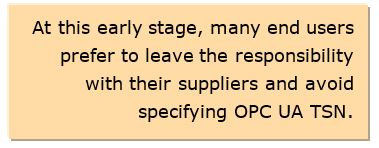 The third part of the market, end users, would benefit the most from a seamless, common Ethernet protocol based on industry standards. The extreme variety of today’s industrial fieldbuses requires a costly, customized communication network to collect and transfer data to upstream IT equipment. By adding OPC UA TSN as a bridge between fieldbus islands, users could make installations interoperable at a modest cost. However, those with production sites with discrete manufacturing equipment may be reluctant to urge machine builders to rapidly migrate to OPC UA TSN and risk failures or lack of reliability and robustness in their critical production machinery. At this early stage, it’s not surprising that many end users seem to prefer to leave the responsibility with their suppliers and avoid specifying OPC UA TSN.
OPC UA TSN is not the only technology threatening to displace existing industrial Ethernet protocols. The Object Management Group’s Data Distribution Standard (also enhanced by TSN), is widely applied in defense, healthcare machine connectivity and energy infrastructure (particularly in North America), but also extends into robotics and machine building. The OPC Foundation, FieldComm Group, and OMG are collaborating to establish DDS and OPC UA interoperability. Automation suppliers with worldwide sales will likely have to offer both communication standards in the future, either as two different protocols or as one communication software package if the OMG-OPC interoperability results in a seamless easy solution that can be configured to be compatible with either DDS or OPC.
OPC UA TSN likely will develop into a standard for real-time and vendor-neutral Ethernet communication protocol for the industrial manufacturing sectors. Key findings so far include:
Based on ARC research and analysis, we have the following recommendations:
If you would like to buy this report or obtain information about how to become a client, please Contact Us
Keywords: OPC UA TSN, Industrial Ethernet, DDS, Digitization, Profinet, EtherNet/IP, SERCOS, Powerlink, EtherCAT, CC-Link IE, ARC Advisory Group.