Representative End User Clients







Representative Automation Clients







Representative Software Clients








Industrial operations are at a critical junction. Manufacturers are focusing on digital transformation in the new normal, while adjusting the technology roadmap in response to the economic slowdown and turbulence caused by the  pandemic. One of the primary motivations for each company's technology investment during this period is the field of "information and data management.”
However, it is not easy to transform a plant that has been in operation for decades in Japan into a digitally driven organization. Information about the plant operation is often managed on a manual/paper basis, or with unstructured data, and optimized and operated differently, based on team or personal experiences. The following three points summarize the issues to be overcome.
Inheriting and optimizing the best parts of conventional operation systems. Understanding how to digitize, standardize, make resilient, and enable efficient collaboration with other departments to achieve a sustainable integrated system of entire plant operation management and unified management of operation data.
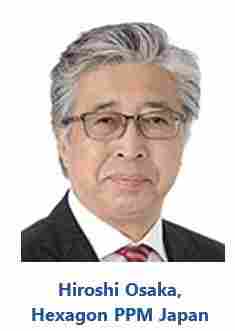 Focusing on these three issues, Mr. Hiroshi Osaka, Representative Director of Hexagon PPM Japan, c/o Intergraph Japan K.K., gave a presentation in the Japanese track of the 2021 ARC Asia Forum for manufacturing plants on the digital transformation journey. For Japan’s manufacturing industry, the company has j5 solutions covering the operation management area, and PAS solutions consisting of OT management, cybersecurity, and alarm management. In asset lifecycle information management area, it revolves around SDx solutions as a platform for various engineering data, in-house documents, etc. This ARC View gives an overview of his presentation.
Operation management carried out by the operation teams of the plant usually includes work instructions, operation log, shift handover and bulletin board posting for every shift change daily. It also includes issue list keeping, and troubleshooting, in addition to incident management and near-miss records, change management records, work permits, etc.
According to Mr. Osaka, the process of instruction and reporting this operation management is crucial “whether they are continuous processes or batch processes, or various kind of products such as monomer or functional chemicals. From the viewpoint of the business process of instruction and reporting, there is no difference. So, it will be important to digitize the data first, digitize the business process of instruction and reporting, and then shift to the digital transformation when each operation department is standardized. There is a huge merit in standardizing and unifying the whole operation of the plant, where it is possible."
In the flow of business transformation by “connected” data, close cooperation between departments, IT and OT, and internal and external collaborations are essential. Responding to this requirement in Japan, Hexagon PPM has successfully expanded its user base by deploying the j5 operation management solution.
j5 is a mission-critical system solution that controls the operation management of the process industry. Mr. Osaka said, "Human-centric data generated from manufacturing department has to be structured, integrated, accumulated, and expanded into business processes." Applications that can be built with j5 are targeted at tasks, such as management of operation, maintenance, and safety. j5 is usually built as a common system across the entire plant. Therefore, it is important to analyze the content of work thoroughly and unify it across operations. Unified information will lead to system integration, and then paperless operations; this will greatly contribute to operational efficiency. "We have received evaluations from companies that have actually implemented j5, the visible effect of it becoming apparent in about half a year," Mr. Osaka said.
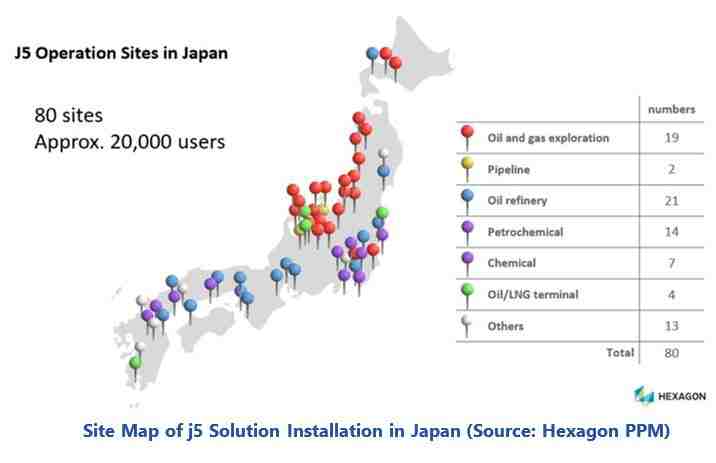
As for Japan’s domestic implementation of j5, there are 80 plant sites with about 20,000 users using j5 every day. (By industry segment, there are 21 oil refineries, 19 oil and gas exploration facilities, and 21 petrochemical/chemical facilities.)
The successful deployment of the j5 solution in Japan’s process industry can be attributed to:
Digital transformation holds great potential for increased agility, efficiency, and product innovation. Continually increased connectivity attracts hackers, expanding the possibility of OT attack surface and cyber threats more than ever. Often, the user company's site does not have a complete inventory of OT assets (asset composition table), which leads to inadequate change management, making countermeasure activities difficult.
Hexagon PPM acquired PAS Global in 2020 with the aim of expanding its business in the OT security area. PAS started its business with alarm management and is now one of the global leaders in alarm management and OT cybersecurity. PAS solutions have not been introduced in Japan so far, but Mr. Osaka plans to introduce it to the domestic manufacturing industry based on many overseas business experiences and achievements.
What is OT integrity, and why is it essential for plant operation? OT cybersecurity requires different measures from IT  cybersecurity. In other words, not only data protection, but also measures for process safety that do not allow the plant to stop operating are indispensable. Therefore, in addition to IT-focused cybersecurity measures, Hexagon proposes best practices that combine process safety and visualization of OT assets. This is the essence of OT integrity. By introducing OT integrity, each company can understand their own OT environment and visualize their OT assets. In addition, it will be possible to understand the vulnerabilities and take appropriate measures, such as applying security patches. Control system settings and change management will also enable OT integrity to be maintained.
Specifically, PAS OT integrity consists of three solutions:
PlantState Integrity is a set of solution modules that govern process safety. This includes alarm management, boundary management to manage safe operation limits, monitor modules that control loop performance, and independent protection layer (IPL) guarantees such as SIS. By linking with j5 operation management, these modules can report the current alarm status, DCS operation status, etc., to the operator on a daily basis.
Automation Integrity is a set of modules that govern the digitization of the automation domain. First, the configuration data of the OT area is collected, then the configuration management is established, and the sensor data management is also added to this.
After the OT area is digitized and visualized, the Cyber Integrity cybersecurity modules will function. This includes inventory management, change management, vulnerability management, and event analysis.
As a result, OT integrity from the sensor level to level 3 can be ensured. Achieving OT integrity not only protects OT from cyberattacks, but also improves control performance, alarm performance, human interface effectiveness and OT system resilience. This will improve the safety, reliability, and profitability of the plant, according to Mr. Osaka.
At the end of his presentation, Mr. Osaka introduced SDx Operations as a solution for realizing lifecycle information management of plant assets. SDx Operations works with SDx Projects for seamless handover from EPC projects. In the case of new plant construction, SDx Projects will be used to share information between EPC companies and owner-operator companies. When the project is completed, the information is passed from SDx Projects to SDx Operations. It also can be linked with various operational systems such as historian, CMMS, and j5. Owner/operator companies can view this information using a dedicated user interface.
However, the number of new plants being constructed has become rare in Japan, and most of the demand for asset lifecycle management is in existing plants, so preparatory work to start using the solution is indispensable. According to Mr. Osaka, the data necessary for asset lifecycle management is scattered in various places such as the equipment management department and the operation department without a standardized document management system. "The key to success will be how well data linkage and integrity can be realized," said Mr. Osaka.
Mr. Osaka’s presentation at the 2021 ARC Asia Forum made it clear that human-centric data generated from the manufacturing department must be structured, integrated, accumulated, and expanded into business processes. Unified information will lead to system integration to achieve OT integrity.
ARC Advisory Group clients can view the complete report at ARC Client Portal
If you would like to buy this report or obtain information about how to become a client, please Contact Us
Keywords: Plant Operation Management, Safety, Cybersecurity, Data Integrity, OT Integrity, Digital Transformation, ARC Advisory Group.