Representative End User Clients







Representative Automation Clients







Representative Software Clients








Industrial organizations typically use either enterprise asset management (EAM) or field service management (FSM) software to manage maintenance labor and materials and optimize work order  schedules. Smart maintenance approaches extend the scope of the EAM and FSM software to include real-time information from the assets. With well-managed business processes, the maintenance or repairs are performed on equipment when needed and before degradation occurs. These critical business processes include condition monitoring, predictive maintenance, managing alerts, and converting high priority alerts into work orders to execute the appropriate inspection, maintenance activity, or repair. This report covers the Scope of Enterprise Asset Management
In contrast, ad hoc or manual methods for managing alerts and the related business processes have proved to be problematic. Alerts get lost, and equipment fails as predicted.
Smart maintenance improves common maintenance metrics like uptime, mean-time-between-failures (MTBF), mean-time-to-repair (MTTR), and cost control. It also improves executive metrics like revenue, inventory and return on assets (ROA).
This report defines the scope of smart maintenance, illustrates its benefits, and provides three user case stories. Key findings include:
The key maintenance objectives involve uptime (especially avoiding unplanned downtime for critical 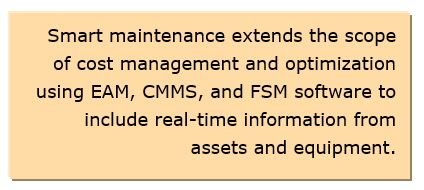 equipment), asset longevity, cost control, safety, and product quality (or yield). Improving equipment reliability avoids unplanned failures that negatively impact revenues, margins, and risk for the business, safety, and environment.
Today, industrial plants typically manage maintenance execution and operations for assets within a site using EAM or computerized maintenance management systems (CMMS) software. Increasingly, FSM software is used to execute maintenance services for assets at a customer’s site. These applications tend to focus on managing maintenance labor and materials and optimizing work order schedules.
Smart maintenance extends the scope of the EAM and FSM expense management and optimization to include real-time information from the assets. With smart maintenance, work is performed when needed and before the performance of the equipment degrades. This avoids performing work too early, before it’s really needed, which is often the case when preventive maintenance is performed based on a time interval or number of cycles. It also avoids performing the work too late. This is particularly relevant for the 82 percent of assets that have a random failure pattern and for which preventive maintenance has no benefit.[1]
The technologies associated with smart maintenance include Industrial IoT (IIoT), edge computing, analytics, mobility, and business process automation (BPA). Deploying IIoT, analytics, etc. does no good if lost alerts create a disconnect between the alerts and executing the repair. Hence, the need for BPA. The related business processes include asset condition monitoring, predictive maintenance, managing alerts, and converting high-priority alerts into work orders to execute an appropriate inspection, maintenance activity, or repair.
Smart Maintenance includes:

In the past, implementing predictive maintenance applications involved an expensive engineering project with custom software. The project interfaced with other systems (usually the historian) to obtain data, perform calculations, and deliver alerts. The data would be imported into a custom application. The analytics were typically first-order mathematical formulas and/or rules-based decision trees. This approach has been problematic for several reasons:
These more traditional predictive maintenance systems tend to be brittle, since changes in the technologies used in the custom software or an update to an integrated application often break the system. Since the original project team disbanded following completion, support involves gathering a new team for a new project. Due to the associated expense and organizational inertia, the predictive maintenance application often just simply “goes away” with the organization returning to the old practices and associated problems.
Using an IIoT platform for smart predictive maintenance provides several benefits that can help mitigate many issues of the past:
 With IIoT platforms, predictive maintenance applications have become easier to develop and support. Most of the development involves configuring or programming the IIoT platform that manages the connected devices, data acquisition, data management, and authorized users. The platform provides microservices, including many types of analytics. As a result, the application developers can focus on configuring the analytics and creating alerts – which is where the value-add occurs.
Existing maintenance practices generally include reliability-centered maintenance (RCM), corrective maintenance, planned maintenance, condition-based maintenance (CBM), and other practices. Smart maintenance goes beyond these. It involves the broad adoption of predictive maintenance (PdM) by collecting data from the machinery to forecast failures. Smart maintenance extends PdM to include the business process to convert an alert into the maintenance work order to prevent the failure. This business process extends across IIoT, predictive maintenance, generating an alert, and executing a work order.
Multiple reliability studies (starting with “Reliability Centered Maintenance” by Nowlan and Heap in 1978) have shown that only 18 percent of assets have an age-related failure pattern that resembles the traditional “bathtub curve”. The other 82 percent of assets have a random failure pattern.[2]
With preventive maintenance based on time or cycles, work orders are scheduled just before the frequency of failure starts to increase. This maintenance strategy is effective only for those 18 percent of assets with an age-related failure pattern. A predictive maintenance approach is needed for the other 82 percent.
Unplanned equipment failures are costly for both work-in-process and revenue and could be catastrophic for safety and environment. Predictive maintenance involves processes that analyze the condition of the machine and generate alarms when issues are detected. Newer sensors, data collection systems, data storage/transfer capabilities, and data analytic tools have lowered development costs and improved sustainability of PdM projects – particularly with IIoT and associated cloud platforms. Combining data collection, storage, analysis, decision, alerts, and business process automation provides smart maintenance - which enables a new level of equipment reliability.
Most change – particularly for mature markets like EAM – occurs organically by building on existing capabilities and adopting new technologies. Examining technology trends for the recent past provides a guide to a probable future. ARC Advisory Group has been researching the EAM area for over 25 years and is thus well-positioned to provide this perspective.
In the past, a CMMS supplier tended to focus on a niche to differentiate itself from other suppliers. To serve its customer base and remain competitive, each supplier deepened its capabilities for a type of asset. These solutions evolved into the current applications. These tend to focus on asset types, i.e., EAM for plant equipment, FSM, facilities, and fleet. However, nearly every business has a combination of these asset types. In the future, leading suppliers will offer one application that seamlessly manages all types of assets.
In the past, EAM focused on managing the resources within the maintenance function, including people, parts, and documentation. Now, the scope has grown to comprise managing the asset lifecycle, including financial aspects. In the future, IIoT-enabled remote monitoring and other capabilities will support asset optimization across both maintenance and operations to enable overall asset performance management (APM). Trade-offs, including parameters like equipment capability, asset health, energy utilization, and quality/yield, will be applied to meet production schedules with low risk and cost.

CMMS focused on managing maintenance resources and each plant (or sometimes even each department), could select its own software supplier. Now, a business unit will typically have a single instance on a corporate or hosted server that supports multiple plants. As equipment becomes increasingly complex, more maintenance will need to be outsourced (using IIoT and condition monitoring) to the OEM or a service organization specializing in that type of device. This trend will require increasing visibility into the capabilities and status of those external resources, which will need to be managed as an extended enterprise within EAM.
In the past, most maintenance was reactive. Schedules were typically established manually. This approach did not consider capacity and resource availability, and thus was only followed loosely, if at all. Now, scheduling assesses skills and parts availability and includes some analytics for optimization. In the future, scheduling will be automated and optimized using machine learning and cognitive computing.
The business process for executing work orders by the technician is undergoing a digital transformation. In the past, the process typically involved printing work orders, hand-written data entry by the technician when time permitted (sometimes at the end of the shift), and an administrative person entering the data into the EAM system. Data quality issues occurred for a variety of reasons including the technician not valuing the data (it is used by someone else), poor handwriting, timing delays, and more. These often caused supervisors to lose confidence in the EAM system, which then devolves into a record of what was done, rather than a proactive planning tool.
ARC’s research indicates that 50 percent of technicians now use a mobile device for work orders. This enables the technician to enter data while performing the work. The software provides pick lists, checks formats, and performs other data validation to help ensure data integrity. Since an administrative person is no longer needed for data entry, that source of errors is removed. The corresponding EAM system becomes a trusted planning and scheduling tool with higher productivity for all those involved. In the future, ARC expects that nearly all work orders will be managed via mobile devices.
As already discussed, prior to IoT, there was relatively low adoption of predictive maintenance. IIoT reduces project development costs and technology risks. An IIoT platform provides a sustainable IT infrastructure, and the development focuses on choosing services for building the application. Today, the under-served need for predictive maintenance has become the primary application of IIoT. With PdM, work occurs only when needed, which reduces maintenance costs while also improving reliability. In the future, these business drivers and further ease-of-use improvements will allow IIoT and PdM to become pervasive.
EAM, along with nearly all enterprise software domains, is migrating from an on-premises server to a data center (private or public) and – increasingly – to the SaaS model. This has improved IT resource utilization by outsourcing commodity IT skills (like desktop software and server maintenance) and focusing internal IT resources on core, value-adding applications to run the business.
Case study presentations by end users at the recent ARC Industry Forum in Orlando, Florida discussed smart maintenance implementations with IIoT, analytics, and other emerging technologies. As we learned, benefits obtained included reduced unplanned downtime, improved asset longevity, and reduced maintenance costs.
In her presentation “Making EAM and IIoT Work as One,” Katie Diesl, Director of Finance for Agriculture at Grimmway Farms focused on using IIoT to manage the mobile assets around its farms. Headquartered in Bakersfield, California, Grimmway Farms produces a variety of fruits and vegetables. It has become the largest producer of carrots worldwide.
Agricultural businesses are increasingly moving towards “precision farming” by using technology to improve the productivity of the land. Examples of the advanced technologies being applied include:
Precision farming allows farmers to derive greater yield from the land while reducing waste, optimizing labor, and helping sustain the environment. The business benefits include increased revenue and margin.
Technology doesn’t help if it doesn’t function properly. Grimmway Farms has over 100 maintenance 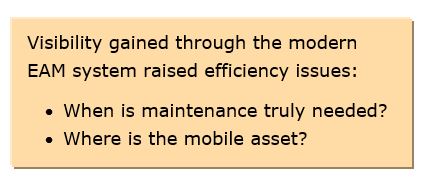 technicians to help keep the assets performing safely, reliably, and optimally. To manage its assets and technicians, Grimmway Farms implemented Infor EAM, a modern enterprise asset management solution, in 2008.
Using Infor EAM, the company identified some efficiency issues related to farming assets including planting, fertilizing and harvesting equipment, tractors, and pick-up trucks. First, they require irregular servicing due to the seasonal nature of the business. Time-based preventive maintenance will often result in over-maintenance because of inconsistent equipment utilization. A second issue relates to the fleet being mobile, in the outdoors, and located somewhere within the over 40,000-acre farm.
Technician time was being wasted doing unnecessary preventive maintenance. To improve maintenance efficiency, the EAM system needed to know each asset’s use measured in terms of miles and hours. Obtaining and managing this information was a manual and cumbersome process that required a high investment in labor to physically take the readings. Errors or missed readings with the manual process led to either over-service or missing services, which could put critical assets at risk.

With over 62 square miles of area, finding an asset is difficult. In the past, the technicians would call field crews to determine the location of the vehicles. Based on the manual logs each technician kept, they would try to locate equipment they believed might be close to needing service. Occasionally, they would arrive at the field location only to find that the vehicles had been moved, so the vehicle would not be serviced.
In other cases, when a technician came across an asset, they often would do maintenance whether or not it was scheduled. In addition to the obvious labor efficiency issues, this over maintenance drove up MRO spend for replacement parts, filters, and other materials.
Trimble GPS devices were deployed on many mobile assets to automate locating vehicles and capturing monthly meter readings. Grimmway Farms deployed the Trimble Vehicle Gateway 660 (TVG 660) in-vehicle hardware. This combines GPS and vehicle diagnostics with wireless cellular networking. It provides real-time location and other operating data to manage fleets. Grimmway Farms has connected 700 of its most critical assets, and more are planned. The information provided includes:
The preventive maintenance work orders are now generated based on the asset’s usage. Also, the 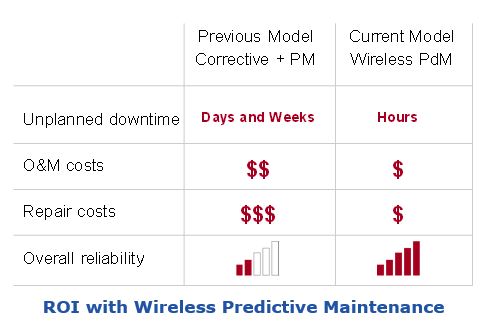 technicians can now easily locate the assets. When a technician goes to an area, they come prepared to service multiple pieces of equipment that need maintenance.
For operations, Grimmway has segmented each farm into blocks (about 80 acres each) which are identified in its ESRI application. Supervisors assigned to specific blocks manage the associated workers and assets. Integration with ESRI allows the equipment to be mapped to a block and the associated supervisor. This provides opportunities to re-allocate equipment to level the load or compensate for seasonal variations by crop. This data helps build a better asset rotation model and allocate equipment more efficiently. Improving asset utilization also reduced the number of rented assets.
The maintenance and operations groups now have more accurate visibility to actual equipment location and usage. The data provides objectivity and credibility for the actions that the analysis recommends. They are more informed, and better able to plan activities.
Benefits include improved maintenance technician efficiency and improved operations.
Technician efficiency improvements:
Operational improvements:
With this initial success, expansion of the program beyond the more critical assets is expected. Grimmway plans to include additional mobile assets, stationary assets, and rented equipment.
Readers can see a video of Katie Diesl’s presentation here.
Dan Arelano, Associate Director Maintenance, Stanford University Energy Operations delivered a presentation “Improving Uptime with Predictive Asset Monitoring and IoT.” The university has a central facility that produces energy for the campus and several city facilities, including Stanford hospital and Lucile Packard Children’s Hospital. Unplanned downtime negatively affects activities throughout the campus – particularly expensive research experiments and hospital operations.
The existing combined-cycle power plant was replaced in 2015 as part of the Stanford Energy System Innovations (SESI) project. Before SESI, the energy came from a 100 percent fossil-fuel-based combined heat and power plant. The daily pattern of energy expended for heating and cooling showed a 75 percent overlap – meaning concurrently some areas were being cooled while others were being heated. This indicated the opportunity to use heat transfer approaches to significantly reduce energy usage.
This new system has grid-sourced electricity and a more efficient electric heat recovery system. Along with Stanford’s 67-megawatt solar power generation, it has reduced campus emissions by 68 percent from peak levels. It also saved 70 percent of water used in the central plant by replacing evaporative cooling with heat transfer – which reduced campus-wide water use by 18 percent.
The control systems had the needed functions for operations. When process parameters exceeded control limits, an alarm would be generated. Initially, if the operators determined maintenance was needed, they would generate a work order. Depending on the operator, there was a lot of variability in these requests, and some issues were not properly addressed. Small problems would cascade into bigger issues.
The focus of the initial maintenance strategy was largely preventive and corrective (responding to the work orders). This approach may be adequate for a commercial facility, but at Stanford unplanned downtime can impact expensive research experiments. On one occasion, a Nobel laureate lost a month’s worth of expensive experimental work due to a temperature spike in the cooling water. Another time, the facility ran out of cooling water during a summer heat wave, causing surgical operations to be cancelled that day in the Stanford hospital. It became clear that unplanned downtime is not an option, and reliability had to improve.
The goals of the new system included:
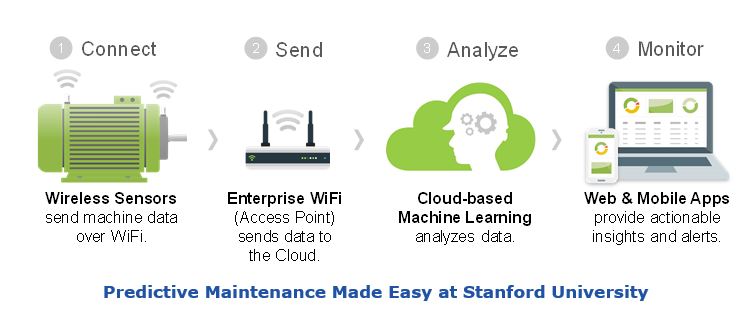
The system met these goals using the Petasense wireless vibration sensor and cloud system:
The solution covered the pumps, cooling towers, and other critical assets. The predictive maintenance identified issues and generated alarms with enough advance notice for the problem to be fixed before leading to costly unplanned downtime. Specific benefits include:
These changes have significantly improved overall system reliability.
Experience gained while implementing and using the system provided new insights. For example, rather than a massive project covering a wide range of equipment and integration of several systems, it can be more effective to keep it simple by focusing initially on the critical problem machines. Focus on the resulting quick wins and build incremental improvements over time. Involve IT early, particularly for help with security.
The successes with predictive maintenance were well-communicated and accepted. As a result, the SESI project will be expanded. Under consideration are:
Readers can see a video of Dan Arelano’s presentation here
Tony Howell, Global Enterprise Asset Process & Policy Manager, Global Manufacturing Engineering Integration at General Motors, delivered his presentation “Manufacturing Asset Management.”
GM has over 140 sites involved in the manufacture and assembly of automobiles that contain 40 million assets. An example of the asset-intensive nature of the automotive industry is an assembly line paint shop that costs $500 million, contains thousands of assets, requires upgrades every few years, and has an expected life of 35 years.
Across the company, the total annual operating budget for maintenance is over $1 billion. Currently, most of this maintenance is time-based preventive maintenance. The EAM application deployed at GM is IBM Maximo, and each plant had its own instance and standards. GM has been upgrading to a new version of Maximo and moving to a single instance for the company. In addition to IT infrastructure-related cost savings, this change to one instance provides an opportunity to move everyone to the same standards and best practices, including asset taxonomy, location hierarchy, policies, and processes. Objectives include:
During a major asset’s operational life, retaining or improving its performance requires both maintenance and upgrade programs. This can continue for decades, and involve considerable investment in dollars, time and resources.

Asset sustainment goes beyond daily scheduling of repairs managed with work orders in the EAM system. It involves extending an asset’s life from the perspectives of capability, uptime, and maintenance costs. The scope of this evaluation includes balancing the asset’s current condition with the organization’s future needs for the asset. For example, with a poor current condition and a long-term future, re-investment is justified to restore the asset’s capability and extend its life. Having the right information to make these decisions about repairs, refurbishments, and replacements can help extend the life of assets, such as getting 35 years from a paint shop instead of 25. For a company which spends over $7 billion a year in capital improvements, this can represent substantial savings.
Currently, GM has three independent applications that contain information needed for an asset’s sustainment program – SAP, Maximo, and an internally developed application, with limited integration between them. This has constrained GM’s asset sustainment program. The company has started to migrate to IBM Maximo Asset Health Insights, which includes:
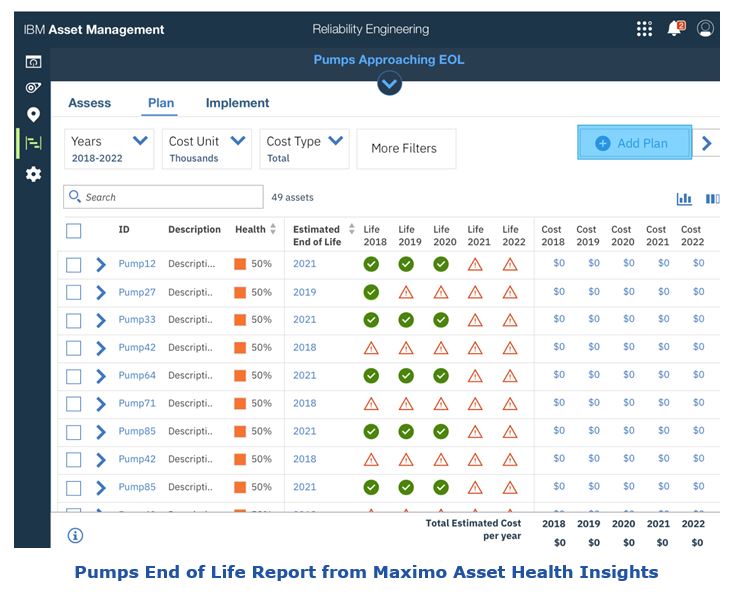
Readers can see a video of Tony Howell’s presentation here.
Technology adoption continues to have a huge impact on asset management software, including both EAM/CMMS and FSM. Control systems typically focus on process data for operations, and the data equipment was isolated. Now, IIoT provides easier access to equipment data needed for maintenance. As at Grimmway Farms, Stanford University, and GM, nearly the entire asset management space is now adopting predictive maintenance strategies utilizing the equipment data to lower costs and improve reliability.
As organizations assimilate these changes, they will see opportunities to optimize across maintenance and operations. This supports a business case focused on return on assets (ROA) that aligns with executive metrics i.e., higher revenue with less assets driving improved ROA.
Smart maintenance provides a means to significantly improve the key objectives of maintenance including uptime, asset longevity, cost control, safety, and quality (or yield). Based on ARC research and analysis, we recommend the following actions:
If you would like to buy this report or obtain information about how to become a client, please Contact Us