Representative End User Clients







Representative Automation Clients







Representative Software Clients








Sustainability has evolved into a systems view involving the interconnected impacts on environmental, economic, and  social concerns. The systems-based methodology of sustainability programs often exposes areas that were hidden from view for a variety of reasons including focused departmental KPIs, accounting practices, and information systems’ design. Sustainability has also become multi-dimensional requiring attention for clean air and potable water. While reducing carbon dioxide emissions gets attention due to global warming, humanity also needs clean water for its sustainability.
The goal of sustainability is to “create and maintain conditions, under which humans and nature can exist in productive harmony, that permit fulfilling the social, economic, and other requirements of present and future generations” per the U.S. National Environmental Policy Act. The approach is systems-based to include environmental, social, and economic impacts.
The systems-based methodology of sustainability programs often exposes areas that were hidden from view for a variety of reasons including focused departmental KPIs, accounting practices, and information systems’ design. Re- examining business practices with a sustainability lens often reveals opportunities for operational improvements. Government regulations and incentives become a factor when the environmental and social costs are not borne by the entity that causes them. For consumer products, the public’s heightened concerns about the environment have made sustainability a key component of brand management.
Organizations are finding that sustainability often makes for good business performance. Reducing emissions means reducing waste, and today’s consumers, B2B customers, and investors alike are rewarding green enterprises with improved shareholder value. Employing more efficient sources of energy aren’t just good for people and the environment, they are good business.
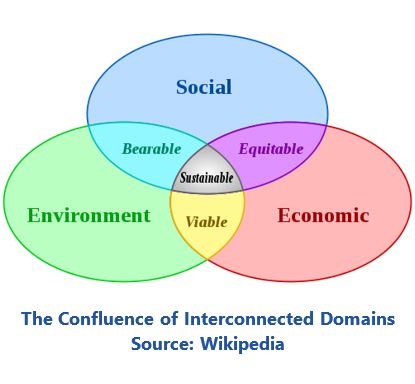 Sustainability no longer means challenging human aspirations. It has evolved to include the interconnected domains for environmental, economic, and social sustainability. Sustainability means a long-term vision for businesses, where they operate indefinitely without using resources faster than replenishment, all while not releasing pollutants into the atmosphere, soil, or water faster than nature neutralizes or removes them.
Sustainability is becoming more significant now, with increased public acceptance of the effects of excessive pollution, rapidly increasing greenhouse gases in the atmosphere, more severe natural disasters, and a scientific consensus that has developed over decades.
Carbon dioxide and methane capture thermal heat from the sun which has given rise to programs to reduce carbon footprint – by country, company, and related organization - ideally in ways that benefit each business. Approaches include direct emissions reduction to working with suppliers to reduce their footprint, purchasing carbon credits, creating offsets via carbon negative activities, and assisting customers in their efforts as they relate to use of products. Enhanced or new product designs are a key approach.
While much of the attention is being given to greenhouse gases, a growing crisis involves clean and safe water to sustain the growing global population. Water is critical for healthy ecosystems, economic development, and for human survival. Fresh water has become a finite resource – without a substitute - that is only renewable if well managed. The UN has identified a trend that if continued will have two-thirds of the world’s population living in water-stressed countries by 2025.[1]
Water sustainability means enough water to meet multiple needs, from agriculture to municipal and industrial. Achieving water sustainability involves effective and holistic management of water resources including:
More than half the world already lives in urban areas, and by 2050, it is expected that more than two-thirds of the global population of 9 billion will be living in cities. Water sustainability will be closely linked with the sustainable development of cities to support this growth.
L&T Technology Services Limited (LTTS) is a global leader in services for engineering design, product development, smart manufacturing, and digitalization. LTTS offers a consulting-led portfolio of business, technology and engineering services and solutions. LTTS is a publicly listed subsidiary of Larsen & Toubro Limited, a large Indian conglomerate operating in over 30 countries.
Recently, LTTS provided ARC a briefing on its range of engineering services for sustainability with a focus on energy and water. Case stories of customer engagements include:
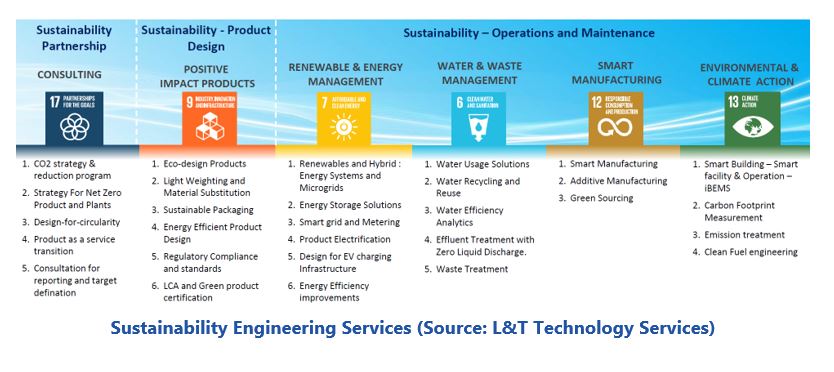
Endeavors for carbon footprint neutrality that help mitigate the well-publicized global warming problem tend to overpower other sustainability needs. While reducing carbon dioxide emissions is a primary concern, humanity also needs clean water. Sustainability is a multi-dimensional issue that requires attention for clean air and potable water. LTTS’ sustainability initiatives have gained traction and are making a difference in the world we live in.
ARC Advisory Group clients can view the complete report at ARC Client Portal
If you would like to buy this report or obtain information about how to become a client, please Contact Us
Keywords: Sustainability, Carbon Footprint, Water Treatment, LTTS, ARC Advisory Group.