Representative End User Clients







Representative Automation Clients







Representative Software Clients









The highlight of the October 2021 American Clean Power (ACP) sponsored offshore wind conference in Boston, Massachusetts, was the US offshore wind industry starting construction starting with the 800MW Vineyard wind project. Vineyard Wind LLC is one of many offshore wind development companies with projects moving ahead. Vineyard Wind is 50 percent owned by Copenhagen Infrastructure Partners (CIP) and 50 percent owned by Avangrid Renewables, LLC. The project will use 62 GE halide X wind turbines rated at 12MW each mounted with 1 mile spacing about 18 miles offshore of Martha’s Vineyard.
This project leads a series of offshore wind projects that includes 30 GW of offshore wind capacity by 2030. A ceremonial groundbreaking (for the cable) was held on Nov 18, 2021. The cost of building these wind projects is estimated at $109 billion to 2030 and the cost of this power is selling for about 7.5 cents per kw*hr. The first projects are fully financed and have met all the needed permissions and environmental impact assessments. These offshore wind projects follow the trail blazing Cape Wind project, which was unable to meet its schedule due to the resistance of developing a new industry in the ocean. Cape Wind complaints were often related to the location nearer to shore and cost. In the meantime, the costs of building and operating offshore wind power have dropped substantially. The location of Vineyard Wind, cost reductions, and lessons learned from Cape Wind and the offshore oil and gas industry have helped these new offshore wind projects to move forward.
The COP 26 conference in Glasgow just a few weeks ago shows how world leaders are pledging to reduce greenhouse gas emissions that have already warmed our planet’s global mean temperature by 1.09°C above the 1850-1900 average (based on 2021 data from January to September). The COP 26 target was to keep the warming of our planet from exceeding 1.5 degrees by 2100 and transition to a sustainable net zero energy system by 2050. Such a transition is technically complex, expensive, and politically challenging as it requires many changes that people will resist. It starts 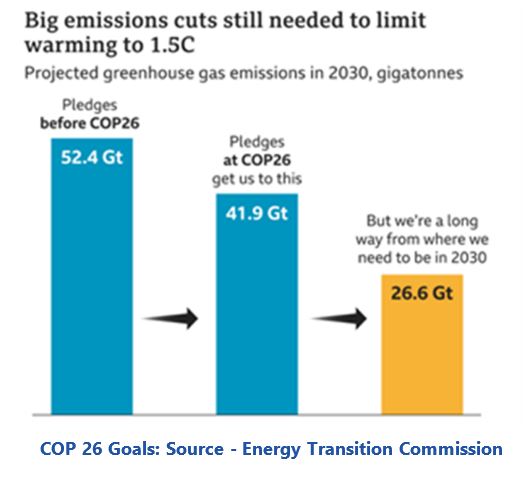 by first making electric power without making CO2 and then transitioning transportation, building HVAC, and industrial processes from fossil power to clean electricity. Some progress towards clean power has been made by switching from coal to gas power generation, but now it will be harder to find low carbon substitutes for gas. Much less progress has been made so far to decarbonize transportation, building heating and industrial processes in part due to so much fossil based electric power. The overall goal to get our total energy system to net zero carbon emissions by 2050 is challenging; and it is urgent that progress is made before 2030 as new greenhouse gas emissions are accumulating in our atmosphere and locking in warming temperatures in the future.
To get to low carbon electric power by 2030 will require new generation assets, but how does offshore wind compare? What are the realistic options? Carbon Capture Utilization and Storage (CCUS) technology is proven to collect most CO2 from fossil power plants, but it adds significantly to the capital costs and also requires more gas consumption than traditional combined cycle gas power plants. A price of roughly $100/metric ton of CO2 would be needed for natural gas to make CCUS economically attractive. To stay within 1.5° C, the International Energy Agency estimates that we need to capture 350 million metric tons of CO2 per year by 2030. We currently capture less than 1 percent of what we emit annually.
Nuclear power is also a known scalable zero carbon option, but current nuclear designs like BWR, PWR CAN-DU, RBMK are hardly being built today due to concerns about cost and safety particularly after a drop in public support following the Chernobyl and Fukushima accidents. New advanced nuclear reactors like the Generation IV reactors, small modular reactor (SMR), and liquid fluoride thorium reactor (LFTR) designs promise passive safety and lower costs. While some of these reactors are progressing to demonstration installations, it is unlikely nuclear power will be able to provide significant capacity before 2030 due to the time needed to verify safety, obtain regulatory approvals, ramp up production, and handle site construction.
Solar, Wind, and Batteries (SWB) is the option that most US electric utilities are expecting for the bulk of new power generation in this time period. The cost of solar, wind, and lithium batteries has dropped so low it has become the lowest cost source of new power. Until clean generation is operational fossil fuel use will likely increase. The “IEA Oil 2026” report estimates that global oil consumption will increase to about 104.1 mbpd by 2026, which is up 4.4. million since 2019 (pre-COVID). It has been low natural gas prices that has made coal power and some nuclear power too expensive to operate. Now it is SWB that is pushing out natural gas in many locations.
Grid operator ISO New England is planning for offshore wind to be about two thirds of the new generation capacity by 2030. This amount of wind power is a whole new way to make power from the perspective of grid reliability. ISO New England is studying the reliability of the future grid under a range of scenarios in order to help the ISO; and stakeholders understand the implications for operations, transmission planning, and market design. Reliability risks during extreme weather events will be amplified with state limitations on carbon emissions. Electric power projections are also trending up with more EVs and more HVAC electrification with new winter consumption peaks due to building heating. To merge new offshore generation into the New England transmission system will require changes to the regional transmission planning tariff, including a new cost allocation methodology for improved transmission and ways to encourage needed grid energy storage.
ARC Advisory Group clients can view the complete report at ARC Client Portal
If you would like to buy this report or obtain information about how to become a client, please Contact Us
Keywords: Offshore Wind, Wind Power, American Clean Power (ACP), Electric Grid, Wind Turbines, Smart Grid, Sustainability, Net Zero, ARC Advisory Group.