Representative End User Clients







Representative Automation Clients







Representative Software Clients








While SCADA (supervisory control and data acquisition) technology has been around for quite a while, today's SCADA  systems are easier to integrate and provide improved capabilities and functionalities. More than ever before, today’s owner-operators use SCADA technology to help improve operations and link operations to business processes to improve business performance management and maximize return on existing capital investments in systems and assets.
However, data requirements are expanding, placing strains on the traditional SCADA architecture and technology. New technology advances promise not only to alleviate the strain but to change the way data is gathered.
When it comes to data in industries such oil & gas, water & wastewater, and electrical transmission & distribution, SCADA is king. It is responsible for nearly all dataflow from the field and into the enterprise. This has been the case for over half a century. SCADA has largely replaced manual data collection and remotely manned operation centers. SCADA applications reach over hundreds of miles to pull in data from far-flung assets. This has also helped reduce risk by reducing the number of employees needed in the field. SCADA applications have expanded as the need for data grows. Often, in the past, this expansion has been limited both by the network’s capabilities and operational costs.
Today’s ever-growing requirement for data has little to do with immediate operations themselves and more to do with ancillary needs as owner-operators look for new ways to reduce cost. Operations is the traditional “customer” of the SCADA system, but the customer base is expanding. SCADA data customers now include the organization’s accounting, reliability, optimization, supply chain, and business management groups, as well as external customers. As the customer base has expanded, so has the use of new technology.
To that end, SCADA suppliers continue to offer more flexible hardware with added intelligence, emphasizing total solutions by coupling hardware and software with service packages. Smarter “edge” devices can host applications that traditionally ran in a central location due to the required computing power. These newer devices allow more analytics and calculations in the field, but also generate more data. The higher computing potential also allows for better network connectivity and bandwidth support.
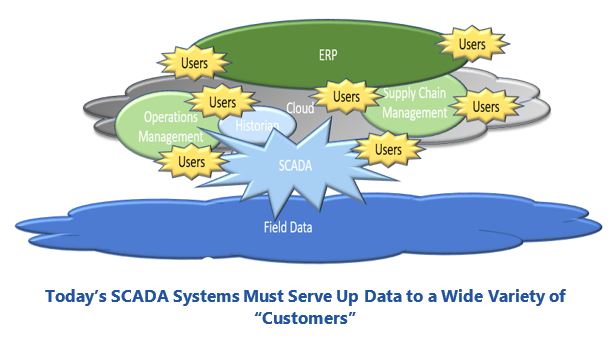 Additionally, suppliers are offering a wider range of web-enabled advanced applications and packaged solutions, particularly for users seeking to integrate SCADA with business and enterprise-level applications and supply chains. Beyond the traditional data gathering and control functions, the addition of business intelligence-enabled applications has enhanced the value of SCADA systems. These new applications give users better insight into the economics of their operations, easier ability to validate nominations and pipeline allocations, and tools to track carbon emissions, which aids regulatory compliance.
Many of the top SCADA suppliers offer a full suite of products and services, including remote terminal units (RTUs), networking technologies, and associated controllers. Service offerings cover hardware support, software applications, communications, and systems integration. Increasingly, suppliers are also moving toward open, industry-standardized technology, including standards-based RTUs, general-purpose PLCs, and third-party network infrastructures based on commercial information technology. This is partly due to the cost of hardware development, but mainly due to the more rapid technology advancement of off-the-shelf technology.
Another key technology advancement that is foundational to the SCADA application are networks. Initially reliant on  low-bandwidth networks like leased dial-up phone lines and other serial connections, SCADA has moved to microwave, radio, and satellite. Recent introductions of IP-based communications, both radio and cellular, have allowed for increases not only in bandwidth, but also communication flexibility. IP communications remove the “shackle” of dedicated point-to-point, master-slave communications.
Understandably, cybersecurity concerns continue to grow. Owner-operators have reported a number of breaches recently. The geopolitical climate has increased anxiety across all industries. Most critical infrastructure relies on SCADA technology, making the systems a prime target. Service providers, suppliers, and owner-operators are scrambling to improve gaps in cybersecurity to better protect these vital systems and their data.
With the expansion of Industry 4.0- and Industrial IoT-type approaches, the number of data customers continues to grow. Increasingly, customers are moving from people to machines as analytics play a larger role. Additionally, network bandwidth continues to expand. 5G connectivity is within sight. This begs the question: “Why continue to use the SCADA system to collect data that doesn’t relate directly to operations?”
Instead, applications have begun circumventing the SCADA system altogether and pulling data directly from the field. Some data continues to pass through the SCADA system because operations groups need that data as well. Cloud applications are going directly to the field in many industries. In some cases, this is done to circumvent cybersecurity concerns at the site, as operational technologists avoid the restrictions or limitations imposed by the enterprise IT organization.
The need to gather data will continue to grow. As such, the “DA” part of SCADA will continue, but be distributed across multiple applications and platforms. In many situations, it makes little sense to poll the field multiple times, especially where adequate power is an issue. The traditional role of SCADA in operating remote assets will continue but become more focused on its core purpose. This is partly due to the licensing costs, which most vendors still do by tag. Lifecycle costs will play a key role in the SCADA landscape and will be an area of disruption as non-traditional vendors begin to create applications to gather data for different reasons entirely but will look to traditional SCADA roles for growth.
If you would like to buy this report or obtain information about how to become a client, please Contact Us
Keywords: SCADA, Cloud, Analytics, Operator, Polling, Industrial IoT, Networks, Cybersecurity, 5G, Edge, ARC Advisory Group.