Representative End User Clients







Representative Automation Clients







Representative Software Clients









Future demand for both electric vehicles (EVs) and the associated electric vehicle supply equipment (EVSE) will, of course, be driven by the increased adoption of electric vehicles by individuals and commercial fleets. This ARC Strategy  Report will explore why the economics of EVs prove particularly favorable for fleet operations, focusing on full-battery, as opposed to plug-in, hybrid electric vehicles (BEVs vs. PHEVs).
Many of the advantages that BEVs bring apply to private as well as commercial use cases. However, low annual mileage and the time-value of money mean that, without subsidies, BEVs don’t currently make economic sense for all individual consumers.
Though the prospects of private BEV use are improving rapidly, those for commercial operations are already favorable. Electrification announcements from UPS, Uber, and Alphabet’s Waymo have made headlines, and ARC Advisory Group believes that the strong economic case will continue to drive this transformation. EVSE suppliers have an opportunity to position themselves at the crest of this wave — becoming valued partners for the new electrified fleets.
Summary of key findings:
For the past decade or so, battery electric vehicles could mainly be found in the garages of technophiles and 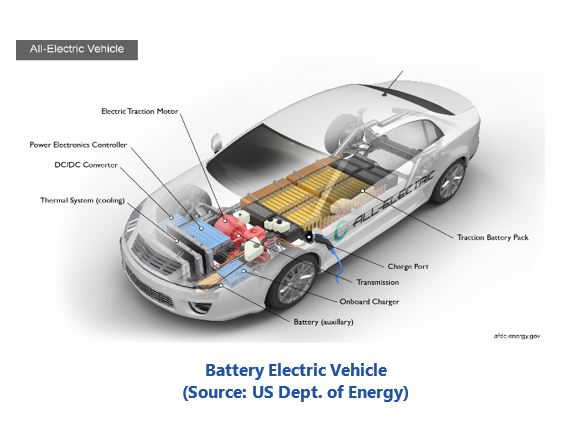 gearheads. Though offering obvious environmental benefits over vehicles powered by internal combustion engines (ICEVs) as well as plug-in hybrids, BEVs were low-range, more expensive, and not quite ready for practical use. The relative scarcity of charging infrastructure did not help their case either.
As of this writing, however, BEVs are elbowing their way into the mainstream. There are a few reasons for this.
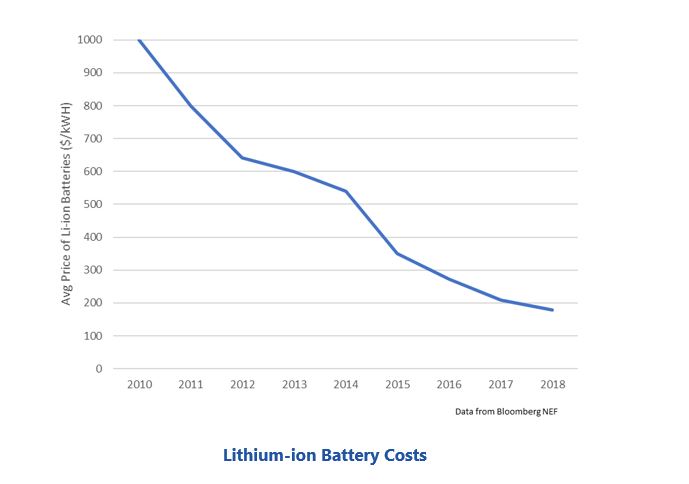
Low range has long remained a red mark against BEVs, making these vehicles impractical for many private commuters and fleet operators alike. However, due to relentless R&D, the price of lithium-ion batteries fell by nearly an order of magnitude between 2010 and 2018 (see figure). New battery technology allows today’s high-range BEVs to travel several hundred miles on a single charge.
Going forward, battery suppliers have announced massive expenditure to build out capacity and invest in further cell improvement. The industry is racing to increase energy density, lower costs, and improve thermal stability. Another priority is reducing reliance on cobalt, a serious ethics and supply chain liability; with Panasonic claiming to be developing a cell completely free of the problematic metal.
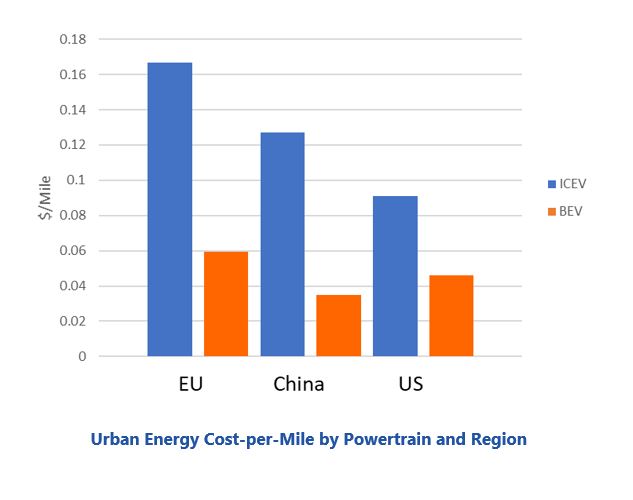
 Electric powertrains have lower energy costs on a per-mile basis than internal combustion engines. They tend to convert energy into motion more efficiently, with today’s BEVs attaining the miles per gallon equivalent (MPGe) of around three times the MPG of their traditional counterparts. Electricity and gasoline prices vary significantly by region, with some countries imposing heavy taxes on transport fuel. The figure be-low draws a comparison between both powertrains’ per-mile energy costs using standard efficiencies and energy prices from cities in three major EV markets.
Beyond enjoying lower energy costs, BEVs have fewer moving parts than fossil-fuel powered ones and forgo liquid fuels entirely. BEV owners do not need to replace or worry about:
Furthermore, BEVs make use of regenerative braking when possible, so their friction brakes tend to wear out half as fast as those of ICEVs.
A BEV owner does need to be mindful of his or her lithium-ion battery. Over time, these lose charging capacity and need to be replaced — potentially costing thousands of dollars.
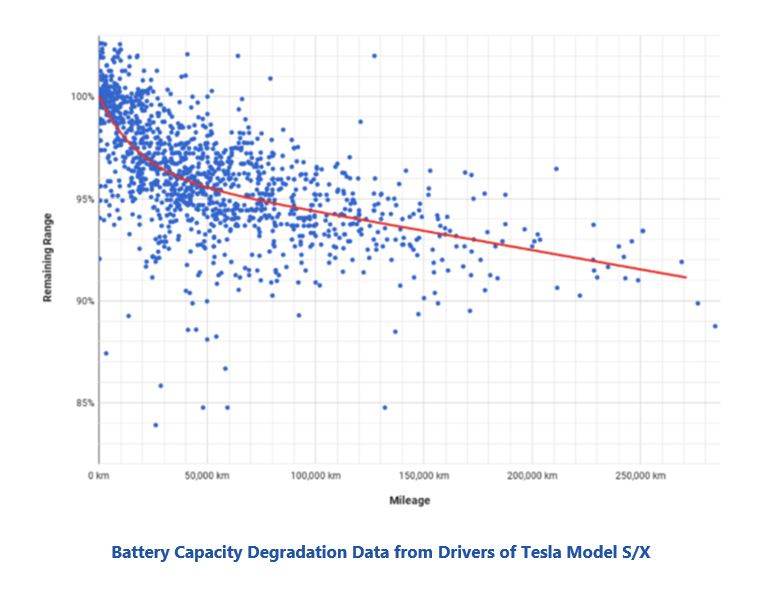
Fortunately, data from drivers of Toyota PHEVs as well as Tesla and Chevy BEVs point to significant battery resilience, with Tesla Model S drivers reporting capacity degradation of just 10 percent after 100,000 miles (see figure on following page). Going forward, improvements in battery design and the adoption of good charging practices will further help mitigate this issue.
BEVs are expected to last a long time thanks to their simplicity and lower number of moving parts. For this reason, an owner may find that when a battery does eventually wear out, it may make sense to replace it instead of buying a new vehicle. Furthermore, since grid/building operators are making use of Li-ion batteries to improve power quality and better integrate renewables, the residual value of a lower capacity BEV battery is expected to be far larger than the scrap value of an entire ICEV. Of course, private owners tend not to keep their vehicles long enough to benefit from this, but in high-usage fleets, full vehicle life can be reached within just a few years.
Despite constant improvement, BEVs remain more expensive to purchase than their ICEV counterparts. This higher upfront cost, however, can be outweighed by lower operating costs (fuel, maintenance) throughout the life of the vehicle. In addition to lowering operating costs, the higher efficiency of BEVs means less emission of greenhouse gases. As more governments introduce carbon taxes, BEVs will become still more competitive. Furthermore, as a region’s electric fuel mix becomes cleaner, BEVs advantages here will amplify. These operating efficiencies, augmented by a variety of government subsidies/perks available in different regions, mean that BEVs now make sense for many consumers.
Since the main financial benefits of EVs come in the form of lower operating costs, it follows that higher-mileage fleet applications will benefit more than personal use.
When making procurement decisions, it is useful to compare differences in total cost of ownership (TCO), which is driven by acquisition and operating expenses as well as salvage price, all discounted appropriately for the entity’s opportunity cost of capital or discount rate.
The calculus of TCO suggests that an electric vehicle’s advantage in operating costs can be easily offset over time by a higher purchase price, even if this initial advantage is rather sizeable. It follows that EV users with high utilization rates offer the strongest business case for adoption.
Fleet usage, with much higher utilization rates than the typical private vehicle owner’s, makes fleet acquisition financially a much more compelling solution – even with the added acquisition cost of an EV over an ICEV. Private EV owners would take decades to fully utilize their vehicle, (and would likely want a replacement long before that anyway), meaning their TCO would skyrocket over the years. Ride-hailing, car-sharing, delivery, and city bus fleets can make the most of their vehicles’ lifespans and amplify the EV operating cost advantage, thus recouping their large capital investment quickly.
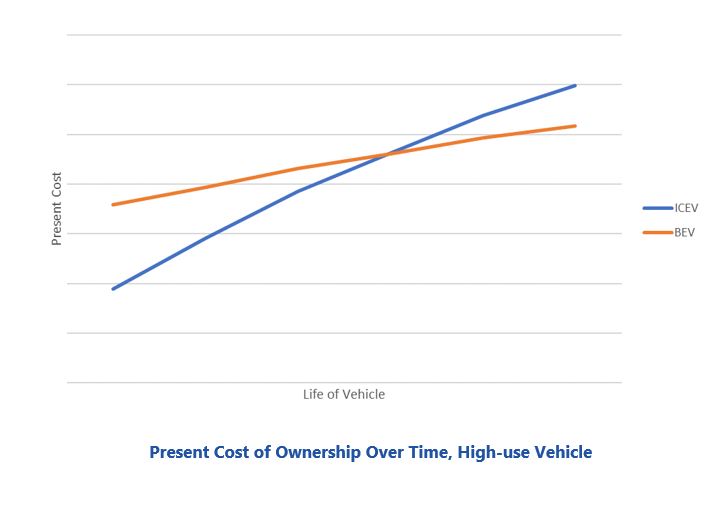
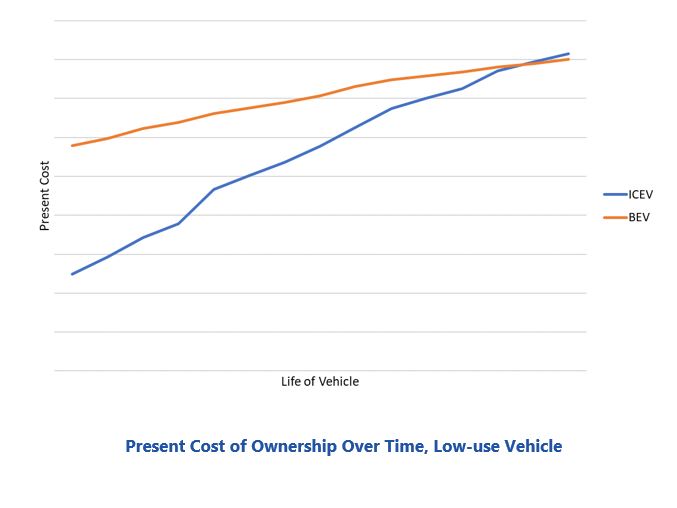
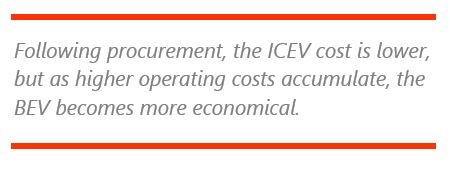 The two figures on the following page compare how the present cost of ownership changes throughout the life of both a high-use and low-use vehicle in both an electric and traditional fleet. Immediately following procurement, the ICEV cost is lower for the high-use vehicle, but as higher operating costs accumulate, the BEV becomes more economical. In the case of low-use private vehicles, the smaller annual operating cost advantage of BEVs may not prove sufficient to overcome their opportunity cost of capital, and certainly not until the very end of a vehicle’s life.
The fleet services mentioned above are heavily represented in urban areas, which are particularly well suited for BEVs. The United Nations estimates that two-thirds of the world’s population will live in urban environments by 2050 (see figure).
Fleets in urban areas generally run enough miles per day to capitalize on lower BEV operating costs, but not so many as to require uneconomically large batteries for a day’s activity. They also encounter plenty of stop-and-go traffic, making great use of regenerative braking and superior idling efficiency. BEVs are almost completely silent - welcome in a city full of noise-pollution - and heavier vehicles (municipal trucks, buses, delivery vans, etc.) benefit from the low-speed torque electric motors provide.
As climate change awareness and sensitivity to air pollution grow, governments at all levels, and municipalities in particular, are introducing measures to address them. Cities have begun curtailing, taxing, and even banning emissions-producing vehicles from city centers, as well as charging them ever-higher urban access fees. City dwellers, particularly those that use ride-sharing services, tend to be environmentally conscious. This can make a “clean” BEV fleet particularly attractive and bolster a brand’s image as green and socially responsible.

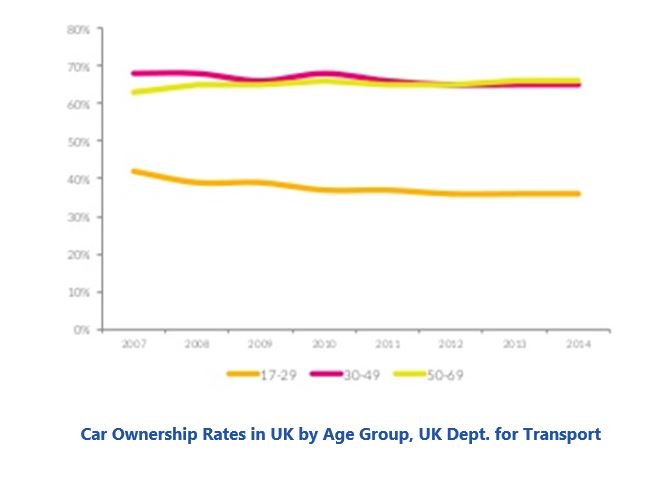
Electric or not, fleets have a bright future in cities. Private car ownership seems to be in decline (see figure). Millennials, soon to be the largest consumer group, have proven less keen on owning cars than their parents. They often prefer some combination of ride-hailing, car-sharing, biking, and public transit services, especially in the urban areas where they tend to congregate. High rates of education-related debt make large purchases difficult as well.
Generational preferences aside, personal transport fleets make economic sense. Private cars sit parked more than 90 percent of the time — hardly a good use of capital, not to mention valuable city real estate. Contrast this with a big city taxi service that can be called on demand and utilizes its vehicles for majority of the day. Beyond personal transport, the growth of e-commerce has fueled the need for urban fleets of delivery vans and scooters.
If/when autonomous driving technology enters the mainstream, mobility services will become even more economical. Without a driver, operating costs will plummet and private vehicle ownership rates will continue to decline.
Urban fleets clearly stand to benefit from going electric. This switch has already begun and is likely to continue. From an EVSE perspective, depot charging for electric fleets has different requirements than private use.
Since a private car is usually driven just a few dozen miles per day, its battery would not be fully depleted most nights, meaning a low-power (level 1) slow charger is enough to top it off before morning. Higher-use fleet vehicles tend to use most of their range every day and thus require more powerful chargers. Delivery vans and municipal vehicles mostly work during the day, so can take all night to charge if needed (a 240V, level 2 unit may be suitable). Ride-hailing services will need some of their vehicles to work throughout the night, potentially requiring the use of more expensive DC Fast Chargers (DCFCs). Operators will have to weigh their need to get vehicles in and out of the charging depot quickly against the elevated cost of purchasing, installing, and maintaining fast chargers.
 As energy will form a large portion of a fleet’s operating costs, they will benefit from capitalizing on time-of-use pricing offered by utilities. Smart, networked charging equipment could be programmed to prioritize charging during periods of low rates whenever possible. Software to optimize charging priority across variable electricity price, maintaining battery longevity, and customer demand will prove valuable. As charging will be key to an operator’s business, providers will also need to compete on the responsiveness of their maintenance and trouble-shooting services.
Fleet operators can provide cleaner, more economical service by going electric. EVSE suppliers that help them stay charged, and do it intelligently, will be “riding in the front seat.”
If you would like to buy this report or obtain information about how to become a client, please Contact Us