Representative Automation Clients







Representative End User Clients


Representative Software Clients








Formulation-based products underpin value creation in many industrial and life sciences sectors, including pharmaceuticals, chemicals, food and beverage, consumer packaged goods, and advanced materials. At the same time, companies face increasing pressure to accelerate innovation, manage regulatory complexity, respond to raw material volatility, and improve collaboration across distributed teams.
Digital transformation initiatives, advances in embedded analytics and AI, and growing integration between R&D and operations are driving renewed focus on formulation-centric systems. As a result, Formulation Management Software is becoming a strategic layer in the industrial software stack, bridging historically siloed functions and data models.
ARC Advisory Group defines Formulation Technologies as Formulation Management Software (FMS) referring to enterprise and scientific software and platforms that enable organizations to design, develop, optimize, govern, and commercialize product formulations or recipes across the product lifecycle.
FMS solutions support the structured creation and management of multi-component products such as pharmaceuticals, biologics, chemicals, food and beverage products, cosmetics, and advanced materials. These systems centralize formulation data, ensure regulatory compliance, facilitate cross-functional collaboration, and connect R&D activities with manufacturing and supply chain execution.
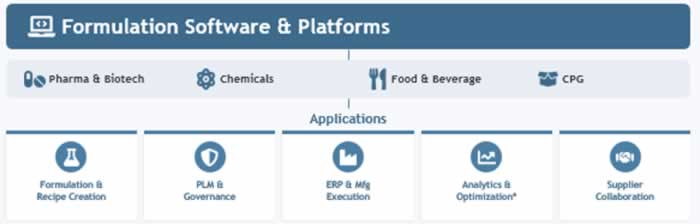
The Formulation Management Software market is being driven by increasing supply chain volatility, stricter global regulatory requirements, sustainability initiatives, and the growing adoption of artificial intelligence. Manufacturers are replacing spreadsheet-based formulation processes with intelligent platforms that leverage AI, predictive analytics, ingredient optimization, and automated compliance capabilities to accelerate innovation, reduce costs, and improve product quality. At the same time, organizations are seeking tools that can rapidly evaluate alternative ingredients, assess environmental impacts, and maintain compliance in an increasingly complex global market.
Adoption of FMS solutions continues to expand as manufacturers seek to connect R&D, laboratory, regulatory, and product lifecycle data within unified digital environments. The convergence of formulation management, LIMS, PLM, and regulatory compliance technologies is enabling greater collaboration, faster product development, and improved data governance. In addition, advances in virtual laboratories and simulation technologies are helping organizations reduce physical testing requirements, accelerate scale-up, and bring innovative products to market more efficiently while meeting compliance and sustainability objectives.
The framework established in ARC’s Formulation Technologies MarketMap and Formulation Technologies Market Data Service provide:
Whether you are an organization modernizing your formulation workflows or a supplier navigating a competitive market, this research offers a clear, forward-looking foundation. Contact us today to have a consultation with our Formulation Technologies experts.