Representative End User Clients







Representative Automation Clients







Representative Software Clients








For an organization to be competitive, it’s no longer sufficient to just sell the best products, produce them as cheaply as possible,  handle the supply chain expertly, and streamline business processes to optimize efficiency. To survive and thrive, a company must also be able to manage its data in real time, align the information to business strategies, and exploit the business value of the data. This Insight provides one example of how a leading company implemented appropriate technologies to gain strategic business value through real-time manufacturing intelligence.
The Hershey Company, headquartered in Hershey, Pennsylvania, is a global confectionery manufacturer renown for its chocolate, sweets, mints, and snacks. The company, which generates over $7.4 billion in revenues, has approximately 20,000 employees. Famous brands include Hershey's, Reese's, Hershey's Kisses, Jolly Rancher, Ice Breakers, and Brookside. The company is rapidly expanding its portfolio through new product development and strategic business acquisitions. The company manufactures in the US, China, Canada, Mexico, India, Malaysia, and elsewhere. It is rapidly expanding brands across global markets and implementing solutions to drive efficiencies.
 Hershey, a leader in corporate responsibility, has been named one of the world’s most ethical companies by the Ethisphere Institute. The company fosters a culture of ethics and transparency at every level. Hershey’s guiding principle is to “do well by doing good.”
Hershey recently implemented what it refers to as an “Accessible Information for Manufacturing” (AIM) enterprise manufacturing intelligence (EMI) solution to support its manufacturing management and reporting functions. The solution leverages the OSIsoft PI System, SAP MII (Manufacturing Integration and Intelligence), and SAP ERP platforms. The PI System, which provides the foundational infrastructure for the solution, enables the company to reliably collect, aggregate, and deliver real-time plant data across its multiple systems, devices, machines, platforms, and applications.
Like other manufacturers, the Hershey Company’s major business challenges relate to increasing global competitive pressures. These include the need to:
Without the right technology, organizations can become tangled in a long, frustrating integration process. Due to constant growth and expansion the company needed an approach that would integrate the many different systems that had been acquired over time. A key strategic decision was to bring all asset data together into the OSIsoft PI System.
Because the operator is usually the closest to and can have an enormous effect on the manufacturing process, it is important that the operator has the intelligence available to make informed decisions. For this project, the company focused on facilitating operator task execution and issue response.
Hershey’s requirements included graphical, easy-to-use solutions that required minimal training, technical skills, and expertise. The company did not want to turn operators into IT experts; just to be comfortable using the information in the same way that they normally work and be able to use the intelligence to make better decisions.
Mr. Gregg, Sr. Project Manager, Global Supply Chain/Manufacturing Systems at The Hershey Company, cited an IBM Survey of over 400 supply chain executive across the globe. The survey revealed that “70 percent of the executives stated their biggest challenge was real-time visibility. They don’t have the appropriate level of insight into what is happening within their operations on the ground level or on the production floor in real time. This lack of insight hampers their ability to make the right decisions at the right time.”
Hershey is using EMI to make faster and more profitable decisions. The company wanted the plant data to be easily accessible so data from multiple plants could be analyzed and compared.
 Manufacturers need to respond proactively to shop floor activity and prevent abnormal behavior before it happens. As a start, companies must first understand the process and the critical inputs to be able to predict and respond to abnormal behavior before it can impact product quality, production, or safety.
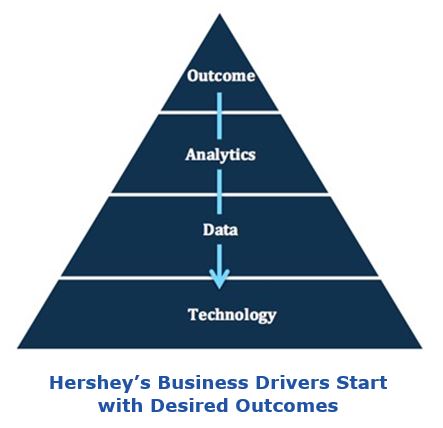
Hershey’s business drivers relate to driving shop floor activity – the outcome and how to engage employees through better visibility. These include:
Before implementing the new technology, many decisions where based on individual operator experience and tribal knowledge; managers had to speak to the operator to determine how the process was running. Operators would just react to failures or out-of-spec occurrences. By implementing the new technology, Hershey went from just meeting product quality and regulatory requirements, to anticipating potential issues and preventing abnormal conditions. By operating with real-time data and information, the company can now anticipate or more quickly respond to potential issues. The operators are more empowered to make better decisions.
The system design and implementation needed to consider all key stakeholders, including R&D, cost accounting, quality control, engineering, supply chain, and finance, as well as operations. According to Mr. Gregg, when starting on this journey it was important to engage the right stakeholders to be able to really understand the needs and opportunities.
 It was important to establish some guiding principles to direct the overall strategic effort. Some of the Manufacturing Information Services design principles include:
Hershey used the OSIsoft PI System to help overcome specific technical challenges. These include:
Hershey’s AIM EMI architecture includes both an asset intelligence (primarily OSIsoft PI System) layer and a manufacturing intelligence (SAP MII) layer. The architecture connects and integrates multiple, disparate devices and applications to provide a unified information system.

The asset intelligence layer collects data from multiple devices, control systems, and SCADA systems via OPC and brings these data into the PI System. Specific assets include:
OSIsoft provides the common infrastructure for all data.
The SAP MII system integrates with OSIsoft PI System, disparate MES applications and SAP to provide the manufacturing intelligence layer while minimizing interface and application touch points. The implementation includes:
MES Platforms – Manages the diverse mix of equipment and systems (product tracking system, bar code/labeling system, materials management and SPC).
SAP – Enables managers to access accurate data in a more timely fashion than the previous end-of-month rollup reports. Hershey was able to leverage SAP MII functionality into the company’s proprietary AIM EMI solution.
To accommodate the increased openness of the new system, Hershey also invested in additional security such as a VPN, firewalls, virtualization, and physical security.
OSIsoft Asset Framework (AF) provides a flexible, scalable and configurable hierarchical data structure. This supports object templates, enables the standardization of applications and reporting, supports real-time data and relational and calculated data elements, provides integrated event and schedule based calculations and rules, and supports open integration. By building on the PI AF, Hershey was able to create a unified, configurable data layer that minimizes the need for hard-coded solutions.
Because the PI System can be gradually built over time, it is not necessary to build and track everything initially. It is important to determine the key PI System inputs that drive the metrics and align these with the business value that the metrics are delivering. 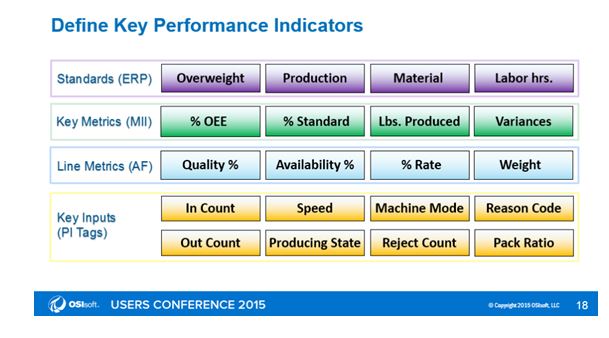 According to Mr. Gregg, it is important to define KPIs upfront so that metrics are built and calculated at the lowest possible level. “If all the inputs for a calculation are available in the control system, metrics should be generated in the control system. If the calculation needs data from multiple control inputs, it’s better to calculate the metrics in the PI System. If the metrics require data from multiple MES platforms and SAP, it is better to calculate the metrics in the MII system. It’s better to maintain business metrics the SAP system as roll ups.”
The company’s engineers and maintenance personnel focus on the asset intelligence layer. Here, they leverage the asset intelligence provided by the OSIsoft PI Systems client solutions like PI ProcessBook, PI Coresight, PI WebParts, and PI DataLink; plus Microsoft Office 365 and SharePoint. The PI System provides different tools and each should be used for the right worker, role, or task.
Hershey built its manufacturing intelligence solution to support operational excellence. The information delivery and KPI reporting were based on a role structure, since each stakeholder (engineers, operators, supervisors, and plant managers) all need different information. The KPIs help drive Lean Manufacturing and Six Sigma improvement initiatives and projects.
The company’s AIM solution was designed to provide diverse functionality. This includes:

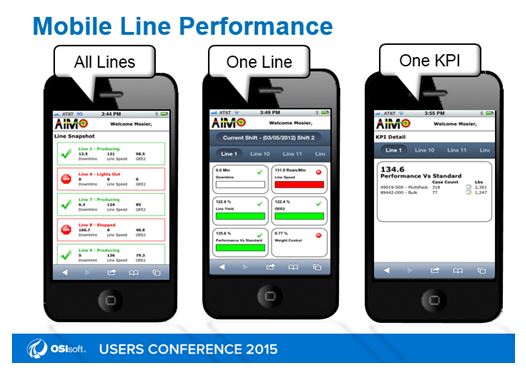 Mobility
Mobile line devices need to be simple to use. The solution supports mobile line performance monitoring via three-click mobile drill down displays for any desired line. Supervisors now carry iPhones so they can see what is going on.
The company believes that is important to measure the value derived and publish the results to maintain momentum and continue technology investments. By providing better information and responses the company has made significant improvements. Some results obtained at one implemented plant included:
Executives should take the time to reconsider their infrastructure and integration issues and consider the efficiencies the company may gain over time from manufacturing intelligence and faster decision making.
The technology being deployed today will play a major role in determining which companies remain competitive in the future. A large part of the success will depend upon deploying the right technologies for data and manufacturing intelligence. Executives should be involved, business challenges should be focused on, and the value should align with the company’s vision and strategies to help ensure that investments are made in the right technologies.
Based on ARC research and analysis, we recommend the following actions for owner-operators and other technology users:
To learn how other end users are taking advantage of these types of technologies to improve business performance, consider attending related sessions at the upcoming ARC Industry Forum in Orlando, Florida, February 8-11, 2016.
If you would like to buy this report or obtain information about how to become a client, please Contact Us
Keywords: Manufacturing Intelligence, PI System, OSIsoft, Hershey Foods, ARC Advisory Group.