Representative End User Clients







Representative Automation Clients







Representative Software Clients








IIoT is being applied by original equipment manufacturers (OEM) to remotely monitor its equipment at the customer’s site and assess its condition. Using analytics, the OEM identifies an emerging problem with a specific machine and sends an alert to the appropriate 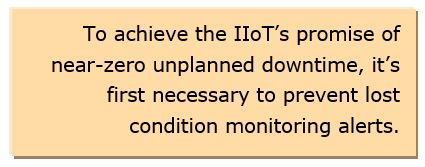 customer. This form of predictive maintenance is intended to prevent unplanned downtime. However, these alerts often don’t get to the right people within the plant, leading to equipment failure as predicted.
As the number of OEMs providing IIoT-enabled predictive maintenance services grows, the quantity of alerts received by owner-operators increases. Since they have many different equipment suppliers, the alerts come from multiple sources with a variety of formats and received by different people. To avoid lost alerts and the associated downtime, owner-operators need a standard business process with governance. This includes triage in which the maintenance group assesses, evaluates next steps, prioritizes, and converts condition monitoring alerts to work orders when appropriate.
Currently, the dominant application for IIoT involves analytics for predictive maintenance (PdM) by an OEM for its equipment. The objective is to prevent a failure and the resulting unplanned downtime. The typical solution is for the OEM to send an email alert to someone in a customer’s plant. This is effective only if, after the alert is generated, someone in the plant acts with a work order for an inspection or repair. Unfortunately, in most plants today, this alert-to-action process has a gap, with alerts becoming lost or misdirected, and the equipment fails as predicted.
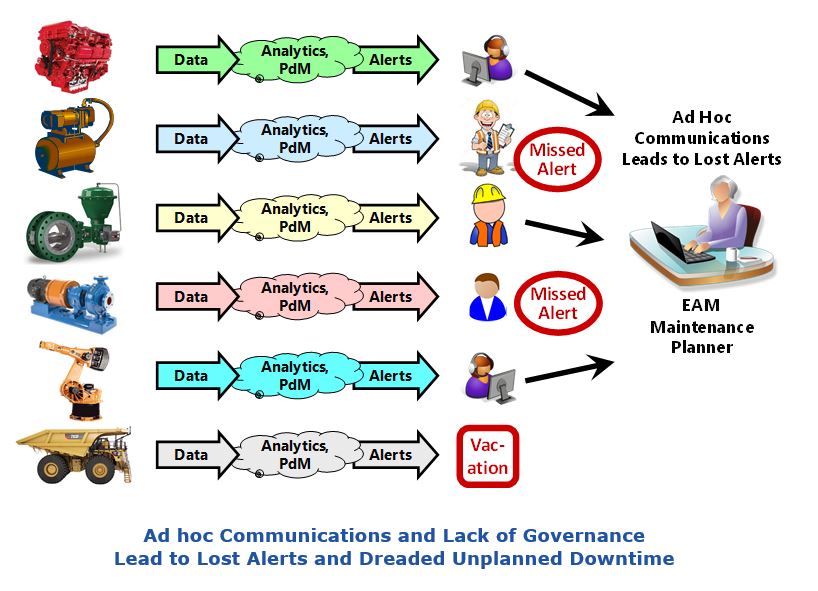
 What causes lost alerts? Most organizations have separate departments for reliability/inspections, maintenance, and operations. Often these become focused on their specific KPIs with little collaboration. This causes the classic “silo” mentality with low cross-functional communications.
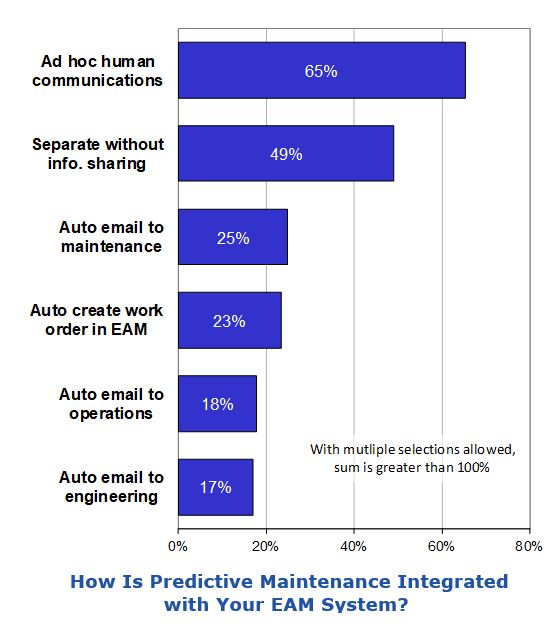
In a recent ARC survey, the majority of respondents indicated that, in their plants, most information related to predictive maintenance is communicated in an ad hoc manner via hallway conversations, email messages, or phone calls. This random, unstructured approach combined with the siloed organization frequently results in lost alerts. The unplanned downtime occurs despite the adoption of IIoT-enabled PdM. The effective management of condition monitoring alerts has become a new business need for owner-operators.
Equipment manufacturers are rapidly adopting IIoT for new sources of relatively high-margin revenue. OEMs provide asset health monitoring and predictive maintenance subscriptions for their installed base (see IIoT enables New Revenue Sources for Equipment Manufacturers).
While initially adopted by suppliers of expensive (million dollar plus) equipment, OEMs with equipment costing as low as $10,000 are now also deploying this approach to help improve availability for their customers while obtaining new, added revenue streams for themselves. Most of these initiatives apply to new products, and it will take time for the suppliers to develop an installed base with associated revenue. However, other suppliers (like Kaeser Kompressoren) offer modules that can be added to existing equipment, allowing more rapid adoption.
From the user’s perspective, as adoption grows, a large industrial site will eventually have hundreds of suppliers with predictive maintenance services. Typically, these alerts take the form of emails going to an individual who was involved in acquiring the equipment. Unfortunately, most organizations lack procedures for:
Each OEM selects technologies and develops its approach to predictive maintenance. This results in alerts coming from a variety of platforms like IBM Bluemix, IFS IoT Business Connector, GE Predix, Microsoft Azure, PTC ThingWorx, Oracle IoT Cloud Service, SAP Predictive Maintenance and Service, Siemens Mindsphere, Schneider Electric EcoStruxure, and others. It also results in a variety of sources like emails coming from either the OEM, its distributor, a local dealer, and/or a contracted service provider. The lack of consistency in platforms and sources also contributes to lost alerts and unplanned downtime.
Reducing the likelihood of lost alerts and the associated unplanned downtime requires a consistent business process. Ideally, the alerts go to the maintenance planner for triage which includes:
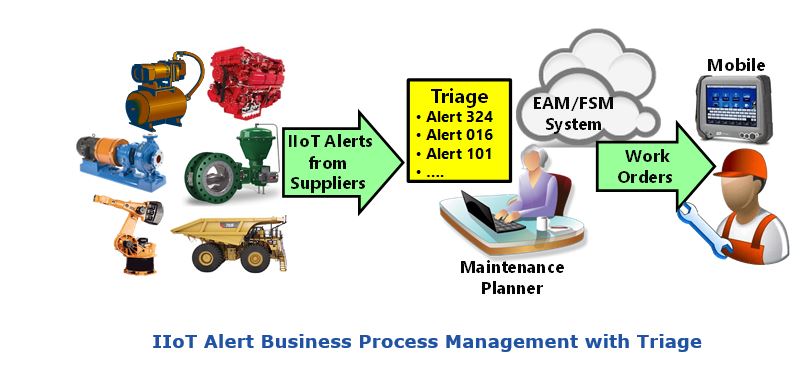
With an understanding of the importance of alert triage, several suppliers have software to help users evaluate, rank, and (if needed) generate appropriate work orders for these types of alerts. These suppliers include ABB (Asset Health Center), IFS (IoT Business Connector Platform), Rockwell (FactoryTalk Analytics for Device Health and Diagnostics), SAP (Asset Health Control Center), and Schneider Electric (Condition Manager). If you know of others, please contact the author.
IIoT alerts need to be managed and processed consistently to avoid ad hoc communications, lost alerts, and dreaded unplanned downtime. Based on ARC research and analysis, we recommend the following actions:
If you would like to buy this report or obtain information on how to be-come a client, please Contact Us
Keywords: IIoT, Alerts, EAM, Maintenance, Asset Management, Unplanned Downtime, ARC Advisory Group.