Representative End User Clients







Representative Automation Clients







Representative Software Clients








Manufacturing execution systems (MES) can help manufacturers and other industrial organizations reduce costs while improving operations, collaboration, asset management, workflow, and safety, but the question remains: What Is the 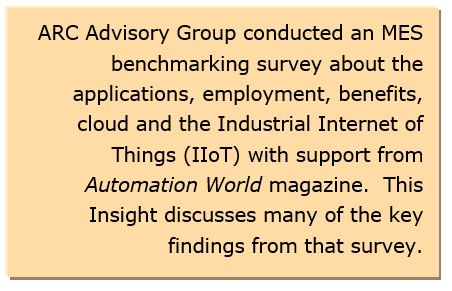 MES Technology Doing for the Next Generation?
Specific MES functionality can vary significantly, depending upon the supplier and industry focus. Many of the newer MES applications are integrated solutions that include quality management and traceability, regulatory compliance documentation, planning and scheduling, energy management, and manufacturing intelligence and analytics, in addition to workflow enforcement and cloud capabilities.
ARC Advisory Group research indicates that MES technology usage continues to increase at a rate faster than automation in general. This is largely due to the technology’s ability to help optimize production for operational excellence. Manufacturers continue to focus on driving waste out of their operations by eliminating silos, simplifying and improving workflows, integrating advanced analytics, adding pervasive visualization, and standardizing on technologies and processes. Whether implemented "in the cloud," or in a more traditional on-premise manner, MES continues to be a critical technology for achieving those objectives.
Although MES functionality can overlap with other systems such as enterprise resource planning (ERP) software and automation software, its main goal is to improve productivity and yields and reduce cycle times. By integrating an MES to the automation, ERP software, LIMS software, asset management software, and other data sources; manufacturers’ operations can improve productivity, reduce costs, and deliver high-quality products.
MES applications and deployments continue to vary by industry and applications. Many applications evolved from proprietary add-on applications to industry standards.
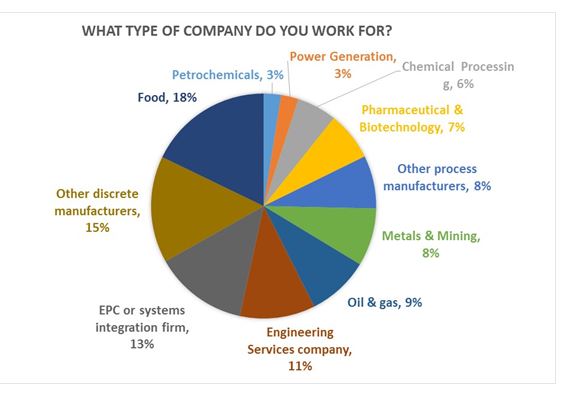
Early this year, ARC conducted a survey in conjunction with Automation World magazine to assess the current state of MES adoption. We received over 240 responses, from which we filtered out any from suppliers to help ensure objectivity. Most qualified respondents had more than ten years of MES experience. We further filtered out those without direct experience with the technology.
According to respondents, the ten most-used MES applications (in descending order) are:

Reporting, production management, and quality system ranked highest as the most used applications/solutions. Reporting – whether as a digital dashboard, KPIs, or other management or compliance report – is the most important function for most companies. For those still operating in silos, getting the right information into the right hands can be time consuming and the MES solution can make immense improvements. Overall productivity, cycle times and yield improvements are achieved using MES. One respondent stated that MES is their “oxygen.”
 A few end users commented that some of the functionality overlapped with their ERP or automation systems (time and labor management, batch management, etc.). Other respondents noted that in their facilities, the MES solution still consists of Excel spreadsheets with macros, Microsoft Project, and other reports “cobbled” together.
MES continues to grow because users continue to see value from their implementations. Some respondents mentioned that they see a lot of benefits from process quality and traceability.
According to the respondents, the top five applications for MES are:
 Next-gen MES applications involve IT/OT/ET convergence, predictive analytics, cloud, and IIoT deployments. About 42 percent of respondents have some cloud deployments. MES cloud deployment adoption varies by industry application and company as some industries see issues such as bandwidth, latency, IP, security as potential challenges. Once these issues are resolved, with newer technologies such as edge devices, ARC believes that cloud usage for MES will grow substantially.
ARC parsed the survey results into all cloud deployments vs. cloud deployment in oil & gas, petrochemical, and chemical industries. Not surprisingly, we found that most cloud deployments in the latter industries employ private and hybrid clouds, but not public cloud computing. In other industries, such as the food and auto industries and others in which it’s critical to collaborate with external partners, public cloud adoption is more prevalent.
Mobility and visualization are more important than ever in new MES applications, with some deployments including integration from product and process design to the factory floor, supply chain, and ERP solutions. ARC refers to this as IT/OT/ET convergence, which is becoming essential for manufacturers to remain competitive.
The advent of the IIoT, the digital transformation, and the use of newer technologies such as sensors, automation systems, analytic data, drones, GPS, virtual process simulation, and other data sources will intensify the need for this convergence. Throwing engineering technology, product design, and supply chain data into the mix is required to manage and integrate process and information flows faster and more efficiently. It will also help eliminate information silos and close the asset lifecycle management loop.
Proposed and emerging process automation architectures (most notably by The Open Group’s Open Process Automation Forum) may or may not mention MES directly. Some architectures mention ISA level 3 (L3), but do not provide details on the MES system or functionality, which will remain critical, since owner-operators will still depend upon MES technology to optimize upstream and midstream operations. Many operating companies believe that MES technology will be a key part of the IT/OT convergence in the future, including integrating the data. This may encompass separate but interoperable plug-in applications for functions like scheduling and planning or workflow execution. The technology may no longer be called “MES,” but the functionality will still be part of the operations technologies suite.

End users have reduced costs just by using better visualization tools that enable the workface to obtain and understand information better. According to survey respondents, predictive analytics are being integrated into some MES solutions with immense benefits. A few users are adding virtual reality capabilities to be able to simulate process behaviors for new processes or products and prevent potential bottlenecks. Other new capabilities will be integrated into MES application or provided as part of an MES application solution.
MES is a valuable operations and production technology that will be integrated into companies’ digital transformation, and bring value to companies. Based on ARC research and analysis, we recommend the following actions for owner-operators and other technology users:
ARC's latest market research on MES for the Process Industries explores these trends and drivers in more detail and includes information on the leading suppliers to this market.
If you would like to buy this report or obtain information about how to become a client, please Contact Us
Keywords: MES, IIoT, Open Automation Group, ARC Advisory Group.