Representative End User Clients







Representative Automation Clients







Representative Software Clients








ARC Advisory Group held its fifteenth India Forum for the process and discrete industries from July 6-7, 2017, Bangalore, India. With the theme, Industry in Transition: Realizing the Digital Enterprise, the event attracted close  to 280 delegates. The digital enterprise transition theme resonated well because all organizations, whether technology suppliers or end users, have embarked on this journey and are at different stages.
Delegates got an opportunity and platform to network and understand how digitization can help them grow in a collaborative environment. What rang out clearly was that digitization is an imperative to succeed in a competitive world; but the transition must be well planned and charted.
A few years ago, new technologies, such as cloud computing, mobility, Internet of Things, Big Data/analytics, and 3D visualization, seemed like mere business jargon; but today, these technologies are driving industrial growth. Industrial companies are revisiting their own business processes and technology approaches as competitors and partners start to employ digitized business processes and exploit the increasing convergence between operational technology (OT) information technology (IT), and engineering technology (ET) on the plant floor. The digital enterprise benefits from smarter products, new service and operating models, new
production techniques, and new approaches to design and sourcing. Information-driven digital enterprises leverage new technologies to achieve agility and sustain a competitive edge. All these were discussed at the ARC India forum.
The session topics were about moving towards the digital enterprise; automation trends and cybersecurity; evolving technology trends; and end user experiences on the digital journey. Both days featured lively and thought provoking question and answer sessions with the speakers.
The two-day Forum Insight will be published in two parts. Part 1 will focus on the first day's proceedings and Part 2 on the second day's proceedings.
G. Ganapathiraman, Country Manager, ARC Advisory Group, India welcomed the delegates and after lighting of the traditional lamp he invited the sponsors (global, gold, and silver) and industry association sponsors, and end user speakers on stage.
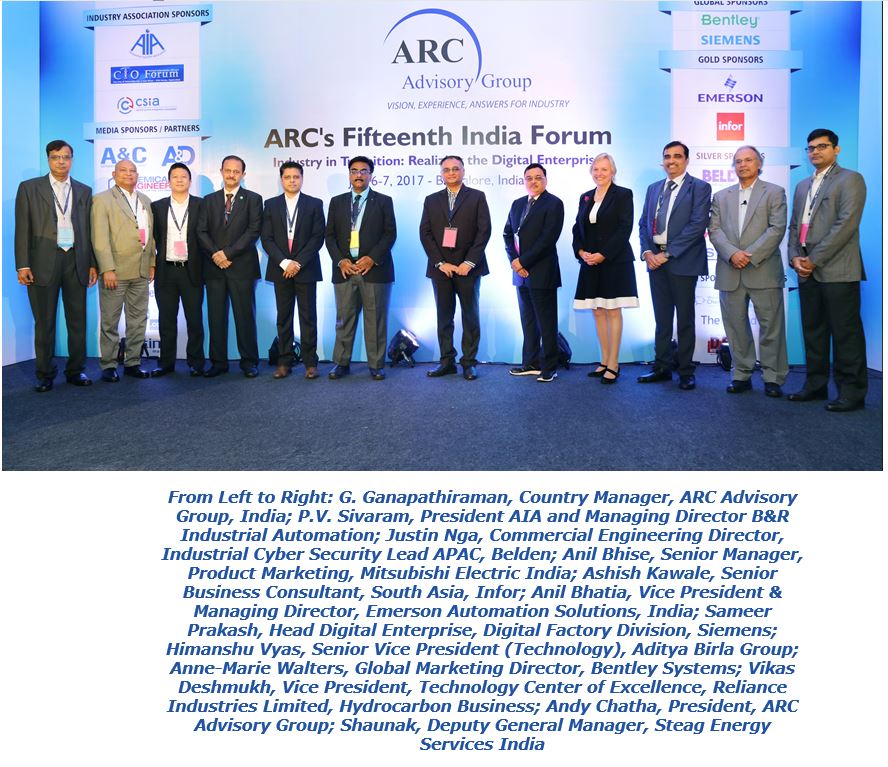
This was followed by a group photo with the media sponsors. After the photo sessions the keynote speakers delivered presentations on the forum’s theme, setting the tenor for the subsequent presentations.
Andy Chatha, President, ARC Advisory Group spoke about how digital transformation is critical to success. A survey conducted by ARC in Q4 2016 reveals that 88.5 percent of respondents believe that digital transformation provides  business transformation opportunities in terms of industrial operations and products and services. He went on to explain the opportunities that it provides to different industry verticals. Software platforms and applications are proliferating and these need to be customized for different clients.
Convergence of information/operational/ engineering technologies is vital. The relationship among these domains must converge seamlessly for operational success. From an asset management perspective, it’s about predicting a problem before it occurs and to enable maintenance at optimum rates and costs; zero downtime demands predictive and prescriptive approaches.
According to Mr. Chatha, a digital enterprise is:
The next speaker, Vikas Deshmukh, Vice President, Technology Center of Excellence, Reliance Industries said that digitization in India’s downstream oil & gas sector has yet to gather significant momentum. He said the challenges of this sector are:
Mr. Deshmukh said that these challenges can be addressed by “going digital” and enhancing continuous improvement. The business model has changed from “maintaining business” to “growing business.” And business can grow only through digitization, which reduces costs; facilitates faster and more intelligent decision making; nurtures innovation; and provides a single version of the truth.
Next, Sameer Prakash, Head Digital Enterprise, Digital Factory Division, Siemens, stressed how digitalization “changes everything.” Across industries customers have essential requirements – speed, flexibility, quality, and efficiency; and these must operate on a foundation of security. Siemens Digital Enterprise provides a portfolio of solutions for the digital transformation of process and discrete industries. He further added that manufacturers must embrace technologies and transform their business into a digital enterprise, which needs to be applied across the entire value chain. A common digital thread linking ideation-realization-utilization enables continuous business transformation and compresses the innovation cycle. According to Mr. Prakash, Siemens’ MindSphere creates a digital twin of the entire process and helps optimize product and production.
The next speaker Peter Zornio, Chief Technology Officer, Emerson Automation Solutions, spoke about harnessing the power of IIoT to achieve operational certainty. After giving a brief overview of the company, Mr. Zornio said the process industry challenges are: location, complex processes, shortage of workers, and disconnected job functions. He graphically showed how Emerson tackles these challenges by deploying IIoT, which he said is an evolution, not a revolution. People resist change, he said. To accept a new way of doing things takes a lot of time and convincing. The IIoT opportunity is real – statistics reveal that approximately $1 trillion is lost annually due to suboptimal operating performance; only 5 percent of companies have an in-depth IIoT strategy for improving plant equipment, reliability and maintenance. In this context he elaborated on the company’s Plantweb Digital Ecosystem for all business models, a comprehensive IIoT portfolio with proven ROI solutions.
Next, Ashish Kawale, Senior Business Consultant, South Asia, Infor, said that the pace of technology innovation is “dizzying” and we are seeing the advent of the fourth industrial revolution. Customers, businesses and technologies are changing and to keep pace corporations need to change too. He spoke about Infor’s five digital transformation initiatives in these areas: business network, customer experience, smart equipment, servitization, and digital workforce. No two transformations are the same, he said, as each one traverses a different path. It is important to network because 80 percent of the data that companies need to run their supply chains is locked up in partner systems. The power of the internet helps converge the physical and financial supply networks and provides visibility. The business objectives are: operational efficiency, customer engagement and employee engagement. And the key digital levers to achieve these objectives are: Big Data/Analytics, cloud, mobile, social etc.
The last speaker for this session, Anne-Marie Walters, Global Marketing Director, Bentley Systems, discussed “going digital the Bentley way” by integrating information technology (IT), operational technology (OT), and engineering technology (ET). Ms. Walters showed videos on reality modeling that increase joint opportunities in surveying and engineering. For delivering infrastructure projects, reality modeling captures the actual context of existing infrastructure through photos and/or scans, creating engineering-ready reality meshes for design modeling, analytical modeling, and construction modeling. In this context she spoke about “inspectioneering” – that combines inspection and engineering - for asset reliability modeling. Ms. Walters spoke about a recent strategic alliance with Siemens to drive new business value through digitization, which she describes as a win-win partnership not only for the two companies, but for industrial growth.
M.S. Niranjan, Director – Engineering, Research and Development segment, NASSCOM, began this next session. He said that the digital forces driving customer experience are: intensifying competition, disruptive innovation, new technologies - all leading to a more aware customer base. He presented the following diagram explaining the challenges surrounding digital transformation initiatives:
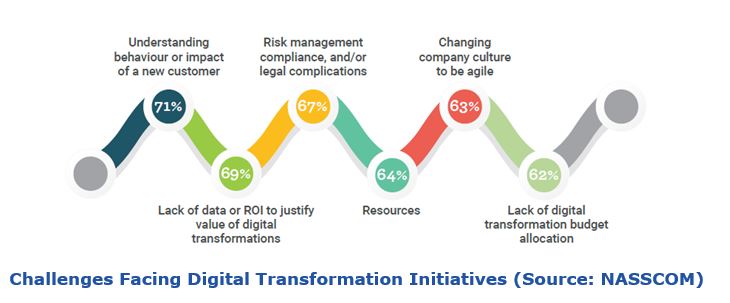
From the end user maturity perspective, he said that the adoption of digitization can be divided into four categories: laggards (yet to define a digital strategy), exemplars (becoming increasingly strategic), aspirants (may be working on a digital roll out plan), and achievers (already on the digital transformation journey). He said that growing digitization, connectivity, cloud computing, cybersecurity and increasing automation are the key trends driving the manufacturing sector to invest in IT. As an association, NASSCOM suggests initiatives and guidance to explore the digital opportunities via flexible engagement models, collaborations, M&As, and so on.
Next was a joint presentation on the importance of an Open Platform to support live analytics and decision making by Anil Bhise, Senior Manager, Product Marketing, Mitsubishi Electric India and Vineet Nayyar, Cluster Leader for Industrial Sector for North & East India and Leads Electronics Industry for IBM India. Using the example of a deceptively simple cup of coffee, Mr. Bhise said that the choices are numerous – temperature, ratio of water to milk, amount of sugar etc. There are many combinations and possibilities; this is why an intelligent cloud is required to analyze all the possibilities, dependencies and consequences. This implies that the automated system is an integral part of the larger picture. However, achieving such a linked and diverse system requires a shift in thinking; a shift to a more open interface between the factory automation (FA) and IT world, between new and legacy systems, and between devices on the shop floor. Speaking about digital operations in manufacturing, Mr. Nayyar said that cognitive factories are characterized by networks of smart operations and facilities across their value chain. The case studies showed that organizations need to intelligently apply automation in hardware and software.
Taking this forward, Srinath K. Narayan, Director, Strategy & Business Development, Siemens Industry Software, India, presented on smart innovations for the digital enterprise. Smart innovations are transforming every industry – self-driving cars, customized implants, pilotless planes, energy that self-optimizes, ships navigated by on-shore captains, and so on. Companies have to adapt to a changing business environment because the products, business models and legacy positions that once gave them a competitive edge are no longer secure. The transformational forces behind these smart innovations are:
P.V. Sivaram, President of Automation Industry Association (AIA) and Managing Director B&R Industrial Automation, spoke about India’s journey in automation and the association’s mission to help people and processes align with the Government’s industrial policy, which focuses on encouraging manufacturing competitiveness, leveraging new technologies, and stimulating job growth. AIA recommends that industry, academia, researchers, and Government collaborate and address this together. The emerging concepts and ideas can be taken up for simulation, demonstration and solutions implementation via a National Center of Excellence. He highlighted the challenges and proposed solutions that are being charted out.
 The post-tea session began with a joint presentation on information convergence by Steag Energy Services, India - Rajbans Talwar, Consultant in Optimization, and Shaunak, Deputy General Manager. They spoke about the external (regulatory requirements, fuel availability, power trading, and increasing share of renewables) and internal (islands of data, too much data, maintenance planning) drivers that converge to meet the organization’s needs, such as:
Several case studies demonstrated quantifiable benefits from using Steag’s products.
Next, Justin Nga, Commercial Engineering Director, Industrial Cybersecurity Lead APAC, Belden spoke about the need for a structured and practical approach to cybersecurity. He believes that the mega trends driving IP adoption are: changing consumer behavior, labor substitution (changing man-machine ratio), and increased productivity. With increasing connectivity there is a need for more trained cybersecurity professionals. A security skills shortage continues to be a challenge as threats grow in sophistication and breadth. Industrial cybersecurity is about confidentiality, integrity, and availability. Against this backdrop Mr. Nga spoke about the Stuxnet worm, Dragonfly, BlackEnergy etc. that caused global chaos. He spoke about the trends and regulatory standards and said that cybersecurity is a journey involving strategic and economic propositions more than technical solutions.
The last speaker for the day, Himanshu Vyas, Senior Vice President (Technology), Aditya Birla Group, gave a brief overview of the company and then spoke about “digital mining,” use of digital capabilities and platform to enhance business. Digital mining is not limited to data analytics and machine to machine communication. Ideally, it should optimize productivity, reduce variability, enhance asset reliability, reduce losses, and increase agility and responsiveness. Mr. Vyas spoke about implementing digital technologies at all operational and business levels of the company. But sometimes, he said, there is a digital disconnect because of an ill-defined business model or business case, fragmented efforts, unclear accountability, etc. Therefore, change management is of utmost importance to support digital transformation, stated Mr. Vyas.
The success of our forum is largely due to the tremendous support we received from our sponsors. These include:
ARC’s recent India Forum, like all ARC forums hosted globally, provided a networking opportunity to understand how digitization is transforming the business landscape. The case studies presented provide actionable information and feedback to all parties as to what to expect, how to implement, and the quantifiable benefits of deploying new technologies. For organizations to succeed, ARC recommends that they transition to a Digital Enterprise in carefully planned steps.
Based on ARC research and analysis, we recommend the following actions for owner-operators and other technology users:
If you would like to buy this report or obtain information about how to become a client, please Contact Us
Keywords: ARC India Forum, Process and Discrete Industries, Digital Enterprise, Digitization, IT, OT, ET, Oil and Gas, Cybersecurity, ARC Advisory Group.