Representative End User Clients







Representative Automation Clients







Representative Software Clients








For supply chain practitioners, additive manufacturing offers large potential savings for printing spare parts on demand  as needed. This is particularly true for companies with large numbers of slow moving stock keeping units (SKUs). Rather than pay to store inventory that is rarely if ever ordered, why not just print these parts as needed? But there are challenges. Where is Supply Chain Additive Manufacturing
The opportunity to use additive manufacturing to print spare parts is becoming widely recognized. In ARC Advisory Group’s conversations with industry insiders, we have come across many companies that have beta projects and are printing a small number of parts; but no company that is doing this at scale. ARC has identified several challenges associated with scaling additive manufacturing in the supply chain:
Industry-leading manufacturers often have concept centers staffed with experts to exploit this type of technology. Manufacturers that have advanced even further have targets for determining the SKUs that will have the best ROI and have set goals for saving money in this area.
Once it has identified the appropriate spare parts for replacement via additive manufacturing, a company must convert 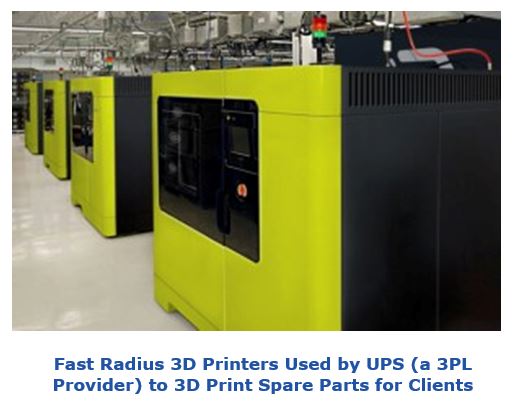 the CAD files for those parts into STL (or other) files that capture those parts’ respective geometries for 3D printing. But that’s just the start.
As 3D printing solution provider, LEO Lane, explained in a recent blogpost, “After finalizing the geometry, the next step is deciding on the production technology and its parameters. As in any process, it’s important to choose the technology and the specific parameters best suited for the production of your particular part, it’s the same when choosing casting, injection molding, or any technology.”
Ideally, the solution employed should be designed to help ensure that the company’s intellectual property is protected and that the quality of the printing process across an extended supply chain will meet product quality specifications. These solutions typically run in the cloud to support a geographically distributed supply chain. The solution must enforce the manufacturing rules; for example, that the parts are produced using the specified printer, materials, temperature settings, and layering angles. It should also enforce distribution rules by only allowing the specified number of parts to be printed.
While the 3D printing of spare parts is only being done on a small scale currently, this is likely to change in the near future as new cloud-based solutions emerge to help control the 3D printing process across an extended supply chain.  It’s likely that 3PL firms with a network of warehouses will become natural service providers for this business line. That is because many critical service parts have service level agreements with tight turnaround times. With regional hubs and the ability to inject parts into their express delivery network, 3PLs will usually be able to provide better service at a lower cost than their manufacturing clients.
UPS, a leading global 3PL, recognizes this. UPS’s strategic investment arm, the UPS Strategic Enterprise Fund, took a stake in a company called Fast Radius that provides 3D printing, CNC, and rapid injection molding services for industrial companies. Fast Radius is located in a facility owned by UPS in its Louisville and Singapore air hubs.
If you would like to buy this report or obtain information about how to become a client, please Contact Us
Keywords: Additive Manufacturing, 3PL, Supply Chain, ARC Advisory Group.