Representative End User Clients







Representative Automation Clients







Representative Software Clients








Faced by challenges, such as cost and capacity constraints and the need to improve both safety and customer service, today’s railway industry is well-positioned to exploit opportunities created by Industrial Internet of Things (IIoT)-enabled  approaches and technologies. We’re seeing this play out in emerging train control systems, such as ETCS Level 3 Train Control Systems
Increasingly, railway operators rely upon smart transportation systems and improved communication technologies such as GSM-R, which has been designed to provide maximum system availability for both voice communications and transmitting European Train Control System (ETCS) messages. These technologies can be leveraged over a large rail network infrastructure to reduce lifecycle costs. In addition, new services such as rail signaling, control systems, asset management, and predictive maintenance, are expected to improve timely decision-making for issues like safety, scheduling, and system capacity.
The European Commission (EC) and European Railway Agency (ERA) developed the signaling and control component of ERTMS to integrate automatic train protection (ATP) functionality across numerous European ATP systems. ERTMS has also been widely adopted in North America and elsewhere.
ETCS technology continuously monitors a safe maximum speed for each train, with cab signaling for the driver and on-board systems that take control if the permissible speed is exceeded. Acceptance of ETCS Level 3 among European rail operators has increased at a considerable rate in recent years. This fully integrated, advanced level train control system does not use wayside signals, as all the information is transmitted using wireless communications.
The Level 3 concept has a potential to make a significant impact on the train control systems. Level 3 functionality can be implemented without significant incremental capital expenditures (beyond those needed to implement Levels 1 and 2) and thus often falls under the budgets for operating expenditures. However, while Level 3 is economical to implement, rail operators must still identify and justify the business value it can provide for them; typically derived through added capacity.
The primary purpose of ETCS was to replace incompatible safety systems used by European railways. Subsequently, 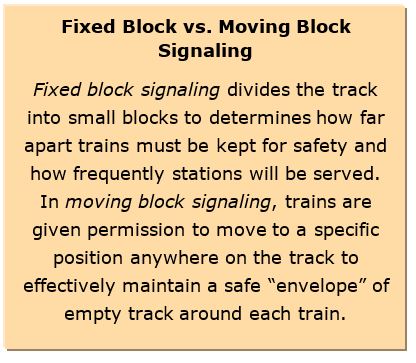 this standard has been successfully adopted outside Europe. ETCS supports intercity train traffic within Europe by making travel simple, comfortable, and relatively economical for passengers and operators.
ETCS is implemented along with the standard trackside and unified control equipment within the train. The lineside information is passed to the driver in the train, eliminating the need for lineside signals. ETCS Level 1 can be superimposed on the existing signaling system. ETCS Level 2, a digital radio-based signaling system, displays the train movement and other signaling aspects on onboard computers. However, the train detection, track vacancy, and the train integrity supervision have to be monitored from trackside using a radio block center.
ETCS Level 3 eliminates the need for track vacancy detection components and operates at fixed intervals. It uses the onboard equipment to obtain short positioning data signals, achieve continuous line-clear authorization, and implement fixed-block or moving-block operation (see sidebar).

The interoperable architecture and multi-vendor supply market have made ETCS enormously attractive for global rail operators. This led to ETCS becoming a critical standard for ATP on the mainline railways. The only concern with ETCS for existing rail lines is that it is unsuitable for the significant capacity increase as it overlaps with conventional fixed block signaling.

For metro railways with high requirements for capacity and performance, Communications Based Train Control (CBTC) is a popular signaling technology. However, as a supplier-proprietary technology, CBTC is not interoperable with other suppliers' products. While limited interoperability may be acceptable within metro railways, it is a major problem for large-scale mainline networks that need a multitude of interoperating products for their long-term sustainability.
To address the capacity constraints and because of the high expectations for infrastructure savings, demand for the ETCS Level 3 is on the rise. Level 3 will provide a foundation for higher levels of train automation to bridge the gap between CBTC and ETCS. Level 3 technology will enable the adoption of moving block, which means that two trains in succession can run at lower speeds. It also allows the removal of track-based train detection equipment, such as track circuits or axle counters. Ultimately, ETCS Level 3 is expected to reduce capital and maintenance costs and improve reliability and optimize train operations through autonomous driving, automatic train regulation, IP radio, and satellite positioning.

With onboard odometers, ETCS Level 3 allows trains to share their location with the TCC (train control center) every six seconds. Odometers are reset by balises at equal intervals and the TCC receives movement statuses in return. At present, the drivers must manually supervise train integrity.
ETCS Level 3 is a priority for ERA, which is experimenting together with interested global rail operators to implement this technology. The railway sector and ERA consider Level 3 as one of the game changers for a competitive and efficient railway system. The technology is still in the development stages and must address multiple issues before being implemented into a standard way of operation. The two main issues that need to be addressed are:
Level 3 aims to address these two problems and allow the needed capacity increases, the primary requirement at the moment. The core of the proposed system is to retain any existing track-circuit or axle-counter sections and create “virtual blocks” as sub-sections within the existing architecture.
To overcome technical complications imposed by the updated features, it is critical to align the balise position and the track-circuit/axle-counter section lengths to ensure that the positional information is accurate.
 Implementing the hybrid Level 3 concept will open the door for further automation. Examples include station/platform functions, automatic train regulation, and autonomous driving in depots and on open track. It will also strengthen the accompanying technologies for automatic train operation, moving block, IP radio, train integrity, satellite positioning, and so on.
While Level 3 functionality can be implemented in a relatively economical manner, it does not address the impact of radio failures. This requires urgent consideration as it also affects Level 2, unless lineside signals are retained.
A high-level route map has to be developed to help ensure successful implementation of the ETCS Level 3 strategy. The scope of the route map should not only include principal train movement control system elements needed to deliver the Level 3 objectives, but also cover other aspects that can be deployed earlier than Level 3 to deliver some of the potential benefits. The focus should inevitably be on the main line route type, but with some recognition for low-cost, high-capacity railway initiatives.
Train operating companies and/or their technology suppliers will need to address the following issues:
For more specific recommendations related to the above issues, please contact your ARC client manager.
If you would like to buy this report or obtain information about how to become a client, please Contact Us
Keywords: Automation, Train Control Systems, Digitization, Emerging Technology, ARC Advisory Group.