Representative End User Clients







Representative Automation Clients







Representative Software Clients








The process control group in refineries, chemical plants, power plants, and other industrial process facilities is responsible for applying and maintaining automation and other operational technologies (OT) that make process operations more efficient, less labor intensive, and safer. That “process control” role certainly isn’t going away, but the digital transformation technologies and associated skillsets required by those technologies are changing, requiring more information technology (IT)-related skills.
These changes demand that corporations rethink their approaches to internal organizational structures to be able to support the technologies more effectively. Industrial corporations need to assess both their IT and OT groups for organizational maturity, digital readiness, and ability to address technological change. Simply maintaining the internal organizational structures implemented in the early part of the 20th century will not drive the operational excellence needed to compete today, or in the future.
Process control technologies and techniques enable process manufacturing and other industrial processes to be automated. This allows complex processes to operate safely and more efficiently with fewer personnel onsite. Modern process control also enables monitoring and control from remote locations.
Until recently, few educational degrees applied specifically to the process control operator or even engineer functions. Companies hired engineering college graduates and conducted on-the-job training to introduce them to process control technologies. For the outgoing generation of operations staff, many had come up through the ranks of the instrument shop. In the not-too-distant past, the required skillset involved understanding what measurement instrument to use, what space was available on the panelboard for the single-loop controller, how much to trim the valve, and what paperwork had to be completed to get the work done.
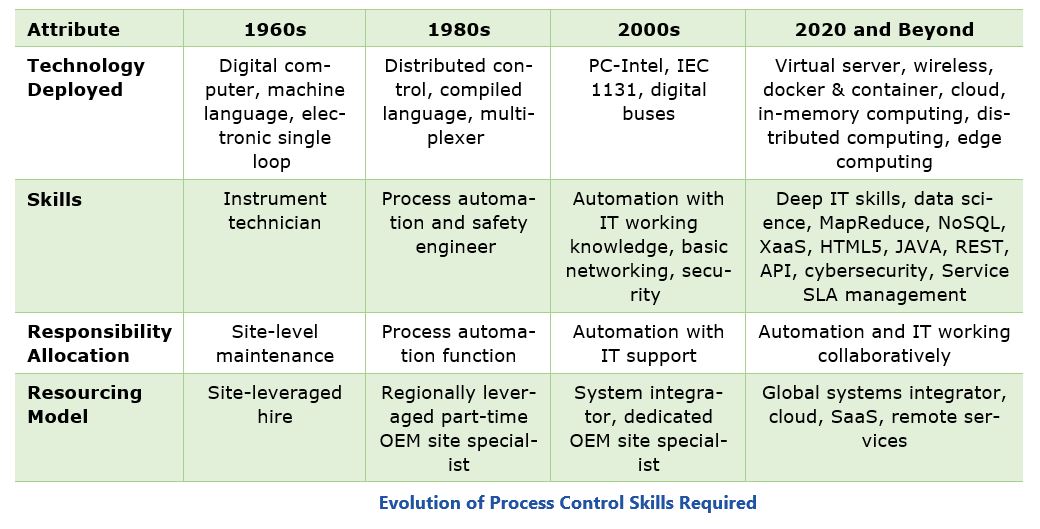
Previously, while an understanding of the process helped, process control-related work tended to be electromechanical in nature and relatively straightforward. Ladder logic programming for programmable logic controllers (PLCs) presented the only real challenge and was assigned to engineers. And since these PLCs offered very limited networking capabilities, this hadn’t yet emerged as a major challenge.
However, the 1980s saw a dramatic increase in the adoption of distributed control systems (DCS). Fortunately, these were easily networked by setting some switches and making a few twist connections. They also allowed control schemes to become more complex (something that happened very quickly) and made it much too easy to configure (often unnecessary and confusing) alarms. Electrical systems increased in complexity, as well.
Moving into the 1990s, instrumentation became more complex as computing and more sophisticated communications capabilities were added to field devices, allowing users to solve process control problems in new ways and/or more efficiently. In the mid-1990s, suppliers began to leverage common off-the-shelf hardware and software in the form of Microsoft PCs and the Windows (or, in some cases, UNIX) operating system coupled with Ethernet-based networking.
Process control in the 21st century has seen the addition of a slew of IT pushing into the OT space. No college education prepares a process automation professional for the full suite of technologies they must now deal with at the facility. Regardless, process control professionals must continue to support and improve the backbone of plant automation across the breadth of implemented technologies. In addition, IT has developed its own methodologies for managing and securing technology, which is slowly filtering into similar OT situations today. OT groups would do well to cross-pollinate many of these best-in-class approaches, but often don’t have the knowledge and capability.
Technology continues evolving. No longer does it just replace mindless tasks, it’s moving up into tasks that take some level of cognition. The tasks need to be done, but increasingly are done automatically (or programmatically). New software-based tuning capabilities, for example, have taken much of the "art" out of optimizing loop performance. Automation suppliers have put a lot of effort into improving ease of use: simplifying engineering processes, standardizing programming, and turning loop configuration practically into a rote activity. Control system maintenance tasks have also become easier due to new remote monitoring and condition-based maintenance approaches. This institutionalizes the knowledge to do these needed tasks and frees up talented human resources to tackle pressing problems.
However, this technology requires new skillsets to support it: skillsets traditionally found in IT. The skillsets required to support installed technology has also changed. Unfortunately, many companies still maintain a process control organization developed in the 1930s and have only evolved the procedures when absolutely necessary.
ARC Advisory Group clients can view the complete report at ARC Client Portal
If you would like to buy this report or obtain information on how to be-come a client, please contact us
Keywords: Process Control, Skillsets, Digital Transformation, Operational Technology, Corporate Culture, Change Management, IT/OT, ARC Advisory Group.