Representative End User Clients







Representative Automation Clients







Representative Software Clients








 This report employs a balanced scorecard approach to identify the practices that contribute to excellence in warehouse operations. A well-run warehouse is productive, safe, contributes to high customer service, and develops the skills of its purpose. It is tough to perform well in all these dimensions. In our survey, only 17 percent of respondents worked in warehouses that performed well across the board.
This report looked for best practices employed by the top-performing companies stand out from their peers. Those practices included:
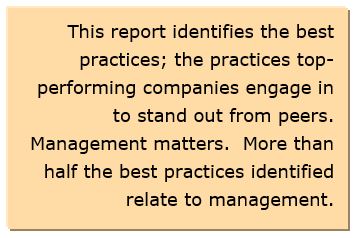
Management clearly matters. More than half the practices that contribute to excellence relate to management techniques. Good management techniques can be learned – being trained in how to give effective feedback helps. And 360-degree reviews where managers see what their subordinates say about them also help managers learn what is working for them and what is not. Further, diligence counts. A good warehouse manager does not sit in his/her office; but is out on the floor observing and interacting with people.
There were 176 survey qualified respondents. Our main partner for this survey was DC Velocity. Manhattan Associates and HighJump Software also helped by sending the survey to their customers. In general, the respondents’ warehouse environments were significantly larger and more complex than the average warehouse. Consequently, the survey’s descriptive analytics would be most suitable for benchmarking larger, more complex warehouse operations. Appendix 3 contains some descriptive analytics related to turnover.

This research employs the balanced scorecard strategic planning management system. There are many versions of the balanced scorecard and companies often implement their own version. The core idea behind this system is that it is often short-sighted to focus too heavily on productivity to increase profitability, since long-term viability also requires focusing on customers, learning and training, and other core goals.
This analysis looks at what high-performing warehouses are doing differently than other distribution operations. When there is a large enough difference in the way Top Performers behave compared to their peers, that factor should be viewed as a best practice.
We defined a high-performing warehouse as one that performs well in terms of productivity, customer service, the way it treats their employees, and safety. The following table shows our proxies for measuring those performance dimensions.
While many respondents did well in some of these performance areas, only 17 percent did well in all of them. These high performers in all dimensions represented the Top Tier.

Appendix 1 provides a more detailed explanation of the methodology. The demographics of the respondents can be found in Appendix 2.
Big distribution centers have a harder time retaining workers. Among companies with over 200 employees, 28 percent 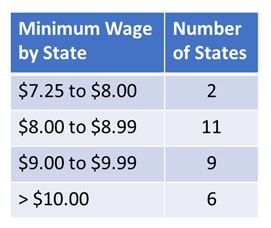 had employee turnover of less than 10 percent. Among companies with less than 25 employees, 46 percent of the respondents had less than 10 percent turnover.
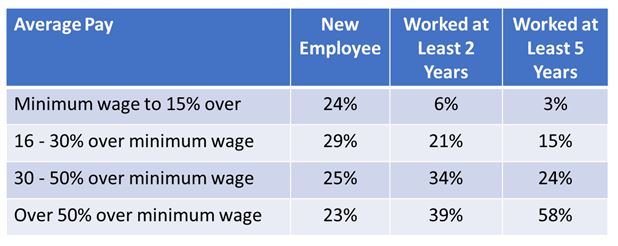
It would be logical to assume that paying workers more would lead to better retention. However, our analysis showed little association between pay and retention.
Warehouse pay is higher than one might think. The U.S. Department of Labor put out statistics on the average pay in the Warehousing & Storage Industry in 2015. For laborers and material movers that did not work with machinery, it was $14.59 per hour. For material movers using power equipment it was $16.97. While the Department of Labor statistics applies to the wages paid by third-party logistics (3PL) providers, our data shows that warehouses across all industries usually pay more than minimum wage, often significantly more.
So, what factors contribute to employee retention? We looked at over 20 factors that might explain retention. The only factor with strong correlation was providing a clean warehouse environment.[1]
When it came to retaining temporary workers, three factors helped explain retention.
While the ability to retain workers does not by itself indicate a high-performing warehouse, having great success retaining workers that are poor workers would clearly be counterproductive.
A high-performing warehouse (distribution center) is also productive, accurate, and safe.
When it comes to improving warehouse productivity, previous ARC research demonstrated that labor management systems based on engineered labor systems greatly increase productivity. In fact, companies really don’t know how productive their labor is unless they are using engineered labor standards; using benchmarking data can give a rough idea but is fraught with “apples-to-oranges” type comparisons.
For example, the Warehouse Education and Research Council (WERC) includes measures such as number of line items picked and shipped per hour for case picking and pallet picking. When it comes to each picking though, slower-moving SKUs are often picked to cart, while fast-moving items are generally picked in zones supported with conveyors. Thus, the throughput for pick-to-cart will never approach pick-to-zone.
We had hoped that Manhattan Associates’ participation in the research would result in a high number of respondents that used a labor management system (LMS), since these usually know for certain whether they have a highly productive warehouse. Unfortunately, we had to use a more subjective measure of productivity.
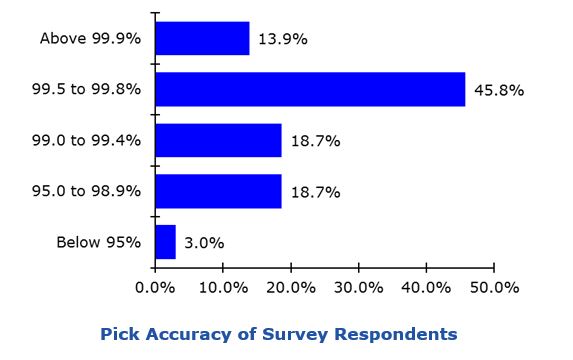
Because of the high number of respondents using warehouse management system (WMS) solutions, it was not feasible for us to associate the WMS to performance. However, for picking accuracy, a warehouse management system (WMS) is essential. ARC defines a WMS as a non-paper-based system that uses barcode scanning, voice, or RFID for data entry. The automatic identification solutions are used to verify pick locations, that the right number of items were picked, or even to verify that the right SKUs were picked. In paper-based warehouses, the picking accuracy is often in the low 90s. In warehouses using a WMS it is higher. In our survey, with a large proportion of the respondents using a WMS, most were achieving pick accuracy of over 99.5 percent.
On the safety dimension, a very large proportion of respondents reported working in safe warehouses, which made it difficult to identify the specific factors that contribute to safety.
Top Performers engaged in the following practices appreciably more often than their peers:
While only a few factors contribute to excellence in productivity, accuracy, or worker retention, several things do contribute to excellence for Top Performers that perform well in all areas. This included several factors that, when viewed by themselves, were not all that telling, but together, provided moderate explanatory value across the performance dimensions.
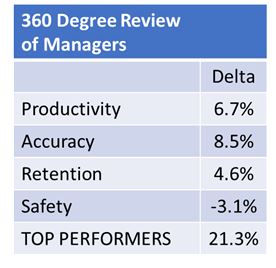 For example, one practice that contributes to excellence is the use of 360-degree reviews of managers, including feedback from the manager’s subordinates, peers, and supervisor, as well as a self-evaluation.
Highly accurate picking warehouses employed 360-degree reviews 8.5 percent more often than the group that included all respondents. ARC was looking for an appreciable difference, a delta of at least 15 percent, before we were willing to accept that a practice was strongly associated with higher performance. Thus, when it came to looking at accuracy alone, 360-degree reviews were not singled out as a practice worth emulating. But using a balanced scorecard approach in which Top Performers must perform well in all dimensions, they are significant. Top Performing warehouses used 360-degree reviews of mangers 21.3 percent more often than the group that included all respondents.
Management matters! More than half the practices that contribute to excellence relate to management techniques. Good management is something that can be learned – being trained in giving effective feedback helps. And 360-degree reviews in which managers see what their subordinates say about them also help managers learn what is working for them and what is not. Further, diligence counts. A good warehouse manager does not sit in an office; he/she is out on the floor observing and interacting with people.
Many of the management techniques reward soft skills - the way one person relates to another. Warehouse managers are still mostly male. More women, who tend to test better on soft skills, are clearly needed in logistics.
If you would like to buy this report or obtain information about how to become a client, please Contact Us
[1] We asked “Do you believe your employees view your warehouse as clean?” We looked at that subset of respondents that reported that they believed over 75 percent of their employees would say the warehouse was clean and compared all respondents to the group containing the Top Performers. Top Performers were 16 percent more likely to say that a high proportion of their employees would say the warehouse was clean.