Representative End User Clients







Representative Automation Clients







Representative Software Clients








The market for automation software is currently in transition. Since a few years, we are moving away from large monolithic on-premise deployment. ARC studies on HMI Software, MES, and PLM show this trend. Already today more than 7% of these software packages are installed in the cloud, and the market for this field increased by more than 30% in 2019 and grew further in 2020. We are in the middle of a transformation and within the next few years, we will see a dramatic change.
This change also impacts the market of cloud-based application platforms, where we see good double-digit growth over the next few years. The market also benefits from other software applications, such as AI, asset management, etc., which all leverage the storage and computing power of the cloud.
This development offers opportunities for software vendors, but also puts established vendors under pressure. Microservices-based software is a core concept of modern cloud application platforms, which are designed with opportunistic (and rapid) business/operational change as a key user benefit. The changeover from large applications to microservices is increasing as more companies understand the suitability of modern platforms for competing in digital economies. No-/low-code solutions are becoming increasingly available, both as standalone platforms and as additions to the coding development environment that defines the cloud platform category. In addition, some platform providers are finding success by targeting functionality, traditionally supported in monolithic operational tech stacks.
All this combines into one single conclusion: There will be more competition!
Often the change in deployment is also accompanied by a change in business models, and software is purchased as a service. This benefits the users as it keeps lifecycle costs low (maintenance, updates, security patches, etc.) while providing the automation supplier with a steady revenue stream. This change in business model also results in the so called “valley of tears”, a period of transition, when a company earns less, as it is moving away from selling costly one-time software to monthly subscriptions / service. (see here)
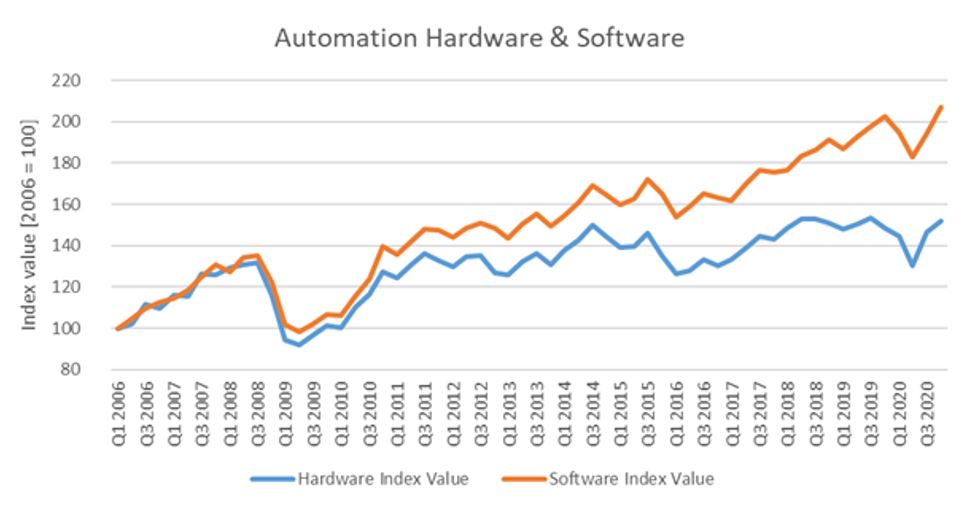
While this maybe sound a bit negative, you would expect the markets to suffer or slow down. Quite the contrary: Automation Markets are going up! (see chart). Over recent years, software markets were far more dynamic but have been stable in 2020, while hardware contracted significantly. Most companies have either gone through the valley of tears or are right in the middle.
I do not want to read too much into the results, but it seems currently that when you move up to the cloud, so do your revenues!