Representative End User Clients







Representative Automation Clients







Representative Software Clients









The combined market for engineering design tools (EDT) for plant design and infrastructure continues to experience stable and steady activity globally. The collective market of infrastructure, power, process, and marine domains includes a large portion of everything built in the world today. This includes buildings, ships, offshore bridges, city infrastructure,  roads & highways, rail transportation, electrical power generation & grids, industrial manufacturing plants, mining facilities, utility infrastructure, oil & gas facilities, chemical plants, and other process industry plants.
Over time, many capital expenditure (CapEx) projects for industrial plants and architecture have become very large, complex, time-consuming, and expensive. Because of this, the engineering procurement and construction (EPC) contractors involved in these projects have made a concerted effort to focus on efficiency, cost containment, and collaborative information access across the de-sign/build/operate/maintain lifecycle. Many of the EDT and building information management (BIM) suppliers currently involved in these markets now offer solutions that address these issues.
CapEx spending has steadied as companies and the governments that fund these projects consider the complexities and costs of new mega-projects in light of future global markets and business drivers. Risk aversion continues to be a significant element of project planning.
Economic macro trends currently affect the EDT, BIM, and architectural engineering, and construction (AEC) market as evidenced by some year-to-year revenue reports from leading suppliers and the flattening of the overall global business. Distinct market drivers include the continued decline of the global crude oil commodities’ market, a slowing down of growth in certain markets such as China and Brazil, and continued reduction and budget tightening for large capital projects in the oil & gas, energy, and civil infrastructure sectors.
Often, executing these massive projects requires forming joint ventures or partnerships between engineering, construction, and owner organizations. Interdependent joining of disparate stakeholders requires use of the latest generation of more collaborative 3D engineering design tools for efficient project execution. Asset owners now see the additional value that design tools can yield beyond the project phase and into the operating expenditure (OpEx) domain of the operate/maintain lifecycle. Next-generation 3D design applications play an integral part in the optimal design, creation, and construction of assets in plant de-sign and infrastructure and now also play an increasingly important role throughout the entire lifecycle of infrastructure and plant assets.
For the infrastructure/BIM portion of the design tools market, the current level of market activity results from the ongoing demand for creating new infrastructure in the developing regions of the world, as well as the need to update and improve existing infrastructure of industrialized countries. The existence of a supportive infrastructure in developing regions is a precursor that is enabling the expansion of industrial facilities in these regions.
The emergence of smart cities and the technologies that support them are driving a significant portion of the activity in infrastructure and BIM. Regional urban areas, as diverse as cities like Glasgow, Singapore, and Shanghai, are adopting technologies that support a move to the next generation of the smart connected city. This involves planning for infrastructure, transportation, security, and building a smart connected ecosystem of building management systems (BMS) based on IoT. Technologies like large-scale 3D virtual mapping and models and other geospatial applications  are enabling city planners, architects, and construction companies to develop, design, and build the next generation of smart cities.
Emerging technologies are having a considerable impact on both plant design and infrastructure. These include technologies like virtual reality systems that capture the physical world and create 3D models using advanced photometry, laser scanning point cloud, and photon LIDAR systems. Virtual reality fuses perception and reality to enable human designers and engineers to interact with the digital 3D models captured from the physical world in a more natural and intuitive manner. Advanced geospatial technology also allows users to accurately map any part of the physical landscape on a global basis. Building new generations of smart cities will depend heavily on these technologies.
Building information management (BIM) solutions have been around for several decades. Initially, BIM was an organized repository for managing original 2D and 3D engineering design files to manage revisions, review designs, and support construction activities. Today, the scope and function of BIM has expanded to also support information collaboration across the design/build lifecycle of projects. Today, BIM embraces everything from parametric modeling to  CAD details, plus specific information about the objects that comprise the design. This information could be used across the CapEx lifecycle of the building (design, procurement, materials management, and construction).
The overarching BIM concept is to provide the user with a digital copy of the physical reality: a virtual building. This involves an object-based model that contains all the information needed to design, build, operate, maintain, and transact information. In other words, a digital, searchable, accessible, and accurate system of record. A complete BIM system represents a “single version of the truth.” Today’s BIM solutions largely focus on the design/build process. However, as BIM evolves it will move into the operate/maintain, or OpEx side of the building lifecycle. As the overall AEC industry moves into the digital future, every building will have a BIM model, or a complete digital representation to support information collaboration across the entire CapEx to OpEx lifecycle.
To further support information collaboration in CapEx projects, moving BIM data to the cloud is clearly the next step for BIM solutions. Typical building projects involve a large cast of players across the design, procurement, materials management, and construction project lifecycle. Making BIM information accessible from the cloud makes it easier for stakeholders across all disciplines (design, engineering, construction, operations, etc.), organizations (AECs, EPCs, equipment suppliers, owners, operators, etc.) and geographically dispersed locations access and update the appropriate data.
Large and complex building and infrastructure projects typically involve many contractors performing structural, electrical, and mechanical work; plus suppliers providing/installing a variety of equipment and systems such as HVAC, communications, security, and environmental. These typically span multiple engineering disciplines. These entities all require appropriate access to engineering design, procurement, materials management, construction, equipment, components, project management, and/or asset management information. A BIM cloud environment deployed on servers on local machines and operating over LAN, WAN networks, and the Internet can provide all of the BIM information required by all the participants and stakeholders across the project.
Many countries around the globe have developed and implemented national policies that mandate BIM structures and methodologies for all domestic AEC and infrastructure projects. The objective, of course, is to ensure that the BIM is implemented correctly and the projects are “done right.” The countries that have developed and implemented BIM standards and guidelines have realized that the only way to improve and optimize capital infrastructure and building projects is to define BIM and mandate that it be “done right.” Typically, this involves a set of requirements that focuses on three broad areas: process, infrastructure and standards, and execution.
The process begins with defining BIM requirements in the owner/operators’ contracts with service providers and sub-contractors (to plan, design, construct, and operate the facility) and with other stakeholders based on the project delivery method. Early in the capital project, a successful BIM process involves identifying the roles and responsibilities of key project stakeholders with respect to information modeling as well as creating a BIM project execution plan (PEP). The results/outcome-driven BIM roadmap details how the project will be completed and deliverables met.
Infrastructure and standards focuses on the human collaboration and software interoperability needed to model the project information successfully, especially as the project progresses from phase to phase. To achieve the necessary level of collaboration, the owner/operator must require all members of the project (BIM team) to adhere to a framework of standards, definitions, and structure from the project’s onset.
Execution involves and encompasses creating a project implementation plan at the project onset. This represents a master plan for how the information will be modeled and managed. The PEP documents the owner/operators’ and the BIM project team’s agreement on how, by whom, when, why, to what level, and for what project results information modeling will be used.
A wave of new technologies is impacting the combined plant design, infrastructure, AEC, and BIM sectors in a number of ways that are already starting to have a significant effect on these areas. These effects will only accelerate in the future. Collaborative information platforms will connect engineering, construction, and operations across a digital thread that spans capital projects and operational asset management. Technologies like generative design, machine learning, and predictive analytics are already being utilized. The virtual and physical worlds will be merged with virtual reality (VR) and augmented reality (AR), enabling designers and builders to create virtual models of everything from a power station to a city, and maintain and support physical assets with virtual engineering information in a combined environment for maintenance technicians.
EPCs consistently point out that one of the primary contributors to cost and time overruns for capital projects is the lack of a continuous and timely flow of complete design/build information across the CapEx/OpEx lifecycle. Both EDT and BIM solution providers have recognized this issue for some time and have focused on providing tools and solutions that address this persistent problem. Leading BIM providers offer solutions that address and enable information collaboration across the design/construct/operate stages of the lifecycle.
A collaborative BIM information environment starts with the engineering design, which typically represents around 3 to 4 percent of the cost of a capital project, and progresses to procurement, materials management, and construction planning. The “build” stage is where the significant portion of the project costs begin to accrue and where inadequate access to all BIM information is most critical, since inefficiency and lack of information here can result in subsequent cost overruns and time delays.
Following engineering design, the next would be the actual construction implementation tools (construction workflows, staging, sub-contractor management, etc.) that come into play, along with collaborative software solutions that enable all project participants and stakeholders to access all BIM information.
Finally, asset lifecycle information management (ALIM) solutions provide a continuum of engineering information to the OpEx-related operations and maintenance side of lifecycle.
Good-quality design, engineering, and asset information is digital, searchable, accessible, accurate, and useful, and the ultimate expression of good quality information for buildings and plants is a digital replica of the physical reality. In other words, what a BIM solution provides.
An integral part of the overall digital transformation for the plant de-sign, infrastructure and BIM sectors are the technologies that enable the implementation of the digital twin. EDT suppliers now offer tools and applications that enable users to build large-scale 3D virtual models of existing industrial plants and complexes, buildings and even entire cities.
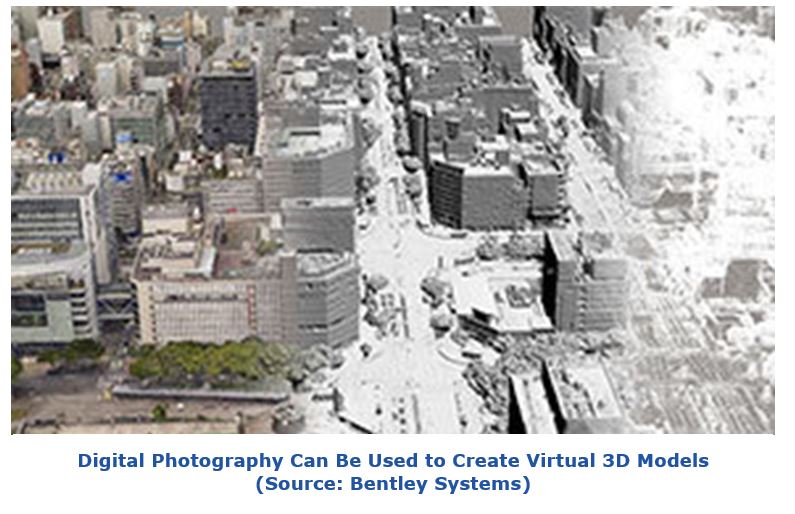
Laser scanning point cloud technology has been around for some time and is used to develop very accurate 3D models of buildings, equipment, and plants within the range of the laser scanning equipment. Photogrammetry technology uses  ordinary digital photography to develop 3D models from photos. The more photos taken of the facility, building, plant, power station, transportation infrastructure, or city, the more accurate the model will be. A wide spectrum of mobile vehicles, drones, and aircraft to photograph and digitally capture virtually every aspect of the subject; limited only by the range of the human photographer, vehicle, drone, or aircraft. Companies and municipalities are using this type of reality modeling to virtually capture the real world to create 3D models to service and maintain existing infrastructure and design and develop the next generation of smart cities.
Augmented reality (AR) is another rapidly emerging technology, particularly for construction, building and plant maintenance, and infrastructure and civil engineering. AR represents a merging of real-world, real-time video with virtual 3D models overlaying the physical images. This technology is being adopted for both construction activities and to support and maintain equipment in field. Virtual images of wiring, piping, conduits, and other construction components can be overlaid on physical walls, construction, floors, roads, etc. that enable the user to see the virtual image in the existing physical environment. For example, workers can visualize underground infrastructure before excavation, helping prevent damage to any existing electrical cables, sewers, and gas lines. AR can enable construction workers to visualize the installation of electrical, mechanical, and HVAC systems before they install the physical equipment.
Moving from the capital project activities of design and construct to the operational side of the asset lifecycle, the major stakeholders become the owner-operators whose focus is on operating and maintaining these often expensive and complex assets effectively, efficiently, and safely. Predictive operational analytics applications and solutions are emerging to help address both asset management and overall asset performance.
Today’s owner-operators need to understand operational data and the related costs in near-real-time, and identify areas for improvement that increase reliability, performance, and safety to optimize overall asset performance.
As industrial sensors become the intelligent edge devices in the IIoT, large volumes of asset data can be collected, aggregated, analyzed, and turned into actionable information. Predictive operational analytics and advanced visualization solutions such as interactive dashboards reveal and display patterns and provide timely, actionable intelligence to enable operations personnel to make informed decisions that affect asset performance, safety, security, and regulatory compliance. Operators can use these tools to predict future performance and take proactive actions that minimize disruption and downtime.
The overall global market for engineering design tools (EDT) for plant design and infrastructure/AEC/BIM remains robust and the demand for these tools by both EPCs and owner-operators is driven by continuing regional growth in both industry and residential and non-residential buildings and infrastructure.
Today, the primary focus for the users of these tools is to substantially increase the efficiency of capital projects while decreasing cost, re-sources, and time. Across industries like oil & gas, power generation, utilities, construction, and  manufacturing the cost and time for building new plants, factories, infrastructure, buildings, and cities constrains the capacity, resources, and ability to initiate and implement much-needed new projects.
Suppliers for EDT/BIM solutions and applications are addressing these pressing needs to optimize and streamline the CapEx to OpEx lifecycle with better tools for design, procurement and materials management, construction planning and workflow, asset information management, project management, and collaborative BIM software. Additionally, we are seeing the emergence and adoption of technologies that are making a significant impact on all areas of the design/construct/maintain lifecycle. This includes virtual reality, augmented reality, prescriptive analytics, and geospatial technologies.
If you would like to buy this report or obtain information about how to become a client, please Contact Us