Representative End User Clients







Representative Automation Clients







Representative Software Clients









Today’s asset-intensive organizations face multiple competitive-, market-, and economic-related challenges, not the  least of them relates to managing the business during a pandemic. This drives the need for new and expanded asset performance capabilities that go beyond traditional maintenance management approaches to include improved access to process data. Asset and process reliability, and the scalability of solutions is needed in today’s next-generation asset performance management (APM) solutions.
APM’s reach extends beyond maintenance tasks and includes mechanical and process equipment integrity. It also should include other performance metrics that encompass full asset availability. Central to this approach is a need for proper planning and scheduling, and visibility into asset availability. The result includes products that have the best quality, yield, and lowest waste. This is because decisions are based on critical cost and risk factors for full lifecycle performance, and not just mechanical integrity.
Most asset-intensive industries require not only access to real-time or near-real-time asset and production data, but enterprise-wide insights and information. This helps ensure that “a single version of the truth” is readily available to maintenance, operations, and planning teams. Central to this need is an ability to better categorize, model, plan, schedule, and analyze data across systems. Consequently, these teams need effective APM tools to help them assess asset performance and make critical decisions quickly, safely, and in a timely manner to avoid unplanned downtime and optimize production. This is often a key objective for digital transformation in industry.
With maintenance, process engineering, planning, and operations teams having to contend with such a broad array of challenges, there is a pressing need for advanced features to better manage industrial assets. Enterprise-level visibility

into asset and production data is critical to manage assets and ensure that performance meets business objectives and organizational needs. This requires the ability to better categorize, model, plan, schedule, and analyze data across systems; connect the data; and provide real-time visibility into asset availability and performance.
A key component of AspenTech’s asset optimization strategy is Asset Performance Management. Its overarching function is to enable the optimal performance of processes, the plant and plant assets over their lifecycle.
Key factors in AspenTech’s current APM solution portfolio are managing mechanical and process Asset Availability, assessing the risk and cost consequences of decisions made in managing the assets, and assuring appropriate Process Health and identifying conditions that lead to equipment degradation or off-spec production with prescriptive guidance on how to avoid damage-creating issues through timely process changes.
Collectively, these uncover insights into the condition of plant assets and processes across the enterprise, help improve asset availability and uptime, and optimize production processes and asset effectiveness in such important areas as planning and scheduling, control and optimization, and monitoring and execution.

As a central part of its strategy to help accelerate manufacturers’ digitalization journeys, AspenTech has further incorporated artificial intelligence (AI) into its latest, cloud-based V12 APM solution to support event analytics and new “Maestro” capabilities to help users select and prepare data for predictive maintenance Anomaly and Failure Agents, perform engineering tasks, and – critically – incorporate the knowledge of plant domain experts as appropriate guiderails for machine learning. Such Agents can be deployed rapidly at enterprise scale, without the need for intense data science or engineering skills, to enable more timely and accurate assessment of asset status and predictive capabilities. According to AspenTech, benefits include improved asset reliability to minimize risk and maximize asset availability and utilization.

Aspen Event Analytics, a new component of the V12 solution with embedded advanced analytical capabilities, helps frontline workers simply and rapidly understand why abnormal deviations occur, and promotes them to uncover insights into what actions can be taken to avoid or minimize disturbance impacts. These include:
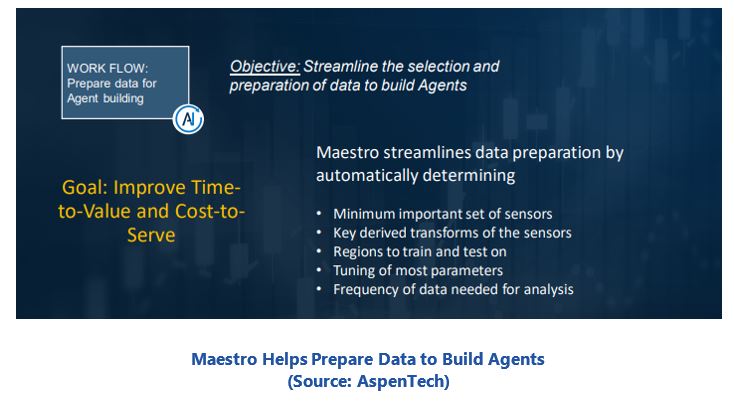
AspenTech incorporated “Maestro” enhancements in AspenTech Asset Performance V12 to help overcome the typical complexity associated with managing data for embedded analytics for maintenance and operations teams. These enhancements help users schedule and prepare the data needed to build Failure Agents for constructing engineering task workflows.
Maestro is particularly powerful as it incorporates domain knowledge with machine learning. This approach ensures the Maestro Agents uncover causation of problems, rather than just correlations. It streamlines data preparation by automatically determining such important information as:
Today’s asset-intensive industries require advanced asset management capabilities that go beyond basic maintenance planning and scheduling and work management. Also needed is an ability to access historical and real-time or near-real time data and translate it to actionable information.
Advanced capabilities, such as connectivity to various data sources and functional data analysis across a wide variety of maintenance and operations data is fast becoming a must-have for all levels of the organization. Organizations without such capabilities will find themselves at a competitive disadvantage.
At the same time, highly effective organizations are using methods and technologies to become even more competitive. Examples include self-optimizing methodologies, embedded AI, and cloud-based applications. Collectively, APM solutions such as AspenTech’s latest Asset Performance Management V12 solution can help accelerate digital transformation for users across a variety of industrial sectors to help achieve the ultimate vision of the self-optimizing plant.
ARC Advisory Group clients can view the complete report at ARC Client Portal
If you would like to buy this report or obtain information about how to become a client, please Contact Us
Keywords: Asset Performance Management, APM, Asset Reliability, Prescriptive Maintenance, Agents, Analytics, Machine Learning, APM 4.0, Process Reliability, Artificial Intelligence, ARC Advisory Group.