Representative End User Clients







Representative Automation Clients







Representative Software Clients








This year’s NAMUR General Assembly, held on November 4th and 5th, was again a virtual event, called “Exchange Forum.” The event had four parallel sessions and drew around three hundred attendees, about half of what a classical General Assembly would bring together.
The unofficial theme was CoSyMoNoS, a term dubbed by Dr. Thomas Tauchnitz, which stands for Connectivity, Safety/securitY, Modularity, Normed, and Simple. These concepts were crystallized in the following topics at the General Assembly:
The Open Process Automation Forum was represented by Jacco Opmeer (Shell) and Ryan Smeltzer (ExxonMobil). The latter announced ExxonMobil’s decision to implement a field trial using the OPAS standard, based on existing equipment in a plant with 2-3000 IO, 200 control loops and several PLCs. ARC prepared a detailed report on this topic. OPAF’s contribution reinforced the alignment between OPAS and NAMUR.
DEXPI and ISO 15926 are the information models that NAMUR focuses on for engineering and for handover to operations. In operations, there are needs to compare the actual plant status compared to engineering specification, to check if equipment is being used within its design limits, and this is greatly facilitated by reading out as-is equipment information using NOA. The information models from engineering and operations could both be implemented in an Asset Administration Shell of the equipment, consistent with the statement from 2018 that both engineering and operational information should be represented and stored next to each other, rather than in a single information model that would confuse the two types of information. An introduction to NAMUR’s view on engineering information models is provided here.
First experiences with Advanced Physical Layer (APL) indicate that the technology is ready to be used. Ring or star-based topologies are simple to engineer and set up, existing fieldbus cabling can be reused, and provider interoperability is operational. Equipment diagnosis using NE 107 status symbols is possible, basic implementation is configuration-free and for more advanced functionality FDI device integration can be used. Although separate topologies can be implemented, APL can also handle control and safety functions over the same network, a component that was missing in fieldbuses. NAMUR identifies the Profinet and Ethernet/IP protocols as the most promising alternatives.
MTP progress is substantial: NAMUR and ZVEI advance on requirements and technical specifications. Jointly PNO/PI was identified as a future host organization that will maintain the standard, develop, and implement certification approaches and push international (IEC) standards. VDI/GMA will continue to create German standards, completing the VDI 2658 series. HMI and process control components are considered ready for implementation, current focus of the work is on maintenance, safety and security, and the process orchestration layer (POL). As there are many details to report, NAMUR decided to devote a separate meeting to MTP in the spring of 2022. For a recent status of MTP and an in-depth analysis of implications of MTP for the future, we recommend this article.
The NAMUR Open Architecture has four main components:
The exchange forum included detail presentations about the NOA. The first presentation detailed how the information model (IM) was derived from requirements derived from target use cases. Parameters in the model are taken from available IEC Semantic ID’s (IRDI’s) in the common data dictionary (CDD) defined in IEC 61987 and/or eCl@ss. In some cases, the CDD had to be amended with new parameters. This guarantees standardized semantics rooted in an established standard. The NOA IM has been implemented in OPC-UA but is in principle technology-neutral. In the future other technologies could be used as well.
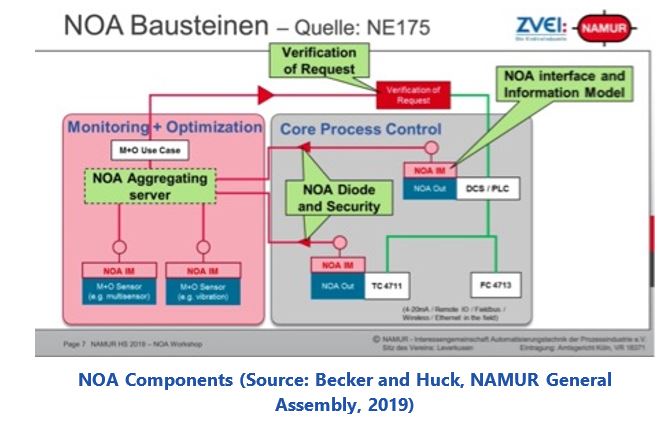
Also, in the case of NOA, a tight cooperation took place between users (NAMUR) who listed use cases and derived parameter lists from them, IEC adjusting the CDD, and ZVEI, FieldComm Group and OPC Foundation for the practical implementation. This close cooperation is probably a key success factor in getting quickly to practical application and products on the market. The result is that Process Automation Device Information Model (PA-DIM), composed of a companion specification of OPC-UA, the standard part, a section with the content of the FDI device package, and a vendor-specific section, is compatible with the NOA IM.
ARC Advisory Group clients can view the complete report at ARC Client Portal
If you would like to buy this report or obtain information about how to become a client, please Contact Us
Keywords: NAMUR Exchange Forum, Connectivity, Safety/Security, Modularity, Normed, Standardized, Simple, NOA, MTP, APL, OPAF, Information Models, ARC Advisory Group.