Representative End User Clients







Representative Automation Clients







Representative Software Clients








As evidenced by the 2021 United Nations annual climate change conference, COP26 (Conference of Parties) climate agreement and the latest Intergovernmental Panel on Climate Change (IPCC) report, we are in a critical time of action on climate change with irrefutable degradation across the Earth’s climate system, atmosphere, oceans, ice floes and on land. This, combined with a shift in corporate mindsets following the past two years of the pandemic, is reshaping industry, sparking innovation, and accelerating transformational technological change throughout the sector. 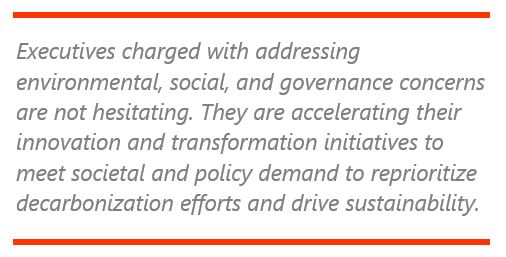 Automation, data, and applications are the foundation for transformational change. Adding analytics and artificial intelligence, combined with human insight, can drive performance optimization throughout the enterprise.
Leaders, having forged their digital strategies in the real-world crucible of the pandemic, are accelerating their innovation and transformation initiatives to meet societal and policy demand to reprioritize decarbonization efforts and drive sustainability. Connected, remote and frontline workers have become accustomed to a cloud-first way of working, initially to ensure business continuity during times of volatility, but now to normalize efficient and agile working models on an ongoing basis. A variety of disruptive technologies have demonstrated their ability to transform business operations and competitive strategies,  improve resilience, reduce costs, and better serve customers. This increased confidence in the power of transformation is now being leveraged to accelerate sustainability ambitions.
Investors, customers, regulators, and other stakeholders are increasingly pressuring industrial companies to be proactive in addressing environmental, social, and governance (ESG) concerns. This dynamic has been growing for some time, but it has only accelerated with the release of the latest Intergovernmental Panel on Climate Change (IPCC) report. Described by U.N. Secretary-General António Guterres as a "code red for humanity," the new report by the IPCC says that global warming is dangerously close to spiraling out of control, and that rapid action to cut greenhouse gas emissions could limit some impacts, but others are now locked in. According to the report, unless there are immediate, rapid, and large-scale reductions in greenhouse gas emissions, limiting warming to close to 1.5°C or even 2°C will be beyond reach. “This report is a reality check,” said IPCC Working Group I Co-Chair Valérie Masson-Delmotte.
Leading companies are heeding these warnings and understand that they are best positioned to respond effectively by accelerating their digital transformation initiatives.
In September 2019, the UN Secretary-General called on all sectors of society to mobilize for a “decade of action” on three levels: global action to secure greater leadership, more resources, and smarter solutions for the Sustainable 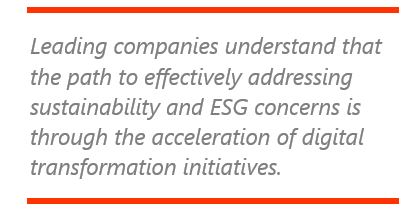 Development Goals; and local action pushing for the required transformations. The COVID-19 pandemic has imperiled progress towards the UN’s Sustainable Development Goals, making achievement of these goals by 2030 even more urgent and necessary.
The IPCC report mainly focuses on reducing greenhouse gas emissions. This usually manifests as energy reduction initiatives throughout the value chain, where initiatives targeting water, air, gas, electricity, and steam (WAGES) improvements can yield benefits. Another important and related concept, the circular economy, is increasingly embraced by companies who seek to participate in a resource-efficient, climate neutral economy. By applying new strategies to raw materials, parts, and products throughout the lifecycle, resources will continue as part of the system instead of being used and discarded. Environmental concerns consider how a company performs as a steward of nature, and social measures focus on relationships with employees, suppliers, customers, and the communities in which it operates. All these concepts, together with related governance initiatives, benefit from accelerated digital transformation programs.
COP26 has arguably resulted in the most ambitious international climate agreement to date. Though we still can expect to see 2.4℃ warming, all nations did agree to return to COP27 with more aggressive goals, just keeping the 1.5℃ Paris goal alive. One important and encouraging development is worth noting – the financial community is moving ahead aggressively, because climate change is seen as a real risk to the global financial system. The Glasgow Financial Alliance for Net Zero (GFANZ), a global coalition of leading financial institutions committed to accelerating the decarbonization of the economy, committed to drive their portfolios to net zero by 2050. GFANZ looks after about a third of the world’s assets ($130 trillion). This in turn will pressurize industrial companies, who will increasingly embrace digital transformation in response.
A related development from the COP meeting is the announcement of the International Sustainability Standards Board (ISSB). The ISSB aims to standardize ESG reporting and integrate climate disclosure with financial disclosure. Instead of today’s voluntary and often misleading carbon disclosure, company financial reports will feature audited and assured emissions, climate policies and forward-looking statements. New analytics, tracking, software, and management systems will be needed to adequately develop and report about a company’s carbon footprint.
Environmental, Social and Governance (ESG) compliance with regulatory bodies and government policies and requirements is a dynamic challenge that continues to accelerate and evolve with increasing climate and social pressures. Initiatives like the European Green Deal, which aims to make Europe climate neutral in 2050, have non-trivial compliance impacts for industrial companies. With the United States rejoining the Paris Agreement and adopting a more aggressive climate agenda, American compliance requirements will also increase. Companies must act to quickly find new, more sustainable methods of “normal” operations.
Improving sustainability will require increased upstream and downstream optimization and tracking, necessitating systems that touch many different customers, partners, systems, and information. This demands an unprecedented scope and scale of solutions to enable industries to be more resilient and agile, including strong industrial data management and robust software applications for both engineering and operations. Companies need to collaborate, innovate, and effectively respond in real time to the dynamic needs of their customers and partners. Both suppliers and customers are increasingly expected to ensure more transparency in supply chain transactions. Companies that can provide high-quality data will have a competitive advantage. This data can also help mitigate risks arising from poor social and environment practices in the supply chain.
Automation, data, and applications are the foundation for transformational change. Adding analytics and artificial 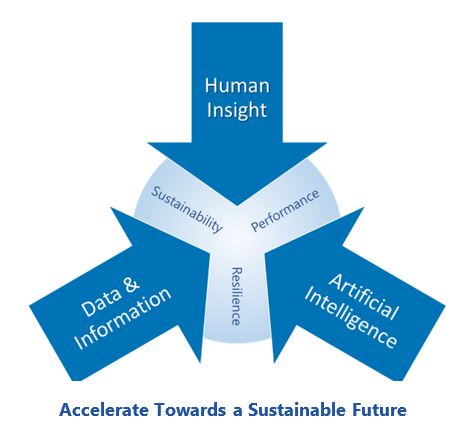 intelligence, combined with human insight, can drive performance optimization throughout engineering, production operations, and the enterprise. To accelerate decarbonization efforts and help your organization respond to the business pressures arising from COP26, pursue “intelligence as a service” and data sharing throughout your ecosystem, enabled by cloud, and enriched by real-time collaboration, with AI-enriched decision support and sustainability-first operating models.
Last century’s approach to optimizing production operations – focused on maximizing the efficiency of standalone operations – doesn’t address today’s need for agile, responsive production systems. Integrated, holistic data can drive operational efficiency and power business processes that extend beyond the plant floor all the way to the customer. Smart, vendor neutral industrial data acquisition and management solutions can help simplify design, optimize production, increase transparency throughout the supply chain, and empower organizations to realize newfound value in circularity and energy efficiency.
In engineering, AI can help reduce total cost and reduce risk in capital projects through automated design generation. In production, predictive analytics technologies can take energy efficiency to the next level, with predictive emissions capabilities allowing organizations to minimize their carbon footprint, ensuring that processes are optimized and consistent with operating and regulatory requirements. In some circumstances, AI can automate and monitor closed loop processes to support full autonomous operation. Planning and scheduling can be optimized through AI with simulation helping create a self-learning approach for continuous improvement to reduce risk and maximize profitability. In maintenance, several AI techniques can be used to increase the reliability and performance of assets through predictive and prescriptive analytics and predictive maintenance.
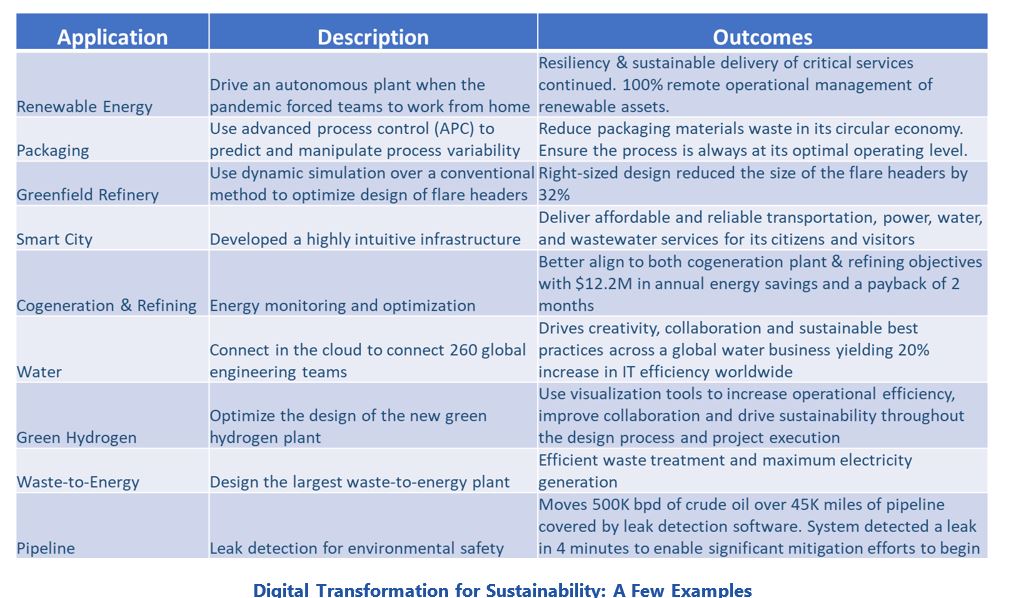
The payoff can be big. In one example, a regulated and non-regulated utility with over 60 plants in 7 states added low-cost sensors and connectivity to their generating fleet for high-fidelity data access. They centrally monitor the power generation assets with predictive asset analytics software. The system saved the company over $34 million in a single early catch event in 2016.
Cloud platforms for applications and the Internet of Things (IoT) are not only becoming a core piece of operations technology (OT) and engineering technology (ET) solutions for many industrial companies, but they are also a major enabler of sustainability initiatives and outcomes. These platforms provide a modern approach for developing and deploying software applications with infrastructure-as-a-service, providing easy access to Big Data, and addressing security and availability requirements, making it easy for remote, connected workers to access the cloud platform to perform their duties. Using a cloud platform will enable separating design-time, run-time, analysis, and visualization functions into separate models – a practice that organizations in many industries are increasingly adopting. Many process industry and manufacturing companies will want to deploy a hybrid on-premise/cloud approach to address sometimes conflicting requirements for performance, security, availability, and the like.
When combined with powerful industrial software applications that incorporate artificial intelligence, for example, cloud platform solutions can enable the development of digital twins and sustainable models and processes. For example, a global industrial water treatment company wanted its engineering teams all around the world to work remotely, yet together, on one platform that incorporates all their engineering data. They wanted their staff to work in a collaborative way, in real-time, all along the design and build phases. By using an engineering solution in the cloud and a variety of other solutions, the company achieved a 20 percent improvement in IT agility and increased efficiency and collaboration by unifying multi-discipline engineers on a single, cloud-based data-centric platform.
The urgent need to improve sustainability is a key driver in accelerating industrial digital transformation initiatives at many companies. The pursuit of innovation and continued investment in digital transformation are critical to ensuring that acceleration. We are in a critical time of action on sustainability, and recent events have heightened confidence and investments in available transformational approaches and technologies.
Achieving a low-carbon industrial future requires transformational thinking and a digitally skilled workforce, together with three core elements: next-generation automation, software and analytics, and a clear focus on energy optimization. Together, the three elements of this sustainability triad deliver positive outcomes that are greater than the sum of each part.
Automation unlocks production sustainability by optimizing process, energy, and resource use, cutting operating costs, and eliminating avoidable safety issues. Software-centric automation built on open standards can boost interoperability and digital collaboration, allowing industries to bring products to market sooner, increase competitiveness and turn IoT data into bottom-line value. Automation saves time and money while developing new skills.
Software and analytics can provide data-driven insights so that industrial operations run efficient processes with digital transparency and unified control that can optimize scheduling and enable production operations to be more responsive and resilient. Using a full suite of digital tools and end-to-end software transforms information by combining artificial intelligence, digital twins, and human insight, to unlock higher levels of performance. Deeper analytics optimize assets while real-time data management ensures resilient industrial ecosystems and digitized traceability that supports circularity.
Energy optimization can propel industrial decarbonization at scale. Increased electrification and other fuel-switching strategies, alongside the convergence of power and process energy, can rapidly reduce industrial waste. Recycling also promises to lower energy demand. Smart and green electricity with renewables and storage can alter how we power machines, processes and plants and tackle resource use across industrial value chains.
It’s important to understand the global reach, experience, expertise, and partner ecosystem when considering a solution partner for any accelerated digital transformation program. Look for solutions that can deliver more accurate and reliable data, together with contextual information. Improving sustainability means improving processes and increasing transparency throughout the entire supply chain with integrated, holistic data driving operating efficiency and delivering sustainable business processes that extend beyond the plant floor all the way to the customer. Examine potential AI solutions to be sure they can support total cost and risk reduction in engineering, energy efficiency and optimized processes in production operations, and optimized asset reliability and performance. Seek cloud-based solutions that provide a seamless approach for developing and deploying software applications and connecting workers while engaging a community of stewards to advance sustainability.
Our “code red for humanity” must not be ignored. Industrial organizations have a huge role to play in helping to reduce global warming, reduce emissions, and halt sea level rises and the degradation of up to 80 percent of planetary biodiversity. The digital tools that can power these transformations, together with actionable roadmaps helping industries advance their own decarbonization strategies, provide a way forward from COP26 and a pathway to accelerate a 1.5-degree future.
Leading companies understand that the path to effectively addressing sustainability and ESG concerns is through the acceleration of digital transformation initiatives, and they are already on that path. For others, the time to start is now.
ARC Advisory Group clients can view the complete report at ARC Client Portal
If you would like to buy this report or obtain information about how to become a client, please Contact Us
Keywords: Sustainability, Circular Economy, Net Zero, Energy Efficiency, Build Back Better, SBTI, SASB, Innovation, Digital Transformation, Industrial Software, Cloud, IPCC, Decade of Action, Climate Change, Greenhouse Gas Emissions, Environmental Social and Governance (ESG), ARC Advisory Group.