Representative End User Clients







Representative Automation Clients







Representative Software Clients








Automation and control system modernization remains one of the major issues faced by manufacturers. These systems 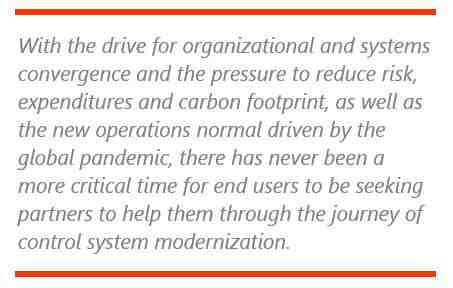 don’t meet the requirements for cybersecurity protection, or the ability to leverage technologies, such as digital twin, cloud computing, advanced process control, predictive and prescriptive analytics, AR/VR, AI/ML, edge computing, and remote and autonomous operations. End users are primarily concerned with preserving their installed plant assets to reduce risk, prevent or minimize any possible unscheduled downtime, as well as increasing organizational efficiency by consolidating its automation and electrical systems and personnel.
Organizational and systems convergence, the pressure to reduce risk, expenditures and carbon footprint, plus other factors are driving end users to seek out solutions to help them modernize their control systems.
The pandemic has shifted market demand more abruptly than any single event that we have ever witnessed, drastically increasing the need for companies to respond faster and become agile, to be operationally resilient and thrive in this new world. End users must deal with this new reality, running their operations and control systems remotely with employees working from home or socially spaced within the plants. Digital transformation has accelerated the ability for physical and organizational boundaries to be broken to engage a real-time workforce, connect teams, and drive collaboration.
End users are under pressure to manage their supply chains to maintain their integrity and flexibility to respond to market demand shifts, from remote locations with the tools to monitor uptime with real-time visibility and control. Digital methodologies have accelerated, driven by the need to reduce risk, protect against failures, ensure product fulfillment, and protect personnel, while leveraging enhanced security architectures.
This is why cloud technology, previously just considered for certain applications (e.g., historian data), is so essential to enable remote, secure solutions that drive faster business value. Cloud is much more than just a hosting option, as digital transformation and the cloud changes the way people work, simplifies processes, connects teams, adds visibility to data, and boosts business agility. Cloud is now an essential part of any control system, but cloud technology cannot be fully leveraged without control system modernization. And especially in these times, if end users don’t have a cloud strategy yet, they will not have the flexibility and agility to maintain a competitive advantage in today’s new normal.
Cloud infrastructure provides an essential foundation to host the necessary software tools, enabling teams to leverage information and construct digital twins. Digital twin technology allows for the efficient building of digital models of complex assets and processes. It also complements the use of technologies, such as augmented reality for engineering, operations and maintenance, as well as virtual reality for operator training and advanced operations. The result of adding digital twin technology to production processes is reduced product variability, improved performance, and reduced production risks and downtime. Again, control system modernization is essential for end users to be able to leverage the digital twin and all its functionality.
Digital twins are essential from engineering to operations, are key for asset management, and were rapidly growing even before the pandemic. The pandemic has further accelerated the growth. Digital twins are used for designing and building simulation applications as well as for operating and maintaining real-time applications. The benefits of digital twins, especially when used in project applications, such as virtual commissioning and training, include shorter project duration, far less rework, and improved uptime, throughput and capacity, quality and yield, and energy utilization. In addition, the benefits to the workforce also include improved operator skills and competency, especially when used in performance applications, such as predictive maintenance, process optimization, and energy management.
ARC Advisory Group clients can view the complete report at ARC Client Portal
If you would like to buy this report or obtain information about how to become a client, please Contact Us
Keywords: Operational Resilience, Digital Twin, Lean Control System Modernization, Power, Automation, ARC Advisory Group.