Representative End User Clients







Representative Automation Clients







Representative Software Clients









Industry’s pursuit of digital transformation to improve business performance is now coupled with the need to adapt to post-pandemic “new normal” operating conditions and ensure sustainable operations. 5G and private wireless networks, coupled with Mobile Edge  Computing (MEC), will enable the significant incremental connectivity performance improvements necessary to enable these core business drivers, particularly in critical low latency applications where legacy wireless technologies are unable to serve.
5G’s low latency, high data rates, and massive capacity promise to free connectivity from the limitations of wired infrastructure, accelerate adoption of AI/ML, AR/VR, edge computing, and mobility, and enable truly autonomous robotics, logistics, and other disruptive applications. 5G technology, coupled with MEC, is uniquely poised to enable these capabilities relative to WiFi, 4G LTE, or other wireless alternatives due to its broader coverage, maximum throughput, low latency regardless of network load, and overall ability to meet the future-proof performance requirements of industrial environments.
Many industrial customers targeting use of 5G, and private networks are unfamiliar with deploying cellular technology in operations. Most customers will require the services of trusted, experienced implementation partners capable of deploying and managing the necessary infrastructure buildouts and ecosystem participants while ensuring the installations meet the needs of operations applications.
Industry interest in 5G and private wireless stems from their perceived potential to accelerate today’s digital transformation strategies and associated business objectives. While specific objectives vary by customer, industry, or other attributes, digital transformation strategies are generally tasked with improving business performance in areas such as reduced cost, increased revenue, and improved business and process efficiencies via reduced asset downtime and production flexibility. Business is likewise faced with the need to prepare and respond to escalating physical and cyber security threats from both internal and external actors.
Legacy strategies for achieving these common business objectives have evolved with the technology available, starting with the mechanization and then mass production strategies of early industrialists. Computer-based automation embodied in the industry 3.0 concept has long been used to maximize production capability, reduce cost, improve product quality, and other core industrial pursuits. Industry 4.0 extends these concepts to creation of autonomous, cyber physical systems enabled by pervasive, high-performance connectivity and distributed local intelligence.
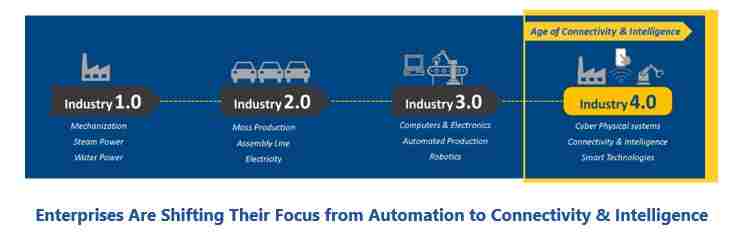
Business improvement strategies enabled by digital transformation require extensive data connectivity throughout the enterprise to feed both cloud and, increasingly, edge applications such as analytics and machine learning. 5G and private wireless both promise significant connectivity performance improvements that meet the needs of Industrial IoT, Industry 4.0, and edge computing, as well as the shift toward increasingly automated and autonomous operations, in critical areas such as latency, capacity, and mobility.
Most industrial customers have an historical view of cellular technology largely as a tool for personal mobile connectivity, and in some cases, for remote access, network failover, outdoor installation, and/or for accessing locations that lack conventional network infrastructure. Ongoing technology improvements, starting with 4G LTE and now focused on 5G private wireless, are leading to increased consideration of cellular as a primary communications medium for industry - in some cases even for indoor carpeted  locations currently served by WiFi. WiFi performance has proven unreliable in the Operational Technology (OT) world in most instances, leading to its continued regulation to off-line applications.
5G and private wireless have the potential to fulfill the holy grail of industrial connectivity: freedom from the high cost and functional limitations of wired infrastructure while overcoming the limitations of existing wireless options. 5G’s low latency, high bandwidth, massive density, reliability, and security, coupled with its status as a widely-supported global standard capable of leveraging related developments such as TSN, make it technically capable of displacing today’s wireline-based industrial connectivity – even in mission-critical applications.
Private 5G networks extend this value proposition for operations by providing dedicated local networks that allow sensitive data to be managed on site and potentially eliminating the need to rely on public networks managed by the telecom providers. Removing reliance on the telecom operators overcomes the potential gap between their network management core competency and operational requirements.
Radio spectrum availability is an issue across different geographic regions, with approaches ranging from strict control by government-operated entities (China) to sales of specific spectrum bands within a given region (Europe, North America, parts of Asia and ROW). Given the reliance on cellular technology, products must also be certified for operation in each target geographic region. Private wireless has matured to address these limitations through use of spectrum either purchased from, leased, or shared by either governments or telecom operators.
As a new and emerging technology, stages of the 5G release timeline reflect increasing capabilities in important areas such as latency, connection density, and TSN support. Timelines for availability of industrial products will depend on several variables. These include 3GPP standard freeze/release dates, component availability, vendor introduction of industrial end products, and the time necessary for trials and rollouts. Release 15 is currently the most widely supported yet future-proof option available.
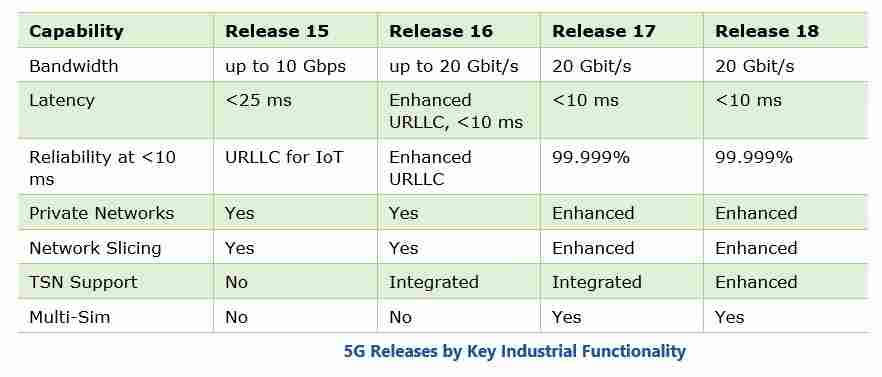
Industrial trials of 5G and private wireless are proceeding with currently available technology as the standard releases unfold. Examples include installations based on Release 15 (5G), private LTE, CBRS in the USA (5G or LTE), LPWANs, and even 900 MHz technology. 5G and LTE solutions in particular are easily upgradeable to future 3GPP releases like Release 16 to take advantage of performance advantages over time.
The numerous industry trials, and now deployments, of both 5G and LTE private wireless currently underway portend the perceived potential for not only incremental performance improvements, but also step-change innovation. These trials consistently reveal concurrent adoption of AI/ML, AR/VR, edge computing, mobility, autonomy, and other disruptive new capabilities enabled by the incremental capabilities of 5G and private wireless networks.
Mobile Edge Computing, or MEC, is necessary to guarantee both network and application latency for demanding requirements in areas such as machine vision and robotics. These applications require vast amounts of data processing, which can result in unacceptable response times without the benefit of on-premise MEC. The combination of local MEC and data storage vastly improves application reliability and reduces security vulnerabilities relative to off-site or cloud-based processing.
High performance wireless networks with low latency and high security are desirable across numero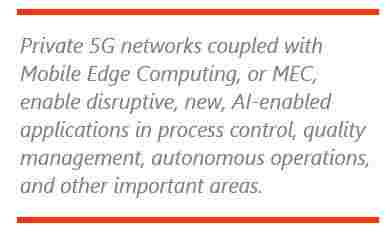 us vertical markets. Customers in manufacturing and energy production are among the earliest to evaluate private 5G networks due to the value inherent in their improved functionality.
Example applications include real-time process control as well as video-based quality control, monitoring, and inspection applications, such as leak and crack detection or pipeline monitoring. Increasing reliance on AI, particularly for high-bandwidth analytics and video processing, coupled with the low-latency requirements of target applications, makes MEC essential in these applications due to its ability to deliver real-time edge compute on site.
The ultra-low latency and massive bandwidth associated with private 5G networks, coupled with on-site MEC capabilities, will allow autonomous mobile robots, drones, and AGVs to navigate and communicate in real time. These capabilities are extremely valuable in industries such as mining, where autonomous operations have a direct safety correlation in addition to improving operations performance. Other industries are also exploiting these capabilities, for example coordinating communications between robots and support AGVs working on moving parts on a production line.
Traditional cellular networks are the realm of the public telecom operators, whose core competencies lie in network and spectrum management and not manufacturing operations. These providers rely heavily on their network service provider channel for delivery of application and customer-specific solutions. The need for these companies to bridge the divide between their traditional channels and their industrial operations targets is increasingly evident as they strive to move into primary roles in industrial connectivity. Telecom providers also typically emphasize their cloud-based network management capabilities as a means of achieving customer stickiness and competitive differentiation, while industrial operations traditionally focus on the hardware devices themselves.
These disparities have exposed a yawning gap between the core competencies of telecom operators and the operational  requirements of industrial facilities. This chasm is exacerbated by the need to customize AI and other edge compute applications in the MEC environment to meet industrial performance requirements. Private networks allow control to remain with the customer, but this option has inherent implications regarding responsibility for tasks such as infrastructure planning and buildout, network and compute, radio spectrum, and application development and management that fall outside of industrial core competencies.
5G and private wireless installations require an ecosystem approach since no single provider, whether legacy automation suppliers or telecom operators, possesses all the technology or knowledge specific to an installation and application. Ecosystem participants may include wireless infrastructure and endpoint providers, network/spectrum providers or managers, equipment providers, application software suppliers, third-party solution providers, and system integrators, among others. Most application requirements can likewise not be met by a standard offering, so dedicated service providers with domain expertise in both operations and network management are stepping in to coordinate ecosystems and tailor installations to customer-specific requirements.
Industrial-grade private wireless solutions from LTTS, a subsidiary of one of India’s largest engineering conglomerates, enable Industry 4.0-focused digital transformation in key verticals such as manufacturing, transportation, healthcare, energy, and mining. The company plays a major role as a system integrator across industries in providing end-to-end private network solutions – from network planning to design, deployment, and seamless integration with partner ecosystems.

Whether working with public or private spectrum, LTTS services bridge the gap between telecom and operations expertise via their rich industrial domain knowledge, multi-vertical experience, deep expertise across the managed network services domain, and use of established tools and AI-powered automation. Combined with their readily deployable Private 5G MEC applications and pre-integrated and tested partner solutions available through their 5G experience center, LTTS is ready to assist customers with rapid time to value in private 5G MEC deployment.
ARC Advisory Group clients can view the complete report at ARC Client Portal
If you would like to buy this report or obtain information about how to become a client, please Contact Us
Keywords: Industrial 5G, Private Wireless, Mobile Edge Computing (MEC), ARC Advisory Group.