Representative End User Clients







Representative Automation Clients







Representative Software Clients









The question this strategy report addresses is “What role will nuclear power play to transition the US and the world’s energy sector to a sustainable low carbon future?” According to a report from Swiss Re, one of the world’s largest providers of insurance to other insurance companies, the cost of climate change amounts to as much as $23 trillion in reduced annual global economic output worldwide by 2050.
Within the past few years, it has become abundantly clear that the world has dragged their feet far too long to decarbonize. The impacts of climate change are increasingly evident this year with widespread record high temperatures that some are calling a “heat apocalypse.” 2022 is also the year when Russia is attempting to use oil and gas as a political weapon to force European countries to help fund a war against a sovereign nation. The urgency to reduce the carbon emissions generated by coal and hydrocarbon fuels could hardly be higher, but will a nuclear power renaissance be the solution?
Global energy systems in transportation, commercial, residential, and industrial sectors are slowly moving away from fossil fuels and electrifying. The utility industry is moving fast in many locations but the transition of the electric grid to reliably deliver carbon free power will take many paths. There is no doubt that SWB (Solar, Wind, and Batteries) will be the main competition for new nuclear power. New advanced nuclear power is unlikely to play a significant role until the 2030s as the first wave of the new advanced reactors is only expected to produce power in the late 2020s. Existing reactor technology has proven very expensive and operating experience has demonstrated vulnerability to accidents that can disperse radioactive byproducts downwind of damaged reactors.
The market for existing nuclear power technology has crashed with little worldwide demand. There are dozens of new nuclear power contenders, new technology, and many avenues for private and government support that is attempting to overcome existing limitations and breathe new life into the nuclear power industry. Considering a problematic history of cost effectiveness and risks dealing with radioactive materials and new unproven reactors, the utility industry is in a quandary. Nuclear power provides grid operators with a reliable and stable base load and some new advanced nuclear reactors can provide greatly improved load following. Nuclear power has desirable power production characteristics that are much simpler to manage compared to the complex management issues of distributed SWB. The cost of SWB has been steadily declining, but the amount of land needed for solar, and wind is meeting resistance; and energy storage durations of weeks or even seasons with the currently popular lithium batteries is very expensive. Nuclear power offers weather and location independent power with a small land footprint and less need for energy storage. Worldwide, electric power is projected to triple by 2050. Today, nuclear power from 440 reactors worldwide provides about 10 percent of the world’s power.
Are fossil fuels with CCS still in the competition for our future power? CCS technology has an energy penalty of between 10 and 40 percent of the energy produced by a power station. About 60 percent of the penalty is from the capture process, 30 percent comes from compression of CO2, while the remaining 10 percent comes from pumps and fans. CCS would increase the fuel requirement of a gas power plant by about 15 percent. The cost of this extra fuel, as well as storage and other system costs, are estimated to increase the costs of energy from a power plant with CCS by 30–60 percent. Considering that fossil power is already more expensive than SWB, adding unsubsidized CCS to a gas power plant would put them at a big disadvantage.
Utilities know that nuclear power has proven to be reliable base load power that is useful for grid stability and normally independent of weather. Industry knows that nuclear plants have an excellent safety record for on-the-job accidents. Environmentalists know that unlike fossil power, nuclear power does not have harmful airborne emissions that result in many health issues and deaths; and nuclear power has an extremely low carbon footprint.
Utilities also know that about one-third of current nuclear power plants are not profitable to operate due to competition from low-cost natural gas and renewables and the high costs of meeting new safety regulations that emerged after lessons learned from the Fukushima accident. Utilities have seen that nuclear project costs tend to skyrocket, and projects have routinely been delayed. Industrialists and environmentalists know that accidents at Chernobyl and Fukushima released long lasting radioactive fallout that contaminated large land areas and the power plant owners did not have the insurance to compensate for this massive property damage.
There is considerable debate concerning the accurate number of projected deaths that have occurred due to the disaster's long-term health effects. Many deaths are attributed to the evacuation and subsequent long-term displacement following emergency mass evacuation and relocation of all the residents in many towns and villages. It is not surprising to find widespread public opposition.
This strategy report will present the complex challenges that new advanced nuclear power plants will need to overcome if they are to play a significant role in the future power grid. New advanced nuclear power plants are typically configured as small modular reactors that can be made in a factory to benefit from manufacturing scale. Small modular reactors (SMRs) have a power capacity of up to 300 MW(e) per unit, which is about one-third the size of conventional nuclear reactors. The IAEA (International Atomic Energy Association) refers to SMR as “small and medium sized modular reactors” and several of the leading designs are above 300 MW(e). New advanced nuclear reactors of any size will be evaluated by regulators, investors, utilities, environmental groups, and the public.
There are more than fifty competing new nuclear technologies under development. A small fraction of these fifty may emerge as the leaders in a nuclear renaissance. There are several privately funded nuclear fusion reactors under development and some promising recent advances in magnetic confinement. Nuclear fusion reactors have unique technical issues and a roadmap that lags the advanced nuclear fission reactors in this report. Nuclear Fusion reactors hold great promise for our future but are excluded from this report.
This report will provide a better understanding of the contenders for new advanced nuclear reactors, where they stand in the regulatory framework, what technical characteristics each reactor has, and the competitive environment of non-nuclear alternatives. The report also provides recommendations for suppliers regarding project timing and how utilities value the operating characteristics of emerging nuclear technologies and the associated project risks.
Nuclear power was developed in parallel with military applications. Seventy percent of existing nuclear plant designs are based on designs originally used for nuclear submarine reactors. Both weapons and power plants started with mined Uranium. Uranium 235 is the fissionable isotope and is only 0.72 percent of the mined uranium, which is mostly U-238. U235 requires enrichment for power applications and nuclear weapons.
Breeder reactors can use neutrons from U235 to convert U238 to Plutonium 239, which is also used for nuclear weapons or generating power. Thorium 232 is roughly three times more plentiful than U-235. Oak Ridge laboratories evaluated thorium to fuel aircraft and operated a thorium reactor generating electric power for more than 5 years. Thorium is fertile rather than fissile and can only be used as a fuel in conjunction with a fissile material such as recycled plutonium. Thorium fuels can breed fissile uranium-233 to be used as a source of neutrons for thorium reactors.
Molten salt reactors are well suited to thorium fuel, as normal fuel fabrication is avoided. Due in part to military reasons, U235 was chosen as the preferred nuclear fuel and work on Thorium power reactors was halted. Had military considerations been absent there is a good chance nuclear power would have developed with a thorium-based fuel cycle.
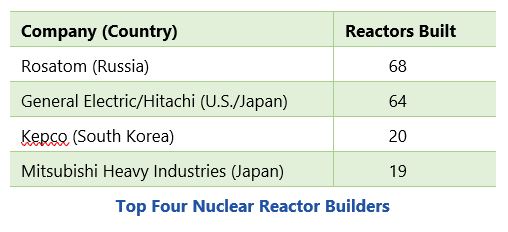 There were many companies that were involved in building the nuclear power plants we have in operation today, like Siemens and Westinghouse that are no longer in business. There are however many companies that are involved in the overall industry in various capacities, including mining, processing, fuel handling, reactor design, construction, licensing, operations, power generation, and decommissioning. The top four nuclear power companies are shown in the table to the left. While some of these companies are active in developing new advanced nuclear reactors, there are many new companies in this competition.
The public is sharply divided about their support for nuclear power, with the biggest public concerns being safety and waste disposal. The need to decarbonize our energy systems has resulted in some rethinking about whether the risks of fossil fuel damage to the environment is greater than the risk of nuclear power. New advanced nuclear power plant designs have focused on improved safety.
It is also important that the NRC review and licensing of new nuclear reactors is done in a competent and non-biased manner and perceived this way by the industry and the public. The NRC has been criticized for having pro- industry commissioners by some and by having anti-industry commissioners by others. According to the NRC website, “The U.S. Nuclear Regulatory Commission (NRC) was created as an independent agency by Congress in 1974 to ensure the safe use of radioactive materials for beneficial civilian purposes while protecting people and the environment.”
Opponents of nuclear power have raised several concerns:
Of these concerns, nuclear accidents and disposal of long-lived radioactive waste have probably had the greatest public impact worldwide. Anti-nuclear campaigners point to the 2011 Fukushima nuclear emergency as proof that nuclear power can never be 100 percent safe. Costs resulting from the Fukushima Daiichi nuclear disaster are likely to exceed twelve trillion yen ($100 billion) and the cleanup effort to decontaminate affected areas and decommission the plant is estimated to take 30 to 40 years. Chernobyl damages were even higher due to more released radiation.
This 2022 Power magazine article concerning the views of former top nuclear regulatory officials does not support a nuclear future.
ARC Advisory Group clients can view the complete report at ARC Client Portal
If you would like to buy this report or obtain information about how to become a client, please Contact Us