Representative End User Clients







Representative Automation Clients







Representative Software Clients








The recent virtual ARC Industry Forum Asia titled Accelerating Industrial Digital Transformation and Sustainability on July 12-14, 2022, at which ABB participated as a Platinum Sponsor, saw registrations of 1,600+ delegates for the two language tracks – Japanese and English. In the session on Sustainability Initiatives, Riccardo Martini, Product Portfolio Manager, Sustainability, ABB Energy Industries spoke about how to use digital technologies to increase energy efficiency and curb CO2 emissions in industries.
At the end of this session, he joined the other speakers for the panel discussion. This blog captures the essence of Riccardo’s presentation (follows Martin Kolos of Emerson Automation Solutions) and his views at the panel discussion. The entire session is available below and hosted on YouTube.
The focus for automation has always been on trying to keep the control structure simple and neat and avoiding the very complex structures. The vast majority of process units are handled by simple control strategies with many P&ID controllers and there are a few applications in a portion of the process units where there's model-based control, but that's in a minority of cases. Simple, decoupled single control loops based on P&ID do not necessarily provide optimal performance in many cases. Each control loop pursues a local optimization with the same priority, missing a global optimization based on multiple priorities.
Riccardo explained all this by giving the example of a steam cracking furnace. After that he spoke about steam & power optimization – the objective, challenges, areas of improvement, ABB’s solution, and benefits.
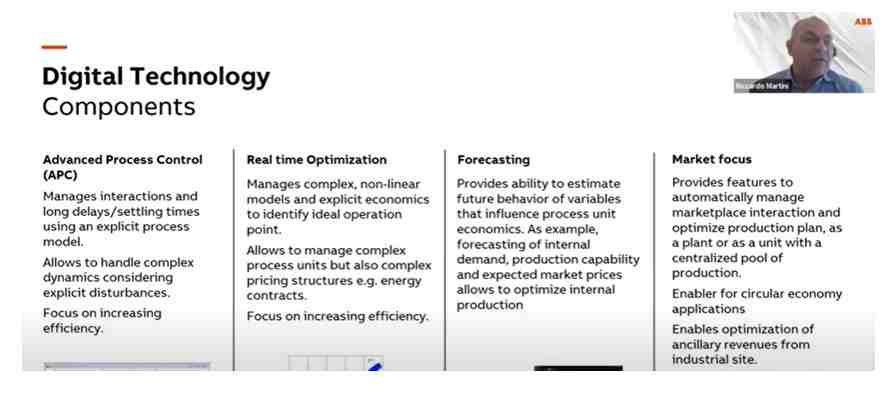
In a steam cracking furnace there are many actuators, objectives and priorities, and obvious conflicts, such as, as an example, carbon monoxide control is given higher priority than oxygen control in case of conflict. “Reality is that process units are complex and it's difficult to handle them with the simple P&ID control loops,” explained Riccardo. So, an additional digital control module or multiple modules to achieve several objectives has to be used to move from local single loop control to a global control that will take care of a process unit/plant or a site all together. Next, there must be a shift from flat production to flexible production to optimize economics. Moving from isolated control to integrated control with other process units will be economically viable and will enable a circular economy and improve market interaction. This digital module will write the set points periodically and can be used to forecast and estimate internal and external factors that have an influence over production economics. The graphic below shows the four components of operation and how those improve efficiency levels:
Objective: To manage complex sites where heat is provided by steam. In the vast majority of cases steam generation is coupled with power generation in a cogeneration unit and with obvious grid/TSO interaction.
Challenges: Operational cost and impact in terms of CO2 production is quite high. Typically, there are multiple equipment (boilers, turbines etc.). Boilers may use different fuel types. Also, there will be variability in steam demand, which the utilities will have to balance, and the availability of alternative fuels may change. Steam generation via energy recovery like of gas availability could be impacted by changes on the process side that are not under control of the cogeneration plant. Due to equipment trips demand for steam could be disrupted and energy prices could vary. Another common challenge is that there are often different control rooms involved in controlling steam networks and, also, multiple automation systems managed by different organizations within the customer company; in the vast majority of cases there isn’t a single large automation system that covers the entire site, so control and coordination of Steam Networks and Power Generation involves different control systems.
Areas of improvement: Steam and power coordinated control can provide tangible benefits by providing automatic optimization features. Optimization of boiler/turbine balancing, optimization of fuel type selection, combustion optimization, improved control of pressure and temperature on headers will all provide tangible benefits and, also, stabilize steam networks. Additional benefits are minimization of steam venting and reduced use of pressure reduction valves, placed in parallel to turbines. Streamlined and optimized grid/energy market interaction will have a beneficial impact on economics and, at the same time, support the use of more renewables.
Solution: In this context, Riccardo spoke about ABB’s multi-layer software solution based on ABB Ability OPTIMAX software. This solution is based on a first digital layer acting as Energy Optimizer. This digital module computes the optimal operating point using non-linear modules and explicit economics, along with forecasting to interact with the energy market and the underlying equipment. The solution also features a steam coordinator layer, based on APC technology, providing dynamic, real-time control of the steam network, considering the optimal balancing targets calculated by the Energy Optimizer. This multi-layered solution enables circular economy management by providing better integration with other process units. The solution is automation vendor agnostic – utilizes OPC connectivity connection to the underlining automation systems.
Benefits: Reduction of CO2 footprint by up to 5 percent, increase in efficiency and savings in fuel costs of up to 5 percent. There are many additional benefits, such as it supports the circular economy, integrates with other digital modules, for example for scheduling optimization, higher production flexibility and so on. Applicability is widespread (greenfield and brownfield); it is vendor neutral and can be used in different markets, for customers acting as energy seller, purchasers or both.
At the end of this session Riccardo took part in the lively panel discussion. Summarized below are his responses.
Do you see an uptick on the whole topic of sustainability?
When it comes to sustainability there’s certainly a lot more interest and awareness and pressure from the management. Rising fuel prices and increasing demand for energy efficiency is also linked to sustainability. Increased use of renewables cause variability in production, and this gets translated into energy prices – the market prices energy sellers that can support frequency stabilization by counteracting the renewables variability. There's a growing need and trend to provide a premium on energy prices to those who provide flexibility, which in turn generates opportunities to be more sustainable. Without improvements in the way assets are controlled and being more flexible, the usage of renewables in the grid cannot be increased. There is pressure from all quarters – financial and environmental to adopt sustainable processes.
Does hydrogen play an important role in ABB’s business?
Yes of course, but that topic was not covered in today’s presentation due to the limited time available for the presentation. The same digital software, ABB Ability OPTIMAX is used to optimize the production of green hydrogen, taking advantage of available degrees of freedom and considering forecasting of renewables production and energy prices. A trade-off can be done between using the hydrogen storage or using the electrolyzer to close the balance with the consumers H2 demand. This concept, applicable to small Green H2 installations, can be further extended to a site like a refinery. In the latter case hydrogen production from multiple sources will become the normal configuration and continuous balancing, considering economic viability as renewables fluctuate, will have to take place. The use of hydrogen will actually force the industries to be more circular as the need will arise to share hydrogen and possibly CO2 networks to distribute between industrial clusters, making them more interconnected and amplifying the need for better coordination.
Has ABB implemented any mobile apps for plant monitoring and optimization for plant managers?
Yes, OPTIMAX has an integrated web interface with user interface or HMI, so it's possible to get all the relevant information in dedicated dashboards. Dashboards can present real time values, forecasting future energy prices and help make decisions in real time over a mobile phone and at any location in the plant or outside. The solution is cyber safe by design and allows to connect remotely via cyber secure connectivity methods, independently from the specific automation system or systems in use. Overall, ABB Ability OPTIMAX is a vendor neutral solution, has standard interfaces, and goes beyond ABB automation systems, in terms of scope, objectives and architecture.