Representative End User Clients







Representative Automation Clients







Representative Software Clients








Summary
The shortage of skilled workers in operations, process engineering and maintenance represents a significant challenge for the oil & gas, refining, chemicals, and all other process industry sectors.
According to a report published earlier this year by oil & gas industry personnel specialist, Air Energi, "Not being able to get the right people at the right time for the right cost could inevitably threaten the overall delivery of oil and gas projects on time and within budget." For owner-operators the "graying" or retiring of experienced workers also creates concern for the sustainability of existing plant operations. Due to the high turnover, as high as 30 percent in many cases, we're seeing growing demand for skilled operators and process engineers.
In a recent briefing, operator training specialists, GSE Systems, updated ARC Advisory Group on the company's unique approach to training workers. This combines human resources with learning management strategies and appropriate simulation and other technology to provide what the company believes is a necessary "reboot" of the industrial workforce development and training solutions currently used to train workers.
Key findings from our briefing include:
Filling the Boots of Experienced Retirees
GSE Systems believes that the current turnover problem in operations can be characterized by an old pair of boots. A pair of boots can tell us a lot about where someone has been and what they do.
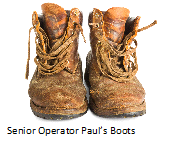
The well-worn boots in the picture on this page, for example, belonged to "Paul," a hypothetical senior operator. Serving as a field operator, board operator, and shift supervisor for the past 35 years, he knows the process technologies inside out. He's traced every line in the plant. He spent his entire career operating various process units and maintaining plant process equipment such as compressors and separators, helping to ensure safe and continuous production of on-spec product. In his career, he handled multiple process incidents, passing on that knowledge to other operations, maintenance, and engineering personnel. He also mentored and trained dozens of new operators and engineers over those 35 years… but, now he's gone. He left his boots, and has retired.
So how is industry going to find the right people to fill Paul's boots? And once we find him or her, how are we going to make them experts and how long will that take? Who will handle the big problems until then? Can we quickly replace the vast knowledge and experience that was lost when Paul left? How do we quickly on-board the next generation that must wear these boots? After all, Paul's boots contain no history of all that Paul learned over his long career.
Traditional Simulation-Based Training Is Limited
The most common approach to dealing with training operations is to design and build a process simulator during the engineering design of the plant or facility. Process simulators are built by control system or automation suppliers for varying fidelity needs and match the operating graphics and control system. Delivery tends to match the schedule of the plant FEED commissioning and startup activities. The traditional simulation-based approach tends to focus more on commissioning and operator readiness at a single point of time, rather than addressing the full scope and lifecycle development of workers and staff. According to GSE Systems, the result usually ends up as a very expensive piece of technology stored in the back room, rather than providing a return on investment.
GSE Systems' solution for employee on-boarding and skills development begins well before the automation system for a project is designed. The company has applied its simulation and other technologies to address workforce development, plant operations, engineering, and process controls.
Entry to Expert (E2E) Approach
GSE Systems calls its overall approach, "Entry to Expert," an integrated training process that begins with tools to help in the workforce screening and selection process. E2E adds the necessary tools and technologies throughout the lifecycle of the plant or facility in a way that also match human development needs. Key components include:
Conclusion
GSE Systems is providing a fresh approach to meet the need for trained and skilled workers for process industries. Applying a variety of tools and technologies at different stages of career development to speed transfer of knowledge and expertise to new operators could clearly help improve transitions and normal operations alike and potentially avoid major incidents. Likewise, GSE Systems' lifecycle approach to training also appears to make a lot of sense.
ARC Advisory Group recognizes that the needs for skills development solutions is changing. Studies have shown that younger people now entering the workforce have different requirements and learning styles than previous generations. No longer does training and education take place solely in the classroom. Training now takes place in a variety of locations using a variety of methods, all supported by modern technologies with high visual content, and virtual reality immersion-based or 3D technologies. To replace the knowledge and expertise lost by retiring workers, these methods and technologies should work in concert with workforce development and career development strategies.
GSE Systems recognizes that operator training should extend over the life of the operations, and not just at a limited point in time. It begins with on-boarding and definition of roles and responsibilities of operators and continues through active management of learning and development.
The company designed its E2E solution to recognize individual student differences and provide a system of learning that employs the right medium and fidelity and includes a large number of complimentary training modules. ARC believes that the capability to capture process and operations knowledge and embed it into a broader program makes E2E unique.
All signed-in ARC Advisory Group clients can view this report in pdf format at this Link
If you would like to buy this report or obtain information about how to become a client, please Request ARC Info
Keywords: Workforce Development, Operations Training, Training Simulators, ARC Advisory Group.