Representative End User Clients







Representative Automation Clients







Representative Software Clients








If you buy power from a utility, they likely have a complex portfolio of power generation that might include some combination of gas, coal, hydro, nuclear, solar, wind, biomass and other power sources. The utility industry is leading the energy transition to decarbonize because clean energy is essential to decarbonize industry, buildings and transportation. Power consumers are increasingly demanding clean energy options to meet their environmental goals and various state, regional, and federal government policies and incentives are pushing utilities to transition to clean power. So how can you determine if your power is clean? Let’s ask Toby about that.
The discussion revolves around the concept of Energy Attribute Certificates (EACs) and Renewable Energy Certificates (RECs) which track and verify clean energy consumption. Both EACs and RECs are essentially digital tags used for the accounting of clean energy. A REC is a specific type of EAC and corresponds to one megawatt-hour of renewable energy generation regardless of when the power is generated. It is the main way utilities in the US keep track of renewable generation. New EACs are emerging as a timestamped version of RECs to better credit generation that matches consumption. Consumers can purchase these certificates to make claims about their clean energy procurement and support the development of renewable energy sources. In North America, several regional entities are responsible for accurately tracking renewable energy production to create RECs to allow utilities to make claims about their renewable power and avoid double counting. If you have a wind or solar asset, the data from your revenue grade meter is collected by the REC registry and used to keep track of your energy production and thus REC production. The owner of the generation asset can sell the renewable power separately from the RECs but only the current owner of the RECs can claim renewable power generation. For example, my local utility has 2 wind turbines, and they sell the power and the RECs separately. Only the REC purchaser can claim that his electricity is coming from those wind farms. Neither the power purchaser, nor our utility can claim renewable generation. In many cases renewable generators sell the power and the RECs together as a package. Homeowners that can sell solar RECs usually do so, but technically only the current owner of the RECs can make the claim for generating renewable power.
EACs are a mechanism that allows consumers to choose between renewable and fossil fuel-based energy. In our state of Massachusetts, we have a regulation that requires municipal utilities to provide 50% of the electric power from non-carbon emitting generation. This accounting uses the REC system. NEPOOL-GIS issues and tracks certificates for every megawatt-hour (MWh) of electricity generated within the ISO New England control area, including imports from neighboring areas. Muni’s can purchase RECs on an open market or as part of a power purchase agreement. New England has two classes of RECs: Class I (from renewable sources like solar, wind, hydro, etc.) and Class II (from specific renewable sources like wood waste or existing nuclear). Class I RECs typically have higher prices due to higher demand and certain regulations that require the use of Class 1 RECs. The current market price in Massachusetts (as of July 2024) is $39-44 per MWh for a Class 1 REC. In July, the NEPOOL Markets Committee was asked to take action on changes to the NEPOOL Generation Information System (“GIS”) and the GIS Operating Rules to accommodate the transfer of hourly certificates that was referred by the Markets Committee to the GIS Operating Rules Working Group. It would appear that timestamped RECs are coming.
Their software platform simplifies the management of EACs which are proof of renewable energy generation. This software includes tracking, matching, and reporting on EACs.
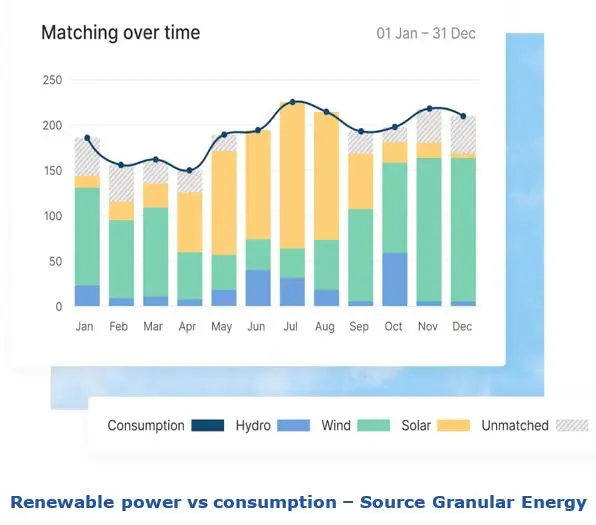
Granular Energy enables utilities to offer hourly matching for 24/7 carbon-free energy, ensuring that customers' energy consumption matches renewable generation on an hourly basis. This provides greater transparency and accuracy compared to traditional annual matching methods and is more popular in Europe. The chart below shows that renewable generation cannot match consumption monthly. EAC’s generated during the unmatched periods will command a premium price and encourage developers to fill the gaps.
Granular Energy has a green energy trading platform that facilitates the trading of green energy products, allowing utilities and energy buyers to source and procure renewable energy more efficiently. This includes tools for analyzing energy consumption and generation data, offering insights into carbon footprint reduction and helping customers make informed decisions about their energy usage.
Both Google and Microsoft have expressed strong support for time-stamped energy attributes (T-EACs) and are actively involved in their development and implementation. Granular Energy is a key partner and supporter of EnergyTag, an independent, industry-led initiative to accelerate the shift to 24/7 clean energy. EnergyTag aims for EACs to have hourly matching, transparency and traceability, and to enable an EAC mechanism that supports 24/7 Carbon-Free Energy. Such a time stamped EAC would have higher value during times when the grid needs that power and would command less value if there is an excess of power on the grid. Renewable energy storage with batteries, hydrogen or other storage systems can increase the value of EACs.
As more consumers choose clean energy, the demand for EACs will increase, which will in turn drive the development of more renewable energy sources and more renewable energy storage.
We encourage you to listen to the podcast here at https://www.youtube.com/watch?v=Ds-FD4duYXQ&t=411s.
In this episode of the Sustainability Podcast, host Rick Rys, Director of Consulting at ARC Advisory Group, engages in a riveting conversation with Toby Ferenczi, co-founder of Granular Energy and Energy Tag. With Ricks experience as a light commissioner in a municipal utility, the discussion takes a dive deep into the mechanics of Energy Attribute Certificates (EACs), Renewable Energy Credits (RECs), and Guarantees of Origin (GOs) and understand their vital role in the energy market. Discover how Granular Energy's innovative software is revolutionizing consumer choice in electricity, providing transparency, and promoting sustainability. Toby also discusses the evolving standards for clean energy certification, the impact of green hydrogen production, and the critical importance of consumer responsibility in driving the energy transition.
Tune in for an insightful discussion on the future of renewable energy, the significance of hourly matching of energy certificates, and the exciting developments in energy storage and flexibility. Whether you're an industry expert or a curious listener, this episode offers valuable perspectives on the challenges and innovations shaping our sustainable future.