Representative End User Clients







Representative Automation Clients







Representative Software Clients








Keywords: AUDI AG, Siemens, EC4P, Virtual PLC, Automation Architecture, ARC Advisory Group.
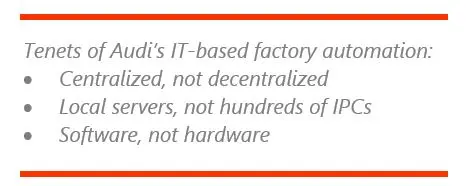
“Software, not hardware” – this simple tenet is the basis of what AUDI AG calls “IT-based factory automation,” a concept that is turning IT/OT converge theory into practice at the German automaker. Dubbed Edge Cloud 4 Production (EC4P), the idea is to replace thousands of decentralized industrial PCs with a much more efficient and flexible architecture of local servers, effectively uniting the cloud and the edge on the shopfloor. This ARC View looks at the evolution of software-defined automation at Audi, which is working together with Siemens, VMware and other partners to create a standardized, software-defined architecture for its car plants.
Key Takeaways
The diagram below illustrates Audi’s vision for acquiring new applications from providers. In the future, applications should be delivered as software only, rather than as a “hardware box,” which is typical today. Except for the PLC, the hardware components on the left are simple infrastructure devices that can be realized in software today. Tomorrow’s solution on the right consists of Audi-standardized hardware ranging from a single industrial PC up to a cluster of x64 servers. All functions, including the PLC, are realized in software and run in a virtual environment.

Currently, each application is delivered on its own device, often an over-dimensioned industrial PC. The pure software approach allows Audi staff to select the right-sized device for each application or run multiple applications on servers or clusters of servers. In case of a disruption, the load can be shifted to other servers rather than identifying and replacing a defective industrial PC. According to Audi, software-based infrastructures have proven themselves in data processing centers and the company is convinced they will also work well in production.
In a virtualized environment, automation applications can be managed like IT assets in the same way that enterprises manage software assets. IT specialists can monitor applications performance, balance loads, and optimize the use of available computing resources.
EC4P was first tested at an Audi plant in 2022, then rolled out into series production a year later in a plant where the company manufactures the models e-tron GT quattro and RS e-tron GT. According to Audi, these small-scale series are ideal for testing ECP4’s capacity as a control system and its use in large-scale production. The next step is to replace classic hardware controllers with virtual PLCs. A test installation of two vPLCs has been running at the same plant since early 2024.
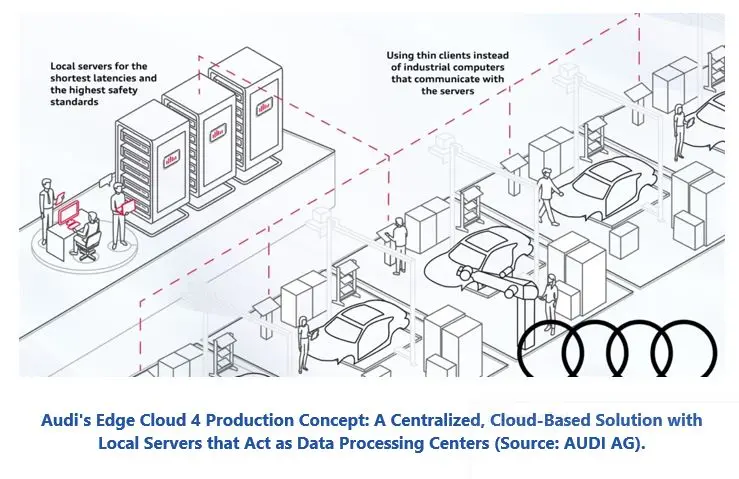
EC4P uses local servers that act as data processing centers. Each server processes production-related data with low latency and distributes it to worker support systems. The system also enables the quick integration of software and new tools, for example, for worker support, bolt control, vehicle diagnostics, or predictive maintenance. EC4P allows the company to redeploy the computing power required by the production line to local data processing centers. In the future, the software-controlled server solution will replace the decentralized control system that relies on expensive industrial PCs that need to be individually maintained.
Clusters of servers allow IT staff to level out demand spikes across all virtualized clients, which speeds application deployment and ensures more efficient use of resources. Audi expects the solution to help cut costs for software rollouts, operating system changes, and other IT-related expenses. The flexible cloud technology also scales to adapt to future tasks.
When industrial PCs first appeared on the shopfloor in the 1990s, users discovered that the IT practice of periodic patching could lead to unpredictable equipment behavior or unexpected downtime of industrial machinery. Regular patching of security updates is important, but not all bug fixes are necessary for dedicated shopfloor applications. The classic dilemma is the clash of priorities: IT considers data confidentiality and integrity to be top priorities, while OT sees equipment availability (no unexpected downtime) as most important.
Audi’s new cloud-based infrastructure improves ease of maintenance and IT security with its centralized approach to updates, allowing IT experts to quickly roll out patches in a few minutes during breaks or maintenance time via the central servers. IT specialists can also install new functionality in virtual clients, including operating systems updates. According to Audi, the server solution gives the company tremendous flexibility to ensure that software and operating systems are always up-to-date.
Now that the EC4P concept has been field tested, Audi is extending it down the “last mile” to the controller level where real-time requirements become a factor. Siemens introduced its first virtual PLC, the Simatic S7-1500V, just last year, and the automation supplier has been working with Audi since January on a test installation that uses two vPLCs in a rear axle assembly application.
The vPLC is just one component in Audi’s vision for software-defined automation, but it is a critical step not only because of the need to ensure that a virtual PLC can meet performance requirements, but also because it completes the all-important mind shift in traditional shopfloor thinking. A vPLC creates challenges for maintenance personnel used to physically swapping out hardware modules to keep critical machinery up and running. Also, PLCs are traditionally programmed and maintained on the shopfloor via direct connection to a PC. In a virtualized environment, whole fleets of vPLCs can be maintained remotely – provided maintenance staff have the necessary IT skills.
For Audi, a requirement for a virtual PLC is that it must run reliably with the same flow latency and determinism as a hardware-based controller. The vPLC should help overcome hardware boundaries and solve the “painful processes” of field updates. Initial testing was necessary to determine the feasibility of running PLC workloads on normal PC infrastructure. At first, Audi ran test set-ups with small scale PCs, but now it runs tests directly in production for fine-tuning.
After learning certain IT skills, automation engineers can deploy and monitor a plant full of virtual controllers across machines, lines and entire plants in a mixed configuration of software-defined and physical devices. A large manufacturing plant today may encompass several hundred PLCs, so the potential cost saving possible with centralized management of automation assets is huge.
Siemens recognized the importance of easing the transition to the vPLC. For example, projects created for other Siemens PLCs can be loaded via TIA Portal into a vPLC with no programming changes. The Simatic S7-1500V is hardware independent, meaning that the user can choose his own hardware and scale his deployment, from a single PC up to x64 servers.
The IT/OT convergence is a powerful force for change in the traditional world of manufacturing. As industrial companies adopt “IT-like” architectures, the potential for cost savings, efficiency gains, and scalability is enormous. Several years ago, Audi set out to create IT-based factory automation with its EC4P concept that consolidates compute and control hardware and applications in a cloud-edge architecture. Now that the concept is shopfloor-tested, Audi is completing its shopfloor digital transformation with the SIMATIC S7-1500V, a virtual PLC from Siemens, by extending the EC4P concept to the domain of real-time machine control.
With its new software-defined approach to automation, Audi expects huge efficiency gains in device and application management and substantially higher flexibility thanks to the scalability of the new architecture. Most of all, the company looks forward to a new process of specifying and deploying software-only solutions for everything from simple functions up to complete automation systems.
ARC Advisory Group clients can view the complete report at the ARC Client Portal.
Please Contact Us if you would like to speak with the author.
Obtain more ARC In-depth Research at Market Analysis