Representative End User Clients







Representative Automation Clients







Representative Software Clients









Embedded Security, IT/OT Integration, and AI Driving Vendor Preference
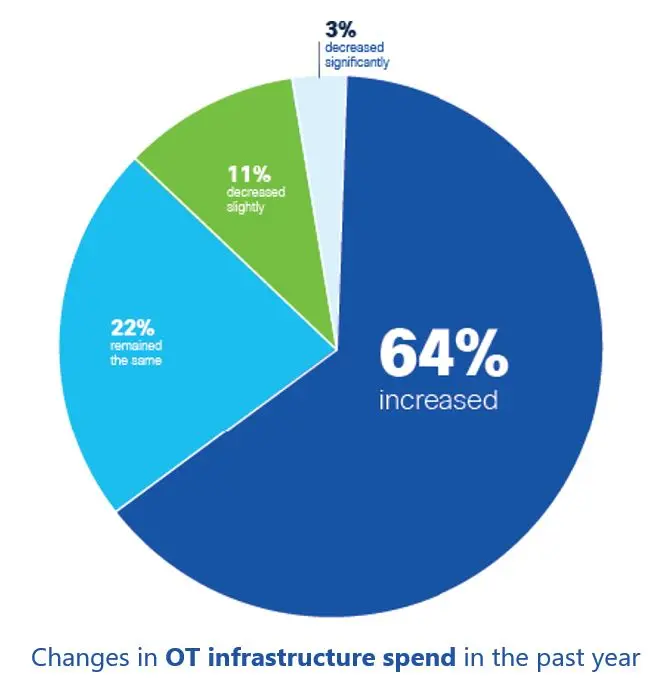
Cybersecurity risks, skilled labor shortages, improved IT/OT collaboration to simplify network operations, and AI-readiness are driving massive transformation in industrial networks. Cisco’s recently released 2024 State of Industrial Networking report indicates 64 percent of respondents have ramped up spend on industrial infrastructure in the past year.
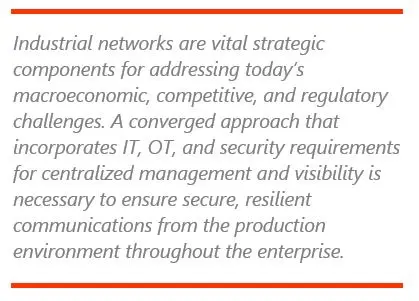
Customers increasingly view the network as a critical enabler of the digital transformation necessary for meeting mounting macroeconomic, competitive, and regulatory challenges. OT cybersecurity is increasingly gaining the attention of CIOs as the industrial threat surface expands. The burgeoning market for AI-enabled applications and processes extending from the enterprise to operational environments is fueling even greater emphasis on networks as a core foundation for business success.
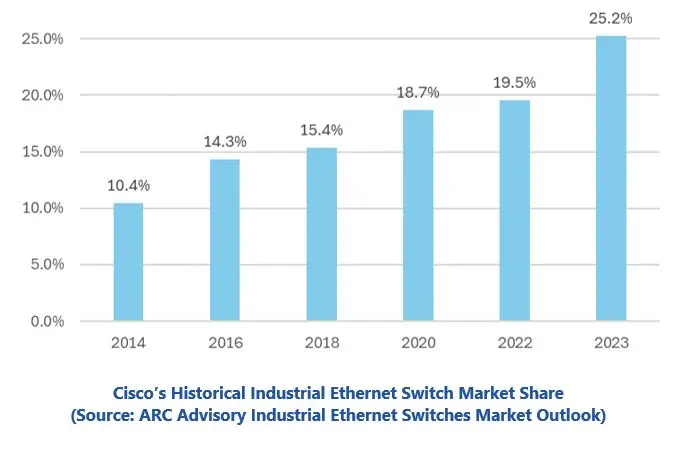
Global network infrastructure leader Cisco draws on its long, unique legacy of successful service to OT, enterprise, and security applications to help customers build the right foundation for successful digitization and prepare for a future of AI-enabled applications. As a result the company has extended its industrial networking market share lead from 19.5 percent to 25.2 percent in our most recent market analysis.
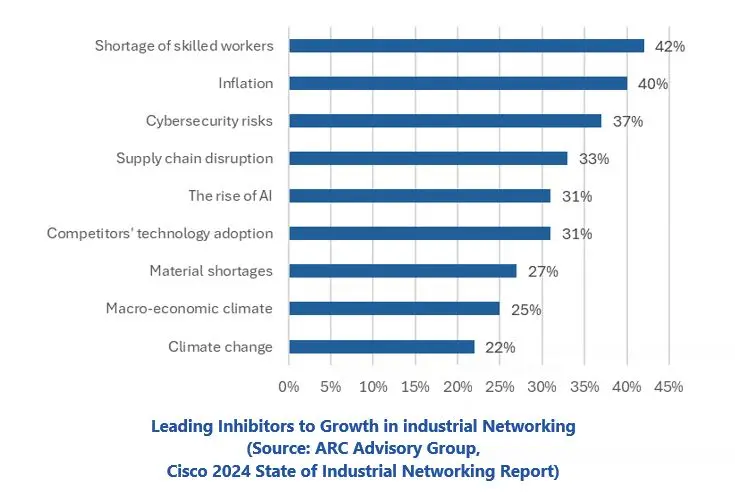
Macroeconomic issues such as shortage of skilled workers, inflation, increasing cybersecurity risks and growing compliance requirements continue to rank among the highest obstacles to growth. Heightened awareness of sustainability and climate change impact require reductions in carbon footprint and adoption of new technologies in both manufacturing processes and the systems that control them, including EHS and ESG reporting software, which must source data from vastly disparate sources in the enterprise. Investments in renewable energy sources are also increasing substantially. The ongoing shortage of skilled workers limits both the ability to optimally maintain and upgrade equipment and the potential to innovate.
Industrial network infrastructure customers are increasingly looking to extend IT processes, security, and network management tools into OT to drive automation, overcome skill gaps, and strengthen industrial threat protection. Network automation can help reduce costs, improve efficiency, and improve production processes by streamlining workflows, minimizing human intervention and errors, enhancing quality and consistency, and enabling autonomous processes.
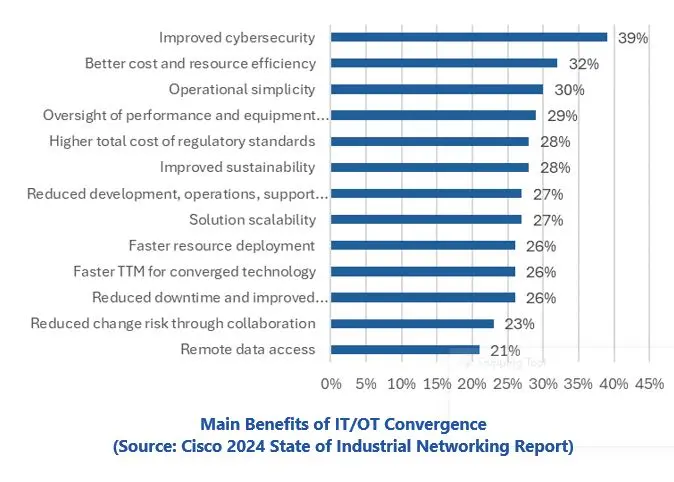
Industry 4.0 and advanced OT networks need more IT capabilities, demanding that more IT and OT organizations collaborate and bridge existing silos. The benefits of extending IT into OT are well documented, including improved cybersecurity, lower costs, operational simplicity, and improved sustainability.
Industrial assets need high bandwidth, resilient, and deterministic networks to meet escalating current and future functional requirements, including a plethora of new AI-enabled applications. Customers can achieve highly available, future-proof secure connectivity by emphasizing simplicity, standardization, and recognition of the increasing convergence of not only IT and OT technologies, but also security.
With an increasing number of legacy devices now connected to access IT and cloud applications for digital initiatives, the potential for cybersecurity breaches has surged. With more legacy isolated, unprotected systems and assets, the already large attack surface increases exponentially, creating a strong incentive for ransomware attacks.
The complexity of both expanding attack surfaces and constant onslaught of new cyber threats, coupled with an increasingly overstretched workforce, has elevated cybersecurity to the biggest reported challenge to designing, operating, and maintaining industrial networks and the leading internal barrier to business growth.
Customers need to connect and protect their industrial assets with solutions that enable the convergence of networking and security, simplify and standardize network management, and leverage software capabilities to automate tasks and enhance visibility. Increasingly comprehensive security postures include not only threat defense but also visibility into what is going on in the network devices themselves, what is on the network, and how everything on it is behaving, which requires extensive software-enabled capabilities.
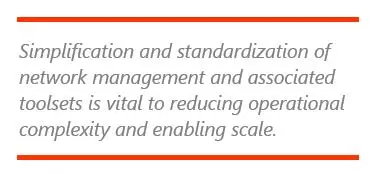
Lack of standardization is one of the biggest challenges to simplifying and securing network operations. Legacy systems, point solutions, and multiple management systems create significant operational complexity and limit scalability. Industrial network standardization is the key to unlocking advanced software capabilities at scale, including automation, threat defense, network management, and new requirements for AI use cases. It also accelerates continued adoption of IT-oriented approaches as a means of effectively visualizing, scaling, monitoring, controlling, managing, and safeguarding installations.
Scaling industrial IoT applications presents a problem from the perspective of connectivity, automation, and cybersecurity. Many current installations are made up of a patchwork of difficult-to-scale point-based solutions acquired individually over time to meet the needs of specific applications or processes.
Horizontal and vertical integration throughout enterprise and operations, increasingly in service to analytics and now AI-based applications, necessitates a converged strategy as management of the respective networks increasingly overlaps. Enlightened executive leadership recognizes the network as the foundation for innovation and futureproofing and the consequent benefits of a unified approach, but IT, OT, and security activities remain siloed, negatively impacting business efficiency and threatening the overall security posture.
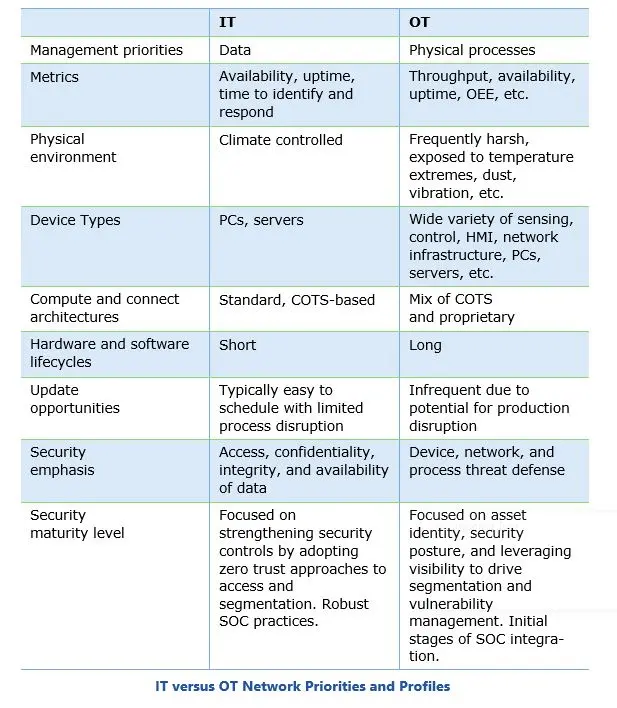
Successful convergence requires that not only IT and OT teams but also security personnel understand the unique requirements of each stakeholder so these diverse skillsets can be leveraged to drive the best business outcomes. OT operations should focus on building innovative industrial processes, IT operations on building modern network infrastructure to support these processes, and security operations on ensuring process data and OT assets are safe from cyber threats. Gone are the times when a single team could do it all. Smart network management leverages modern IT technologies and skilled IT teams to drive success for the organization.
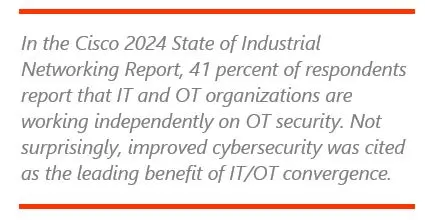
Security organizations increasingly straddle the IT and OT environments, managing a variety of dynamic internal and external threats as well as traditional and emerging response mechanisms. Chief Information Security Officers (CISOs) are now common throughout industry, with their organization participating in purchase decisions across the board.
Centralized management and visibility of security operations and unified visibility into IT and OT security events are essential for a converged approach, with customers increasingly leveraging IT-oriented methods to this end. A converged approach can heighten operational efficiency and reduce both operational complexity and the size of the attack surface while extending the benefits of AI and data analytics applications. A converged approach can likewise encompass both hardware and software through consolidation of network and security functionality into multi-function network infrastructure devices with visibility and management provided via integrated operator and management consoles.
Convergence should further extend to both organizational alignment and purchasing strategies as the range of potential stakeholders expands to include OT, LoB, IT, security, and maintenance personnel. This alignment should include a collaborative approach that recognizes and incorporates the priorities and challenges of each stakeholder entity and their respective operating environments and business objectives. A converged strategy must likewise consider ecosystem alignment between preferred OT vendors and IT/enterprise/hyperscaler and cybersecurity suppliers.
Global network infrastructure leader Cisco draws on its long, unique legacy of successful service to OT, enterprise, and security applications to help customers build the right foundation for successful digitization and prepare for a future of AI-enabled applications. The $57 billion company is building on 40 years of innovation in networking hardware, management, automation, and security to bring modern capabilities to purpose-built industrial network equipment.
Recognizing the importance of network design, threat protection, and management, Cisco brings enterprise-grade networking features, network design solutions, and best practices that reflect increasing adoption of enterprise-wide security postures and scale to meet the needs of industrial networks. Embedded cybersecurity capabilities, including visibility, policy enforcement, remote access, next generation firewalls (NGFW), and more are some of the company’s biggest differentiators. The company leverages common Catalyst Center enterprise-grade network management solutions and automation to deploy and manage industrial installations at scale, reduce operational complexity, and lessen skill gap issues.
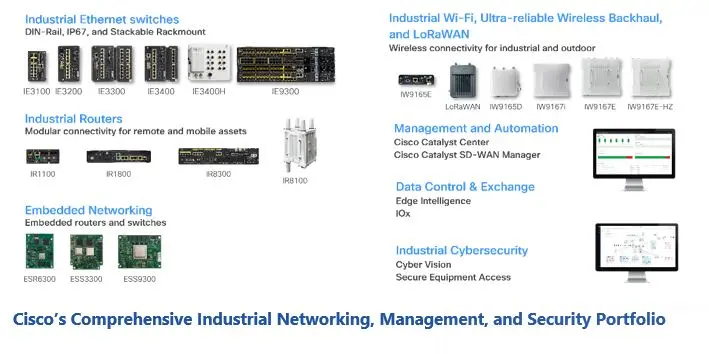
The company’s comprehensive industrial network portfolio spans DIN rail, rackmount, and IP67 industrial Ethernet switches as well as wireless and cellular infrastructure. The industrial offerings boast a complete OT feature set including rugged designs, lossless resiliency protocols, built-in security, edge computing, and industrial standards compliance and certifications, while leveraging a consistent product portfolio and common management environment that extends from the machine to the data center, enterprise, and cloud.
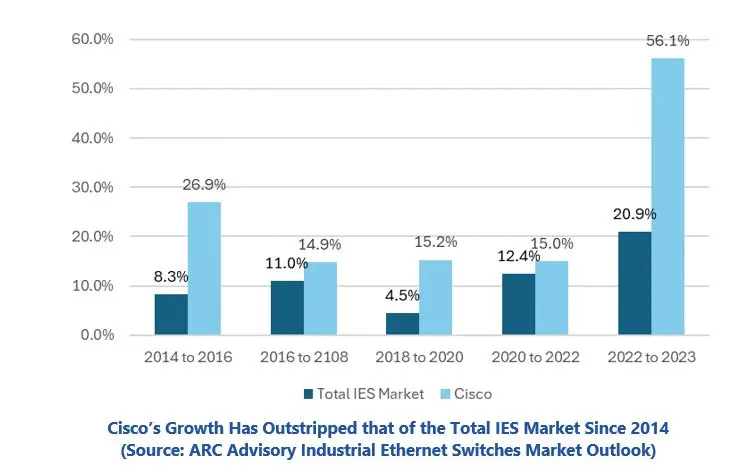
Building on this comprehensive legacy, Cisco’s industrial Ethernet switch (IES) portfolio, value proposition, and associated market share have expanded rapidly since the company first entered the market in 2003. The company is now the leading IES provider with a global 2023 market share of 25 percent. Since the inception of ARC’s IES market coverage in 2014, the company’s average annual compound growth of over 21 percent is double that of the total market.
Cisco is not only the global market share leader, but also the top provider in important regional and vertical markets. Their 2023 market share in North America topped 40 percent, while their 20 percent market share in EMEA, the largest IES market, trails only longstanding full-line German automation supplier Siemens, with the gap closing every year.
The company’s focus on bringing IP connectivity to the operations environment has resonated with customers in important IES vertical markets, including manufacturing, utilities, transportation, and other infrastructure segments. Cisco enjoys double-digit market shares in key manufacturing industries, such as automotive and food and beverage, and is the leading player in important utilities segments such as electric power transmission and distribution, oil & gas, and water and wastewater. The company is also the leading provider in the large and growing transportation and logistics segment, with particular success in roadway and port automation.
Cisco Validated Designs (CVDs) offer substantial value to specific industries by providing pre-tested and documented network architectures tailored to specific business needs. These end-to-end designs coupled with IT-oriented tool sets accelerate network deployment, increase predictability, and mitigate implementation risk. Organizations can use these guides to reduce network deployment time, minimize chances of network failure, avoid costly design errors, and optimize performance and resource utilization.
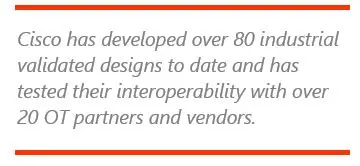
The Cisco OT infrastructure ecosystem includes both leading global industrial automation providers, such as Rockwell Automation, Mitsubishi Electric, and Schneider Electric, as well as an extensive global network of trained and experienced partners and system integrators. This ecosystem complements Cisco’s own global workforce in its ability to deliver customer-specific infrastructure solutions.
Material for this report was drawn from ARC Advisory Group’s extensive ongoing coverage of the industrial Ethernet Switch and associated industrial network infrastructure markets as well as Cisco’s 2024 State of Industrial Networking Report. Readers are encouraged to view these sources for further validation of the trends outlined in this report, as well as to:
Recognize the network’s escalating role as a foundation for meeting business challenges and enabling business innovation.
Leverage the convergence of IT, OT, and security environments to ensure safe, resilient operations.
Prioritize network uptime and total cost of ownership over the total lifecycle of your network installation, not just upfront costs.
Ease system management complexity by leveraging converged software tools and infrastructure devices.
Recognize that the network functions as the AI nervous system for delivering the process, machine, asset, and sensor data required for today’s AI applications to improve business metrics.
Leverage validated network designs and ecosystems to leverage synergies throughout your network infrastructure.
Consider Cisco for your industrial network infrastructure requirements. Find out more about their Industrial IoT offerings.
ARC Advisory Group clients can view the complete report at the ARC Client Portal.
Please Contact Us if you would like to speak with the author.
Obtain more ARC In-depth Research at Market Analysis