Representative End User Clients







Representative Automation Clients







Representative Software Clients








Palo Alto made a big splash recently with its release of Precision AI, a complete suite of offerings with embedded AI designed to make cybersecurity easier and increase cyber resilience for both IT and OT applications. This is a major release for Palo Alto, featuring premium video content starring Keanu Reeves and a great presentation by Palo Alto CEO Nikesh Arora on the impact of AI on cybersecurity. What's interesting about the Palo Alto rollout is that the company is focusing not just on embedding AI into its security products and applications, but also in securing its end user customers' implementations of AI.
While the new Precision AI strategy is a sweeping one at Palo Alto Networks, there are several activities related to OT cybersecurity that are worth noting as part of the rollout. For example, the company has released new capabilities to safeguard remote operations, mitigate risks for hard-to-patch assets, and extend protection into industrial environments. You can read the full OT release blog here.
End users are under constant pressure to get more done in industrial cybersecurity with dwindling resources. AI has great potential to take a lot of the extra work out of OT cybersecurity and has great promise in providing more real time threat detection and response. Precision AI is a great example of how AI can be used for practical purposes in OT cybersecurity and really take some of the burden of cybersecurity personnel. We blogged about Palo Alto's release of AI copilots for various applications earlier this week. The following are some of the key OT and industrial related releases that were a part of Precision AI, including a guided virtual patching solution, a secure remote access solution for distributed workforce and partners, and new ruggedized firewalls that include 5G ready form factors.
A "fully integrated, risk-based Guided Virtual Patching Solution for OT environments" powered by Precision AI (the Palo Alto proprietary AI system), embeds machine learning, deep learning, and generative AI. With Guided Virtual Patching, machine learning analyzes historical data for more accurate threat detection, while Precision AI's deep learning can build predictive models that can detect security issues in real-time. Generative AI provides a natural language interface to make the system more intuitive.
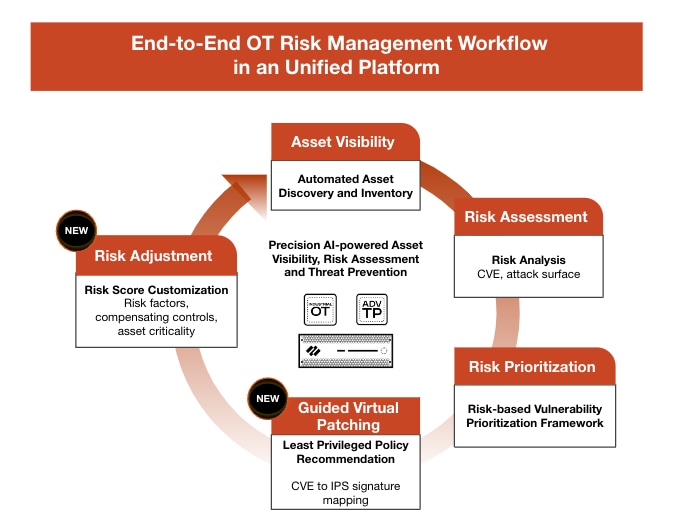
According to Palo Alto, "Guided virtual patching is part of a new end-to-end risk management workflow that starts with a comprehensive risk assessment and attack surface mapping, enabling the quick identification and prioritization of critical vulnerabilities. By recommending threat prevention profiles and least privilege policies, guided virtual patching reduces exposure and effectively secures hard-to-patch OT assets. Customizable risk scores allow you to adjust for asset criticality with confirmed compensating controls, giving you full control and audit trails over how risks are managed across your OT environment. The end-to-end workflow helps cut through the noise, allowing you to focus on top-priority vulnerabilities and manage risks more efficiently, ensuring your mission-critical systems remain secure and fully operational without disruption."

Source: Palo Alto Networks: https://www.paloaltonetworks.com/blog/wp-content/uploads/2024/10/Screenshot-2024-10-16-at-7.06.29%E2%80%AFPM.png
According to the head of ARC's cybersecurity practice Sid Snitkin, "Operational technology environments are becoming increasingly complex and interconnected, making them more susceptible to cyberthreats. The ability to deploy AI-powered tools, like guided virtual patching, is a game-changer for industrial cybersecurity. It enables organizations to address vulnerabilities in real-time without the costly and often disruptive downtime that traditional patching methods would require. This approach not only reduces risks but also enhances the overall resilience of OT infrastructures."
With Palo Alto's introduction of the Prisma Access Browser and its Privileged Remote Access feature, Zero Trust network access (ZTNA) is now extended to OT environments. These OT-specific workflow capabilities ensure secure, seamless access to IT, OT, and cloud applications for the distributed workforce across employees and partners. According to Palo Alto, "Our remote access solution features a simple, browser-based architecture with an integrated jump server that reduces deployment complexity, making secure remote access management easier for both users and administrators. Tailored specifically for OT, it supports unique workflows and security compliance requirements, offering just-in-time access for OT administrators and session recording for audit and regulatory needs."
Palo Alto offers a series of firewalls with new features for 5G and embedded machine learning. "The PA-400R Series is engineered for demanding environments, like utility substations, factory floors, and renewable energy sites, with high IP ratings for durable protection. Both the PA-450R and PA-410R models offer 5G-ready form factors with native 5G WAN uplink capabilities, making them ideal for distributed operations and remote site monitoring. The PA-410R features a DIN-rail mount for easy installation in industrial setups. Both models include a built-in modem with dual SIM support, simplifying deployment and saving space. This flexible and scalable suite of NGFWs is designed to effectively secure critical infrastructure and industrial assets."
Palo Alto has made significant enhancements to its capabilities for advanced asset discovery and analytics enhancements in its Industrial OT Security service. The company offers flexible asset discovery techniques, including both active and passive methods, as well as a Virtual Metadata Collector that enables users to map all their assets, including in remote or hard-to-reach locations.